Globalisation (Edexcel IGCSE Business)
An introduction to globalisation
Spec point —
1.5.1· concept of globalisation
-
Globalisation is the business and economic integration of different countries through increasing freedoms in the cross-border movement of people, goods, services, technology and finance
-
The past twenty years has been characterised by rapid globalisation and growing international business expansion
-
Businesses that trade internationally import and export goods and services
-
Imports are goods and services bought by people and businesses in one country from another country
- In 2022, the UK’s biggest import was cars, valued at approximately £3.25 billion
-
Exports are goods and services sold by domestic businesses to people or businesses in other countries
- In 2022, China’s biggest export was smartphone manufacturing, valued at approximately $21.4 billion
-
-
Exports generate extra sales revenue for businesses selling their goods abroad
-
Imports result in money leaving the country, which generates extra revenue for foreign businesses
Reasons for globalisation
Spec point —
1.5.1· concept of globalisation
- The growth of globalisation has occurred for a number of reasons
Reasons for increased globalisation
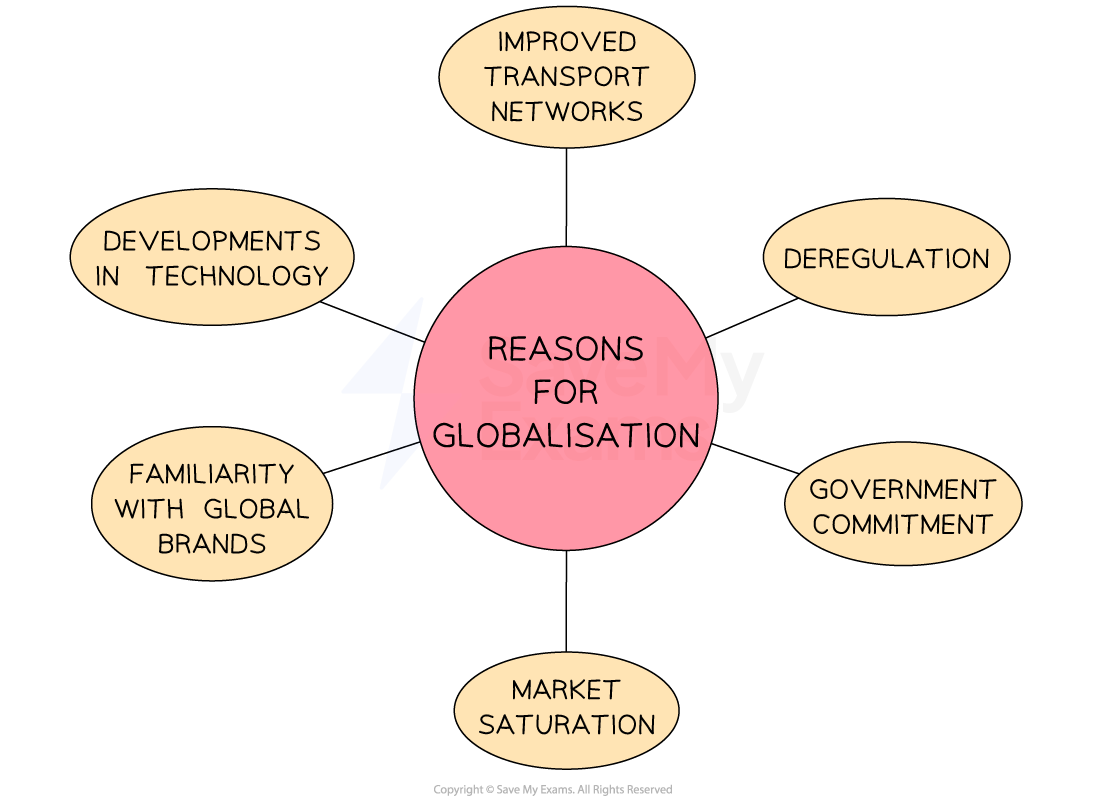
*Globalisation has been driven by developments in technology, saturation of domestic markets and deregulation *
-
Developments in technology
- This allows faster communication, transfer of data and online sales around the world
-
Improved transport networks
- This allows international business travel and improved distribution of products
-
Deregulation
- Deregulation such as the removal of trade barriers as well as simpler financial systems, has made trading internationally easier
-
Government commitment
- Governments have taken steps to increase trade so people, products and finance can move more easily across borders
-
Market saturation
- Saturation of domestic markets means that growth can only be achieved by targeting new target markets overseas
-
Familiarity with global brands
- The increase in tourism and access to overseas media has familiarised consumers with global brands
Opportunities of globalisation
Spec point —
1.5.1· opportunities and threats of globalisation for businesses.
-
Since the 1990s, globalisation has led to reduced levels of poverty in developing countries
- Employment levels have increased
- Living standards, health and education outcomes have improved
-
Businesses have been able to take advantage of this development
- Better qualified and more productive workforces
- More attractive markets in which to sell products
- New locations for production facilities
The main opportunities of globalisation for businesses
| Opportunity | Explanation |
|---|---|
| Large markets | - Global markets have many more customers than domestic markets - Higher sales increases revenue and should increase business profit - E.g. China's Huawei produces and sells consumer electronics in over 170 countries, earning a profit of CN¥73.05 billion in 2023 |
| Economies of scale | - Higher output as a result of increased sales can reduce business costs - These economies of scale can increase profits and improve business competitiveness - E.g. British-Dutch multinational Unilever sells more than 400 brands in over 190 countries and is the fifth largest consumer goods company in the world |
| Labour | - Domestic staff shortages can be overcome by employing workers from other countries - Labour-intensive businesses can locate in regions with lower wage costs to reduce outgoings - High-quality specialists from anywhere in the world can be employed - E.g. US brand Gillette's shaving products are largely manufactured in China where the company owns two factories |
| Taxation | - Head offices and other business functions can be located in regions with favourable tax regimes to reduce costs - E.g. With sales revenue of $12bn in 2022 Smurfitt Kappa, whose headquarters are in low-tax Ireland, operates paper plants in the EU and North America |
Exam Hint In the exam you may be asked to explain a benefit of globalisation. Look at the question carefully to determine whether you are being asked for a benefit to businesses, their workers or consumers. Each have benefitted in their own ways from globalisation.
Threats of Globalisation
Spec point —
1.5.1· opportunities and threats of globalisation for businesses.
- Globalisation can also present significant problems and risks for businesses
1. Increased competition
-
Competition from international rivals may put domestic firms out of business
- International firms may benefit from lower costs and greater economies of scale, so they can offer lower prices than domestic businesses to consumers
- Large overseas competitors can spend more on research, marketing and distribution than a small domestic business
- Access to cheaper labour or materials allows them to sell products at lower prices
2. Increased need to develop a profitable niche
-
Businesses risk losing sales and market share as a result of globalisation unless they can adapt or exploit a profitable market niche
- Exploiting a gap in the wider market is often very profitable
- E.g. Walkers Crisps dominate the lunchbox market with their multipacks
3. Vulnerability to international takeovers
-
Domestic Public Limited companies risk being taken over by foreign rivals
-
Capital can flow easily across borders
-
Most countries allow foreign businesses to take ownership of domestic businesses
- E.g. In 2009 UK confectionary company Cadburys was acquired by US company Kraft in a hostile takeover
-
4. Greater risk from external shocks
-
Interconnected financial systems allow economic difficulties in one part of the world to be felt by businesses operating in another
- The UK's vote to leave the EU in 2016 caused immediate financial shocks around the world, with stock exchanges in countries as distant as Australia and Japan reporting sharp falls
-
Global distribution networks can be affected by natural disasters or other interruptions, such as accidents or terrorism
- In 2021, the grounded container ship Ever Given blocked the Suez Canal for six days, causing delays to deliveries of goods such as semiconductors, which impacted technology manufacturing around the world
Was this revision note helpful?
Build on this topic