Retailing & E-tailing (Edexcel IGCSE Business)
Retailing
Spec point —
4.3.3· methods of distribution • retailers
Retailing
- A retailer is a business that purchases goods directly from a manufacturer or from a wholesaler and sells them in small quantities to end consumers
- Retailers add value by providing convenience and services such as delivery, packing and after-sales service
- Retail businesses can be located almost anywhere, though they are often concentrated in high streets, shopping malls and retail parks
Types of retailers
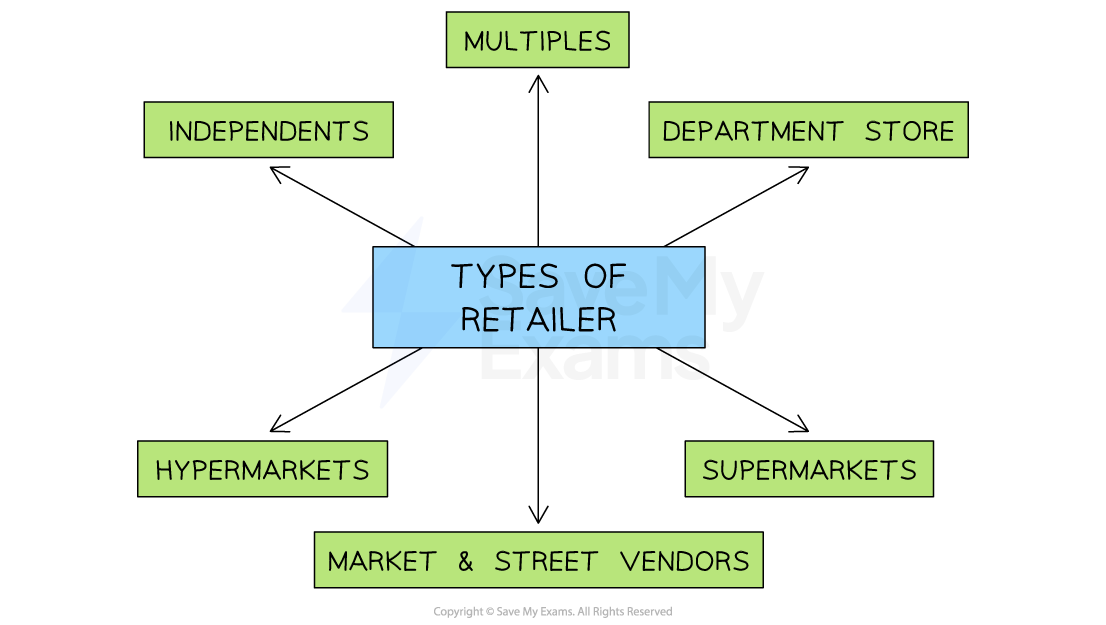
Retailers can exist in a variety of forms, from small independents and market traders to large multiples, departments stores or hypermarkets
Features of retail businesses
| Type | Features | Example |
|---|---|---|
| Multiples | - A chain of stores sell the same range of specialised products - Often located on high streets or in shopping malls | - Zara and Sephora operate multiple fashion and beauty stores across Europe |
| Department stores | - A large store which has separate sections that sell different product ranges - Often take prime spots in high streets or within shopping malls | - Galeria Karstadt Kaufhof is Germany's leading department store operator |
| Supermarkets | - Large stores, traditionally focused on selling groceries, though most now sell a wider range of products - Often located conveniently on the outskirts of towns where free parking is provided | - Mercadona is Spain's leading supermarket chain with a market share of more than 27% |
| Hypermarkets | - Very large warehouse-style stores that sell a wide range of products, sometimes in bulk - Often located on the outskirts of larger towns and cities, with access to major road networks | - Walmart and Kroger are the largest 'big box' stores in the US |
| Independents | - Small outlets that usually sell a specialised product range on a modest scale - Usually located on high streets, meeting the needs of local residents | - Chocolatier Dumon is a small confectioner based in Brugge, Belgium |
| Markets, kiosks and street vendors | - Small independent vendors that sell a limited range of products at particular times - These vendors may move to different places or pay to locate permanently in a premium location | - Marrakesh's Souk el Attarine is the home of hundreds of copper and brass vendors |
E-tailing
Spec point —
4.3.3· methods of distribution • e-tailers (e-commerce).
E-tailing
-
E-tailing is the trade of goods and services over the internet
- Businesses can trade through their own websites
- Alternatively, platforms such as Amazon, Ebay and Etsy offer the chance for small businesses to sell their products online
-
The rise of e-tailing means customers increasingly pay online using credit/debit cards with the result that contactless payment systems (such as Apple Pay and Paypal) are growing in popularity
-
E-tailing can make life more convenient for customers and is a source of competitive advantage
- It also provides the potential for small businesses to reach large audiences
-
However, setting up an e-store can be costly and some consumers may be concerned about security risks of purchasing online
Advantages and disadvantages of e-tailing for businesses and consumers
| Advantages | Disadvantages | |
|---|---|---|
| Businesses | - Websites offer a direct and cheap promotional method - Businesses can easily make online purchases of supplies and materials from other businesses - An easy-to-use and well-thought-out website can encourage customers to buy more - E.g. Automation suggests complimentary products often purchased at the same time - Dynamic pricing techniques can easily be implemented so profit can be maximised during periods of high demand | - Competition comes from many businesses around the world, allowing customers to easily switch brands - Large warehouses and efficient stock control systems are needed to fulfil online orders - E-tailing is not suitable for businesses selling personal services such as beauty services or home improvements - The lack of face-to-face contact with consumers means businesses miss out on instant and useful market research feedback |
| Consumers | - Competition drives prices down and allows customers to easily 'shop around' and compare prices - Electronic payment using credit and debit cards is relatively easy - E.g. Using 'one-click' platforms such as Apple Pay - E-tailing is convenient as it allows customers to shop from anywhere in the world - E.g. when travelling, 24 hours, on many different devices - Customers can buy from worldwide retailers so have increased choice - E.g. Chinese etailers Shein and Temu are increasingly popular in the UK | - Poor connections or technical difficulties can sometimes deter or stop customers from using the website to make purchases - Customers in low-income countries may not be able to access the products due to poor infrastructure, limiting potential market size - Many consumers are concerned about identity theft or fraudulent use of credit cards if they buy goods online - Products cannot be handled or tried out before purchase, which means customers frequently return them because they are unsuitable |
Exam Hint Although other distribution channels exist, in this specification you only need to learn about retailing and e-tailing.
Was this revision note helpful?
Build on this topic