Viscous Drag (Edexcel IAL Physics)
Stokes' Law
Spec point —
25
Stoke's Law
Viscous drag
- Viscous drag is defined as:
The frictional force between an object and a fluid which opposes the motion between the object and the fluid
- The viscous drag on a small sphere can be calculated using Stokes’ law:
-
Where
- F = viscous drag force (N)
- η = coefficient of viscosity of the fluid (N s m−2 or Pa s)
- r = radius of the object (m)
- v = velocity of the object (m s−1)
-
The viscosity of a fluid can be thought of as its thickness, or how much it resists flowing
- Fluids with low viscosity are easy to pour, while those with high viscosity are difficult to pour

-
The coefficient of viscosity is a property of the fluid (at a given temperature) that indicates how much it will resist flow
- The rate of flow of a fluid is inversely proportional to the coefficient of viscosity
Terminal velocity of a sphere in a fluid
- When an object falls through a fluid (e.g. a skydiver falling through the air), it reaches terminal velocity
- This occurs when the *weight of the object balances with the upthrust and the viscous drag force
weight = upthrust + viscous drag
Forces acting on a sphere falling through a fluid
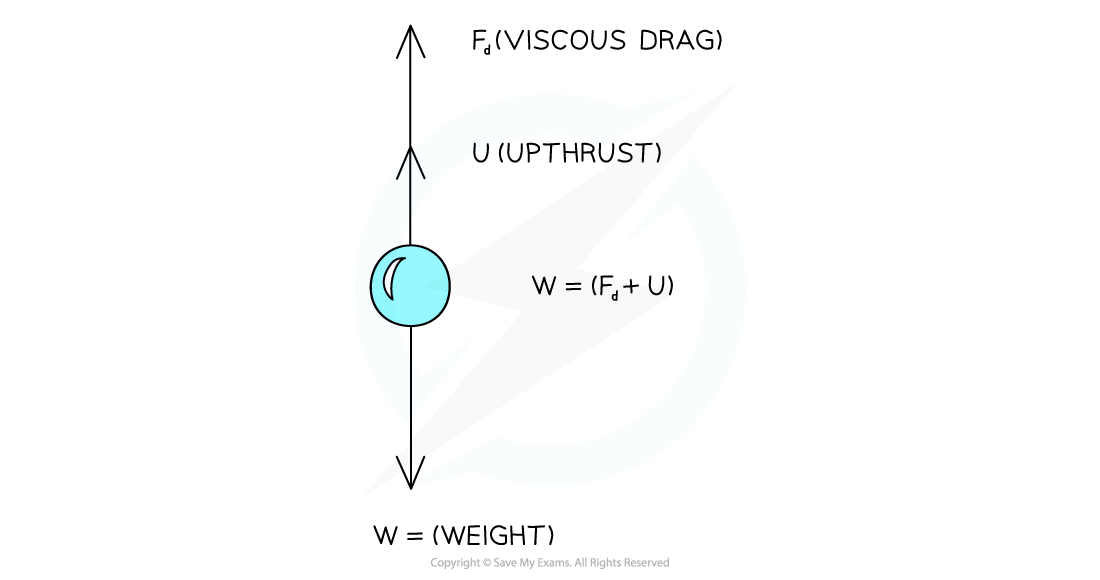
At terminal velocity, the forces on the sphere are balanced: W (downwards) = Fd+ U (upwards)
- Consider a small, solid sphere of radius moving slowly at terminal velocity through a fluid of viscosity
- The upthrust on the sphere is equal to the weight of the fluid displaced
-
Where
- = mass of the sphere (kg)
- = mass of the fluid displaced (kg)
- = acceleration due to gravity (m s−2)
- = terminal velocity of the sphere (m s−1)
-
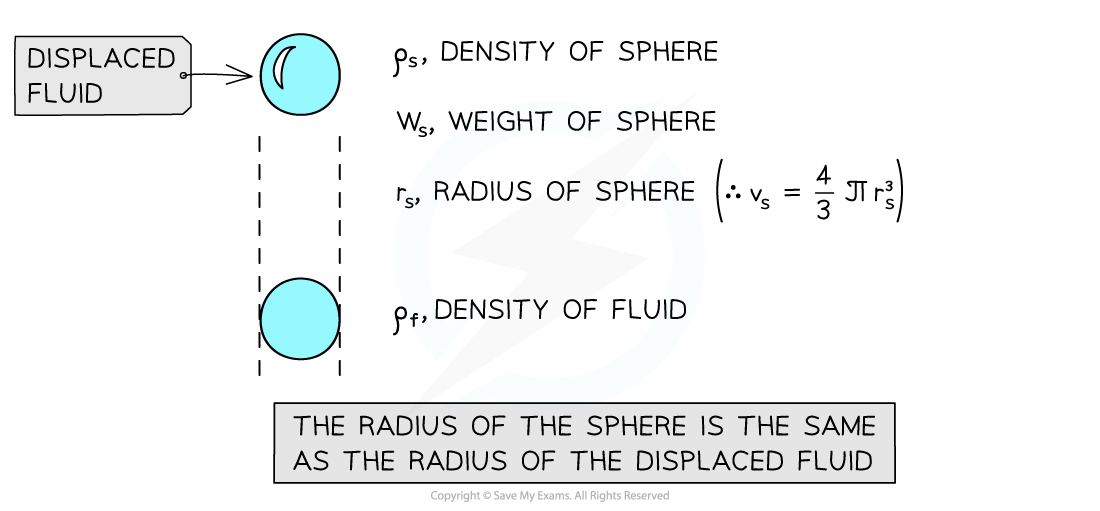
Using the density equation, the mass of the sphere is given by:
-
Where:
- = density of the sphere (kg m–3)
-
The volume of displaced fluid is the same as the volume of the sphere
-
Therefore, the mass of displaced fluid is given by:
-
Where:
- = density of the fluid (kg m–3)
-
Substituting the expressions for mass back into the original equation:
- Rearrange to make terminal velocity the subject of the equation
v_ term=(4 / 3π r ^3g (ρ _ s - ρ _ f))/(6π eta r)
- Finally, cancel out r from the top and bottom to find an expression for terminal velocity in terms of the radius of the sphere and the coefficient of viscosity
-
This final equation shows that terminal velocity is:
- directly proportional to the square of the radius of the sphere
- inversely proportional to the viscosity of the fluid
Understanding Viscosity & Stokes' Law
Spec point —
25
Understanding Viscosity & Stoke's Law
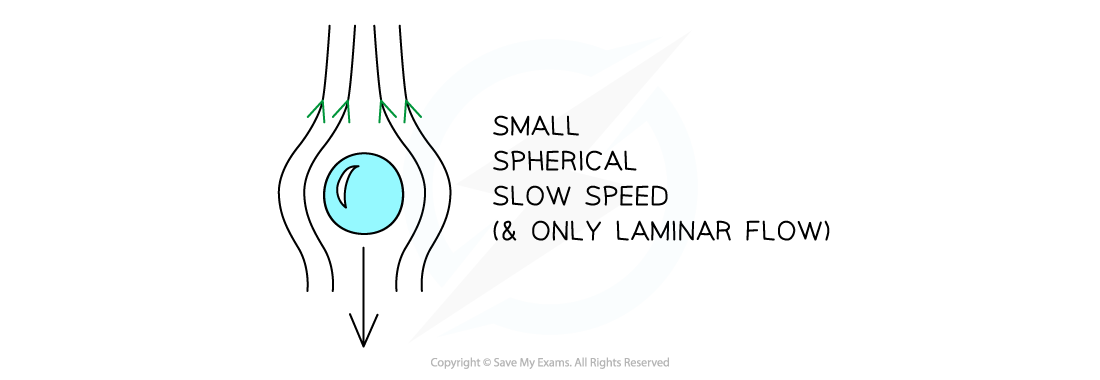
Conditions for Stoke’s Law Equation
-
The equation can only be used when certain conditions are met:
- The flow is laminar
- The object is small
- The object is spherical
- Motion between the sphere and the fluid is at a slow speed
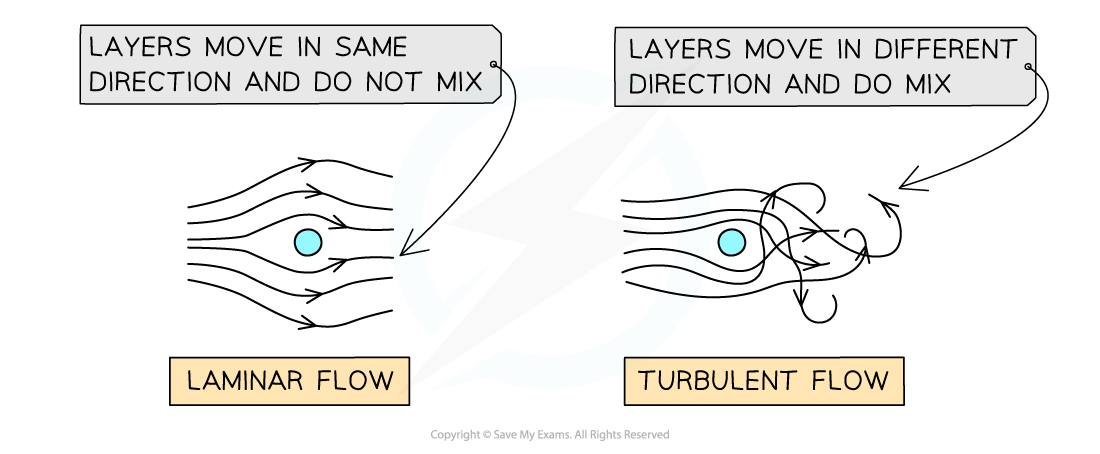
Laminar flow and turbulent flow
-
As an object moves through a fluid, or a fluid moves around an object, layers in the fluid are created
-
In laminar flow, all the layers are moving in the same direction, and they do not mix
- This tends to happen for slow-moving objects or slow-flowing liquids
- The equation above only applies to laminar flow
-
In turbulent flow, the layers move in different directions, and the layers do mix
Changing viscosity
-
Viscosity is temperature-dependent
- Liquids are less viscous as the temperature increases
- Gases get more viscous as the temperature increases
Worked Example A ball bearing of radius 5.0 mm falls at a constant speed of 0.030 m s–1 through an oil which has a viscosity of 0.3 Pa s and a density of 900 kg m–3.
Determine the viscous drag acting on the ball bearing.
Answer:
Step 1: List the known quantities in SI units
- Radius of the sphere, rs = 5.0 mm = 5.0 × 10⁻³ m
- Terminal velocity of the sphere, v = 0.03 m s-1
- Viscosity of oil, η = 0.3 Pa s
- Density of oil, ρf = 900 kg m−3
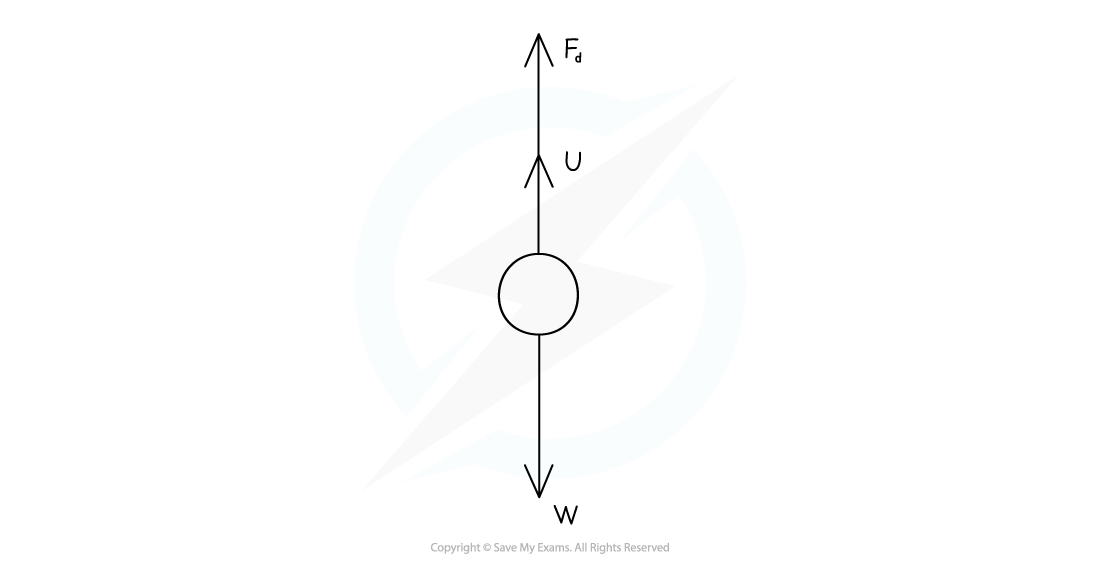
Step 2: Sketch a free-body diagram to resolve the forces at constant speed
Ws= Fd + U
Step 3: Calculate the value for viscous drag, Fd
Fd = 6πηrv = 6 × π × 0.3 × 5.0 × 10-3 × 0.03 = 0.008482
Step 4: Write the complete answer to the correct significant figures and include units
- The viscous drag, Fd = 8.5 × 10⁻⁴ N
Exam Hint You may need to write out some or all of the derivation given in the first part above.
It is really important to keep clear whether you are talking about the density of the sphere or the fluid, and the mass of the sphere or the fluid.
Practice using subscripts, and do try this at home. It isn’t one to do for the first time in an exam!
Was this revision note helpful?
Build on this topic