Centripetal Force (Edexcel IAL Physics)
Spec point —
91
Centripetal Force
- Centripetal force can be calculated using any of the following equations:
-
Where:
- F = centripetal force (N)
- v = linear velocity (m s-1)
- ω = angular speed (rad s-1)
- r = radius of the orbit (m)
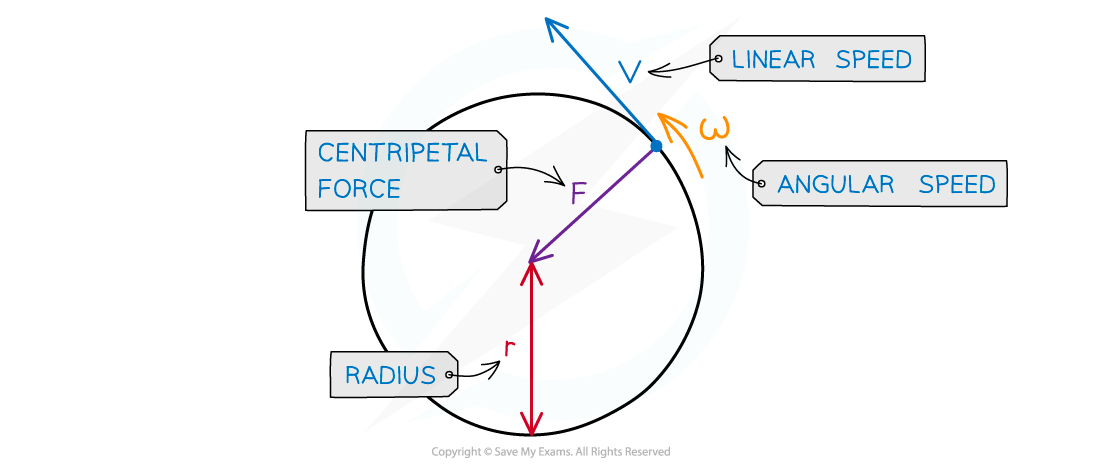
Centripetal force is always perpendicular to the direction of travel
-
The centripetal force is the resultant force on the object moving in a circle
- This is particularly important if there are multiple forces on the object, such as weight
Vertical Circular Motion
-
An example of vertical circular motion is swinging a ball on a string in a vertical circle
-
The forces acting on the ball are:
- The tension in the string
- The weight of the ball downwards
-
As the ball moves around the circle, the direction of the tension will change continuously
-
The magnitude of the tension will also vary continuously, reaching a maximum value at the bottom and a minimum value at the top
- This is because the direction of the weight of the ball never changes, so the resultant force will vary depending on the position of the ball in the circle
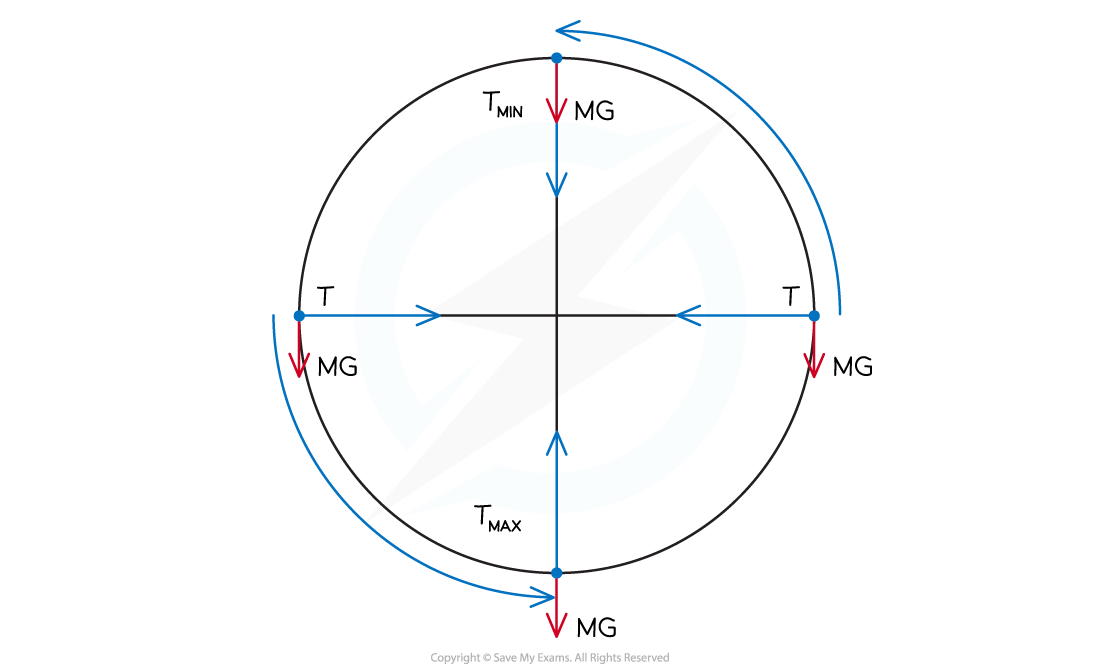
- At the bottom of the circle, the tension must overcome the weight, this can be written as:
- As a result, the acceleration, and hence, the speed of the ball will be slower at the top
- At the top of the circle, the tension and weight act in the same direction, this can be written as:
- As a result, the acceleration, and hence, the speed of the ball will be faster at the bottom
Worked Example A bucket of mass 8.0 kg is filled with water and is attached to a string of length 0.5 m.
What is the minimum speed the bucket must have at the top of the circle so no water spills out?
Answer:
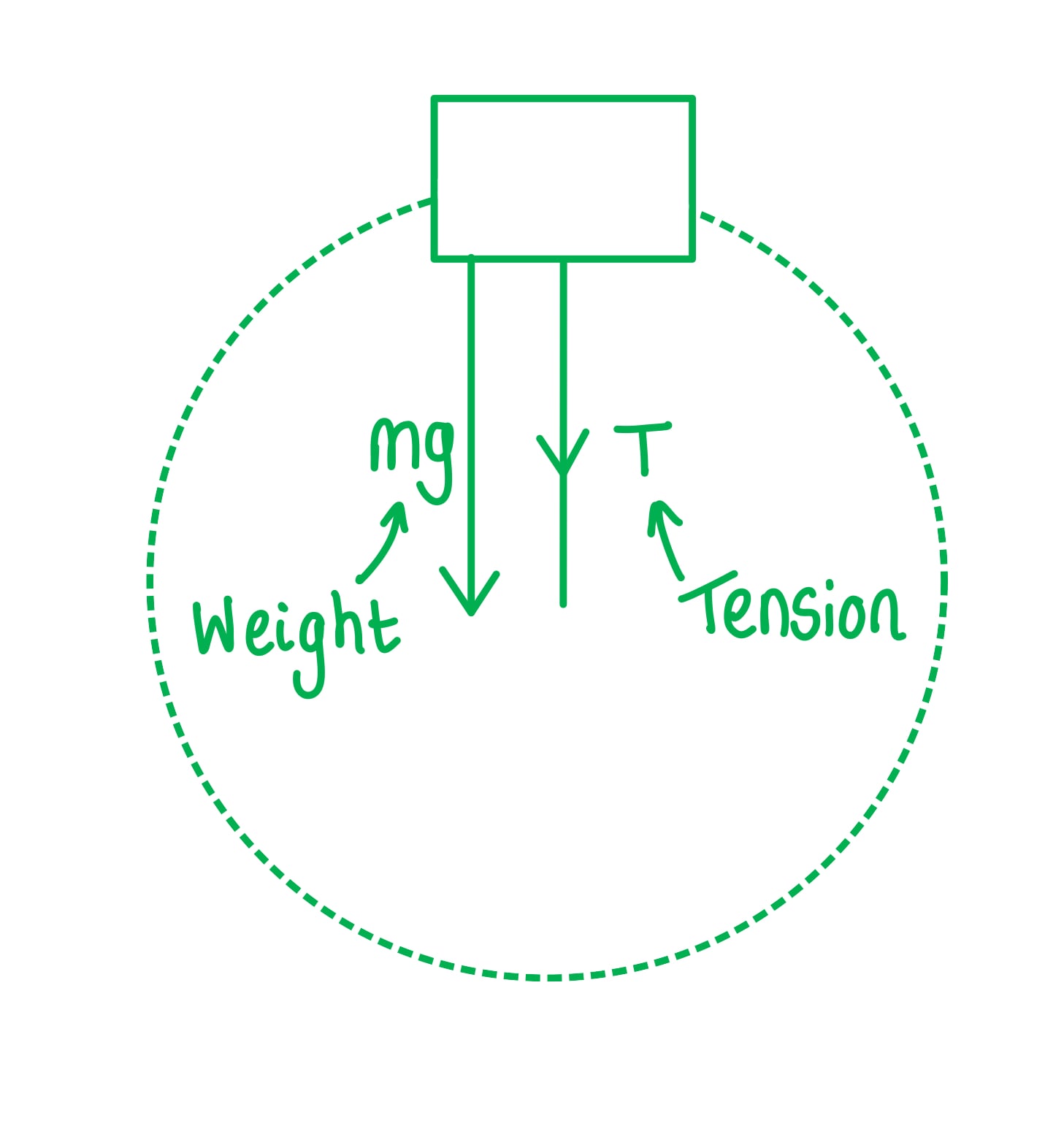
Step 1: Draw the forces on the bucket at the top
Step 2: Write an expression for the centripetal force
- The weight of the bucket = mg
- At the top of the circular path, the weight and tension act in the same direction, so the centripetal force is
- The minimum speed v is when the string is taut but not stretched, so the tension here is zero (T = 0)
Step 3: Rearrange for velocity v and calculate
- m cancels from both sides

Was this revision note helpful?
Build on this topic