The Principle of Conservation of Energy (Edexcel IAL Physics)
Spec point —
20
The Principle of Conservation of Energy
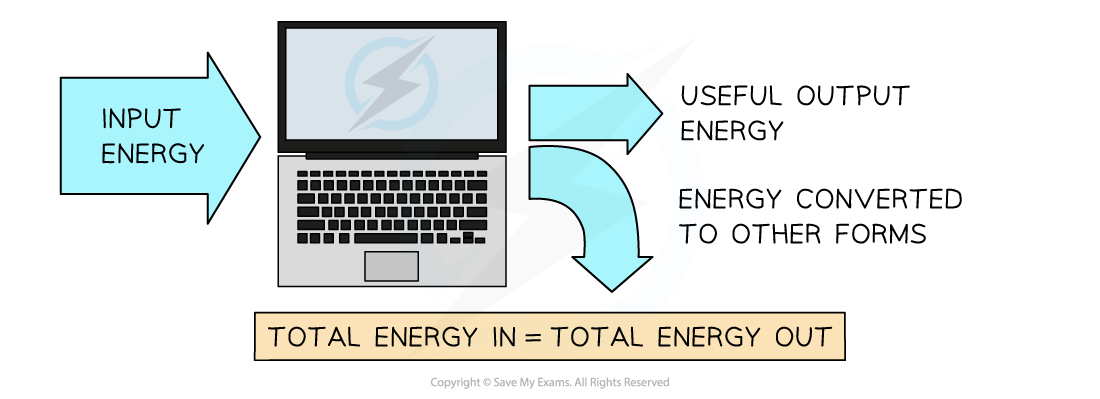
- The principle of conservation of energy is a law of Physics which always applies to a closed system
-
To apply conservation of energy, heat losses are usually ignored during the calculation stage
-
In reality there are always some energy losses from the system
- These should be mentioned when comparing calculated, ideal values to real-life situations
-
Conservation of energy is often applied in questions about exchanges between kinetic energy and gravitational energy
-
Common examples include:
- A swinging pendulum
- Objects in free fall
- Sports such as skiing or skydiving where gravity is causing motion and few drag forces apply
-
The gravitational potential energy stored initially is transferred to kinetic energy, or vice versa
-
This allows either;
- Final velocity to be found from the distance the object moved, or
- Height of a drop from the final velocity
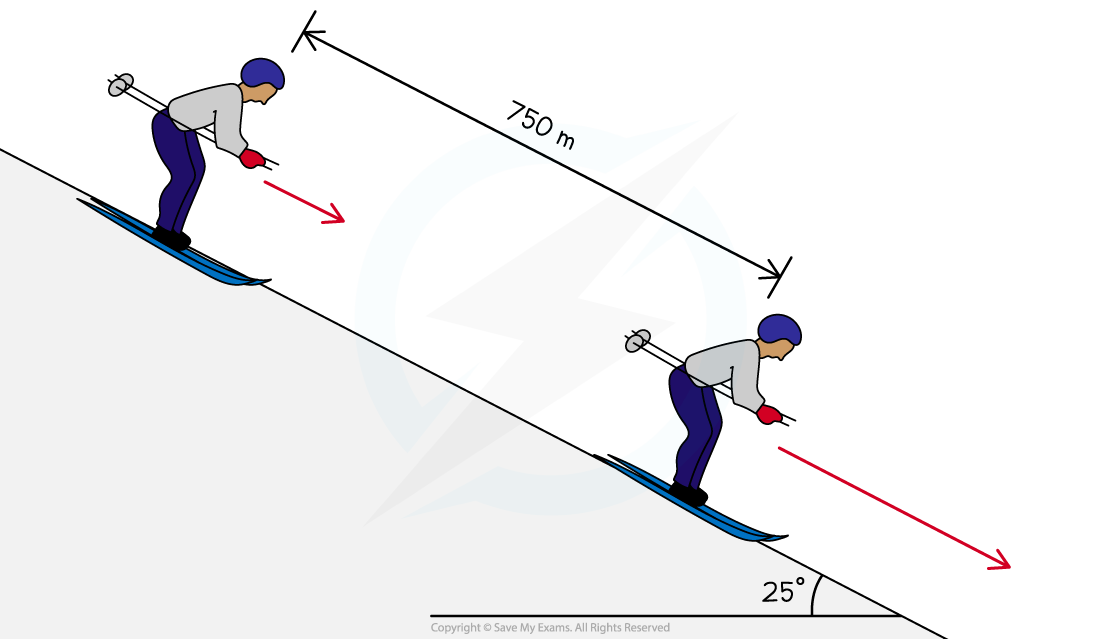
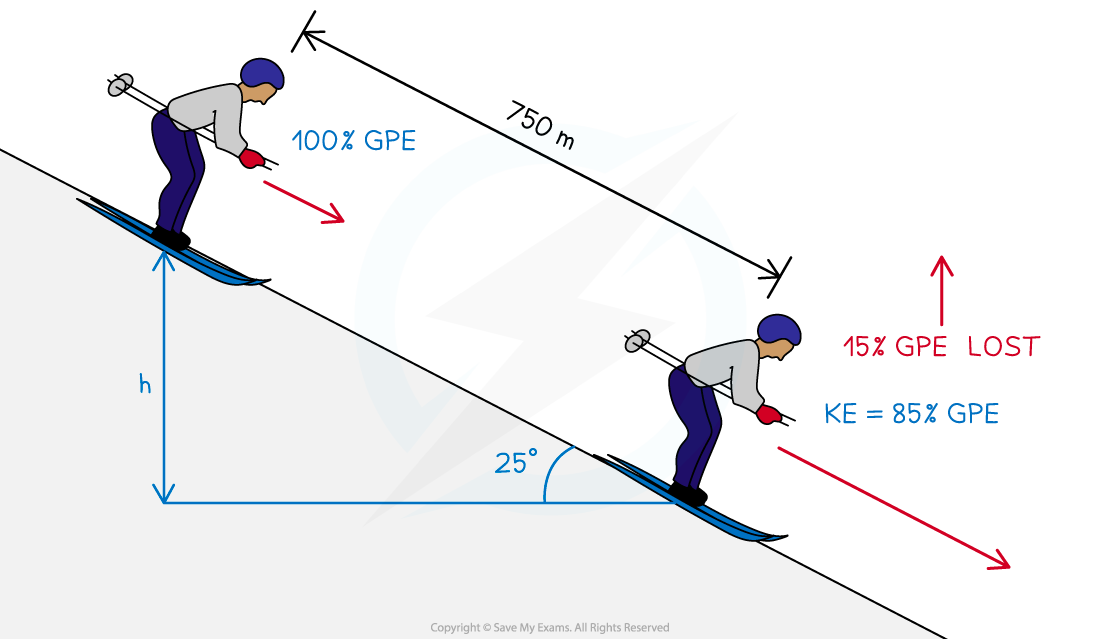
Worked Example The diagram below shows a skier on a slope descending 750 m at an angle of 25° to the horizontal.
Calculate the final speed of the skier, assuming that he starts from rest and 15% of his initial gravitational potential energy is not transferred to kinetic energy.
Answer:
Step 1: Write down the known quantities
- Vertical height, h = 750 sin 25°
- Ek = 0.85 Ep
Step 2: Equate the equations for Ek and Egrav
Ek* *= 0.85 Egrav
½ mv2 = 0.85 × mgh
**Step 3: Rearrange for final speed, v
** Step 4: Calculate the final speed, v


Exam Hint Gravitational energy:
- This equation only works for objects close to the Earth’s surface where we can consider the gravitational field to be uniform.
Kinetic energy:
- When using the kinetic energy equation, note that only the speed is squared, not the mass or the ½.
- If a question asks about the ‘loss of kinetic energy’, remember not to include a negative sign since energy is a scalar quantity.
Was this revision note helpful?
Build on this topic