Resistance & Temperature (Edexcel IAL Physics)
Modelling the Variation of Resistance with Temperature
Spec point —
79
- All materials have some resistance to the flow of charge
- As free electrons move through a metal wire, they collide with ions which get in their way
- As a result, they transfer some, or all, of their kinetic energy on collision, which causes electrical heating
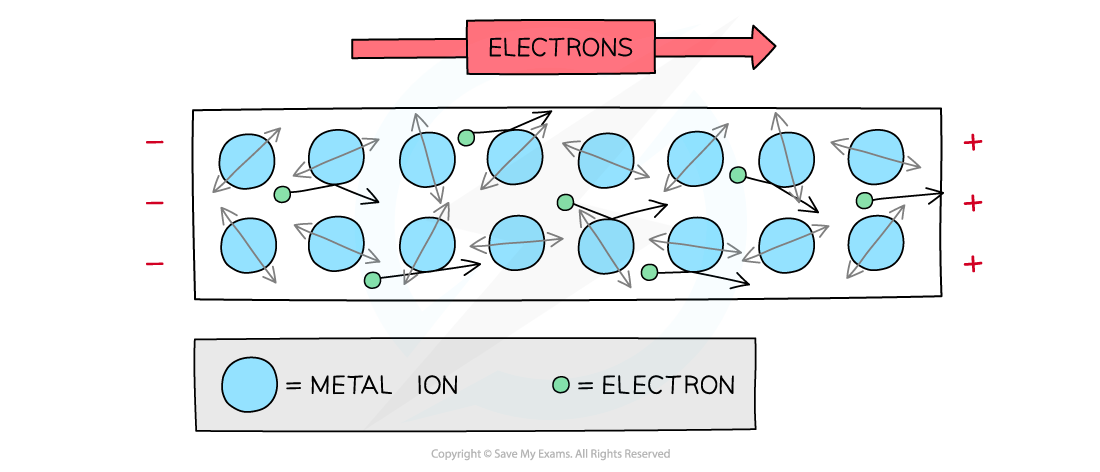
Free electrons collide with ions which resist their flow
-
As temperature increases, the vibrations of the ions in the lattice also increase
- This increases the chance of collisions between the conduction electrons and the ions
-
Since current is the flow of charge, the ions resisting the flow of electrons cause resistance
-
Therefore as temperature increases so does resistance
- At small increases of temperature this increase is linear
-
A higher current will cause temperature to rise
- This is due to more collisions between free electrons and ions
- The collisions cause the ions to vibrate more
Resistance & Temperature for Metallic Conductors
Spec point —
79
-
All solids are made up of vibrating atoms
- This includes metal solids
-
As the temperature in a metal rises, the ions vibrate with a greater frequency and amplitude
- The electrons collide with the vibrating atoms which impede their flow, hence the current decreases
- electric current is the flow of free electrons in a material
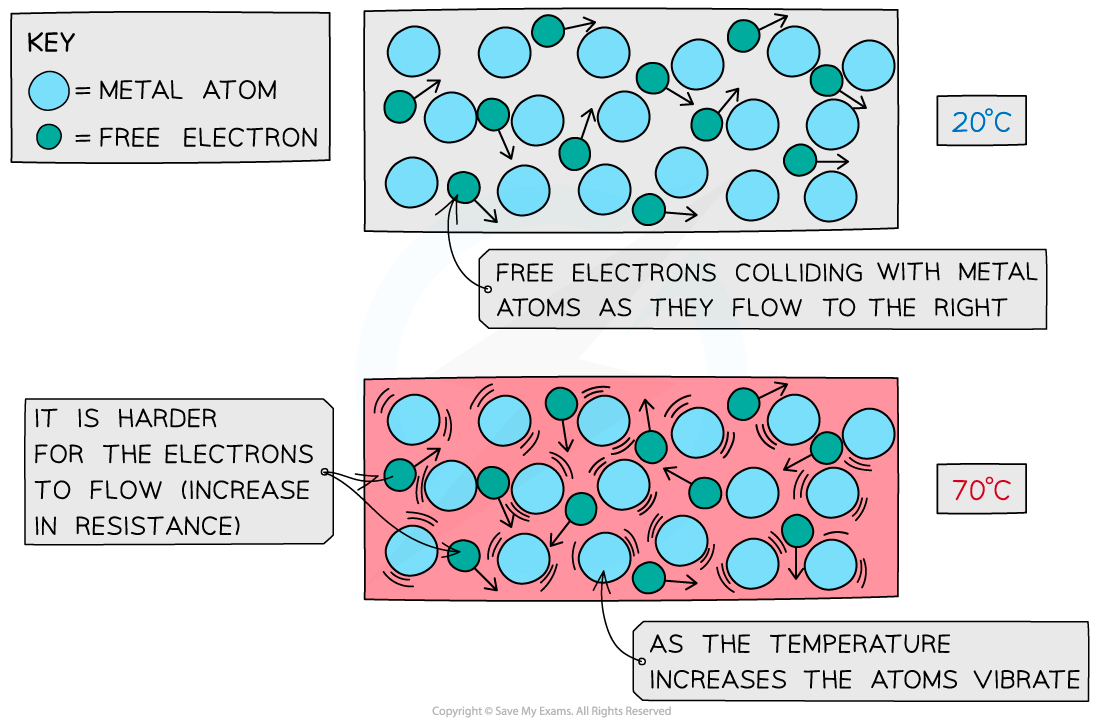
Metal atoms and free electrons at low and high temperatures
-
Current decreases because the resistance has increased (from V = IR)
- This is because resistivity has increased
- This is from ρ ∝ R (if the area A and length L is constant)
-
For a metallic conductor:
- an increase in temperature leads to an increase in resistance and resistivity
- a decrease in temperature leads to a decrease in resistance and resistivity
-
The I-V graph for a filament lamp shows this effect
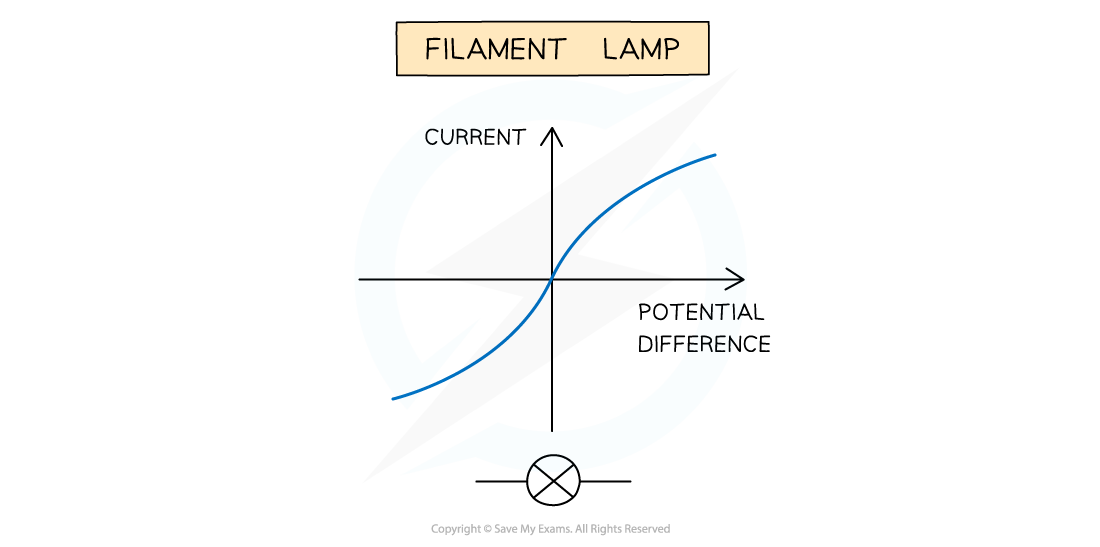
I-V characteristics for a filament lamp
-
As the current increases, the number of collisions between free electrons and the lattice of ions increases
- This increases the temperature of the filament in the lamp
-
An increase in temperature leads to increased vibrations in the lattice of ions
- As a result, the frequency of collisions between free electrons and the ions increases, which leads to an increase in resistance
-
Resistance opposes the current, causing the current to increase at a slower rate
- This is seen on the I-V graph as a curve with a decreasing gradient
Worked Example The temperature of a non-ohmic resistor increases as the current through it increases.
Explain this is terms of the structure of a metal.
Answer:
Step 1: Consider the effect on rate of electron flow:
- Rate of flow of electrons increases
Step 2: Consider the effect on number of collisions of conduction electrons with the lattice
- This increases the number of collisions of conduction electrons with the ions in the lattice
Step 3: Describe what happens to the vibrations of the lattice
- Therefore vibrations of the lattice ions increase
Resistance & Temperature for Thermistors
Spec point —
79
-
The resistivity of a thermistor behaves in the opposite way to metals
- This is because it is a type of semiconductor
- Semiconductors behave in a different way to metals
-
The number density of charge carriers (such as electrons) increases with increasing temperature
-
Therefore, for a thermistor:
- An increase in temperature causes a decrease in resistance and resistivity
- A decrease in temperature causes an increase in resistance and resistivity
-
Thermistors are often used in temperature sensing circuits such as thermometers and thermostats
-
A thermistor is a non-ohmic conductor and sensory resistor whose resistance varies with temperature
- Most thermistors are negative temperature coefficient ntc) components.
- This means that if the temperature increases, the resistance of the thermistor decreases(and vice versa)
-
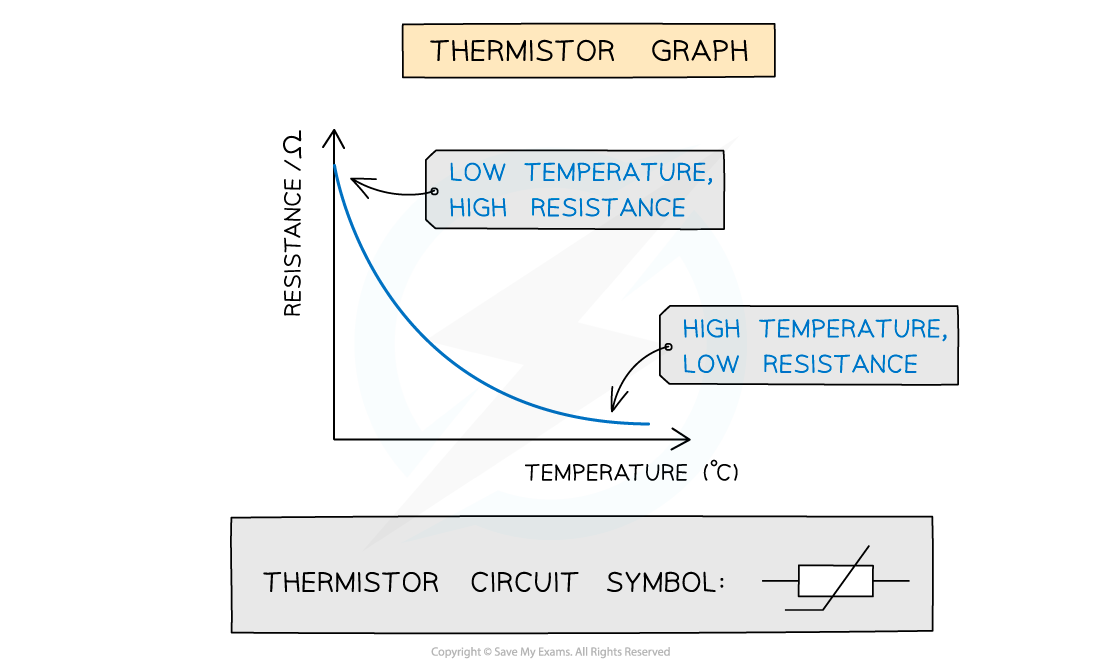
The temperature-resistance graph for a thermistor is shown below
-
Thermistors are temperature sensors and are used in circuits in ovens, fire alarms and digital thermometers
- As the thermistor gets hotter, its resistance decreases
- As the thermistor gets cooler, its resistance increases
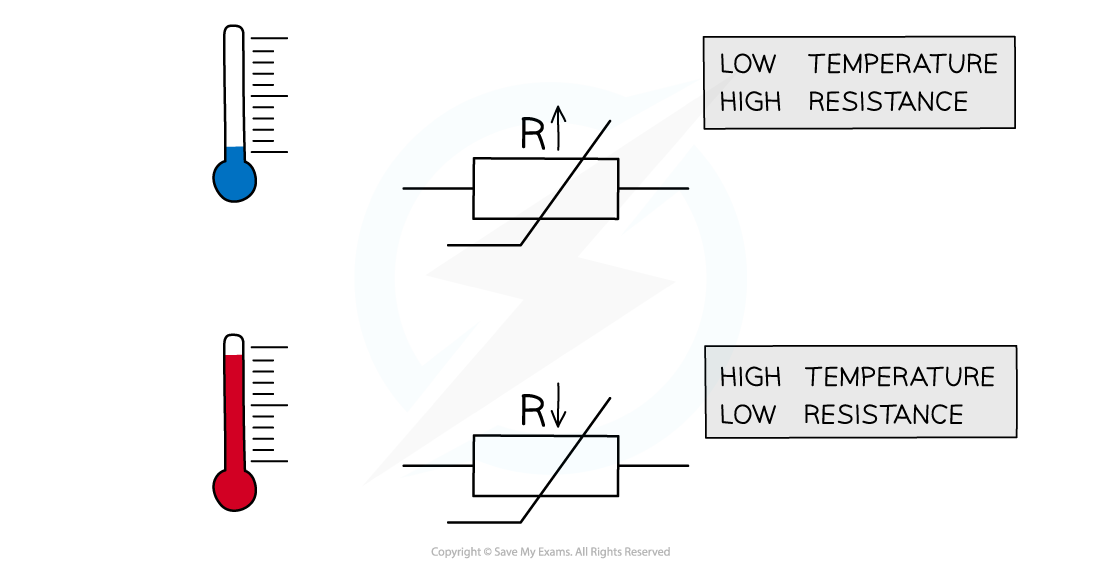
The resistance through a thermistor is dependent on the temperature of it
Worked Example A thermistor is connected in series with a resistor R and a battery.
The resistance of the thermistor is equal to the resistance of R at room temperature.
Which statement describes the effect when the temperature of the thermistor decreases?
A. The p.d across the thermistor increases
B. The current in R increases
C. The current through the thermistor decreases
D. The p.d across R increases
Answer: A
Step 1: Outline the nature of a thermistor
- The resistance of the thermistor increases as the temperature decreases
Step 2: Consider the properties of current in a series circuit
- Since the thermistor and resistor R are connected in series, the current I in both of them is the same
Step 3: Consider a relevant equation
- Ohm’s law states that V = IR
- Since the resistance of the thermistor increases, and I is the same, the potential difference V across it increases
Step 4: State the conclusion
- Therefore, statement A is correct

Was this revision note helpful?
Build on this topic