Reducing Errors (Edexcel IAL Physics)
Reducing Errors
-
Reducing errors in an experiment is vital for obtaining more accurate results
-
Even if the experimental result is close to the true value, there are always potential limitations of experimental methods such as the presence of random errors
-
Random errors cannot be completely removed but their effect can be reduced by taking as many repeats as possible and using the average of the repeats
-
There are always opportunities to identify limitations of the procedure, some common examples include:
- Parallax error when reading scales
- Not using a fiducial marker(eg. when measuring the time period of a pendulum using a stopwatch)
- Not repeating measurements to reduce random errors
- Not checking for zero errors to reduce systematic errors
- The equipment not working properly or not checking beforehand with small tests
- Equipment with poor precision and resolution (eg. using a ruler over a micrometer)
- Difficult to control variables (eg. the temperature of the classroom)
- Unwanted heating effects eg. in circuits
-
Parallax error is minimised by reading the value on a scale only when the line of sight is perpendicular to the scale readings (i.e.. at eye level)
-
Examples of where parallax error is common are:
- Determining the volume of liquid
- Making sure two objects are aligned
- Reading the temperature from a thermometer
-
If it makes it easier, use a marker to help where possible
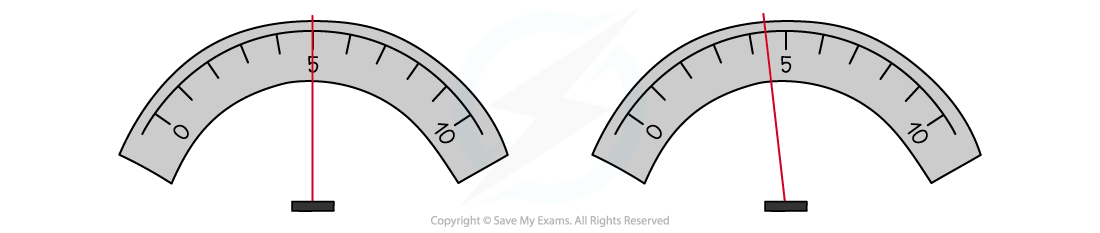
Reading the value of the needle head-on (left image) looks different to reading it from the right (right image). This is parallax error
-
A fiducial marker is a useful tool to act as a clear reference point, such as when measuring the time period of a pendulum using a stopwatch
-
This improves the accuracy of a measurement of periodic time by:
- Making timings by sighting the pendulum as it passes the fiducial marker
- Sighting the pendulum as it passes the fiducial marker at its highest speed. The pendulum swings fastest at its lowest point and slowest at the top of each swing
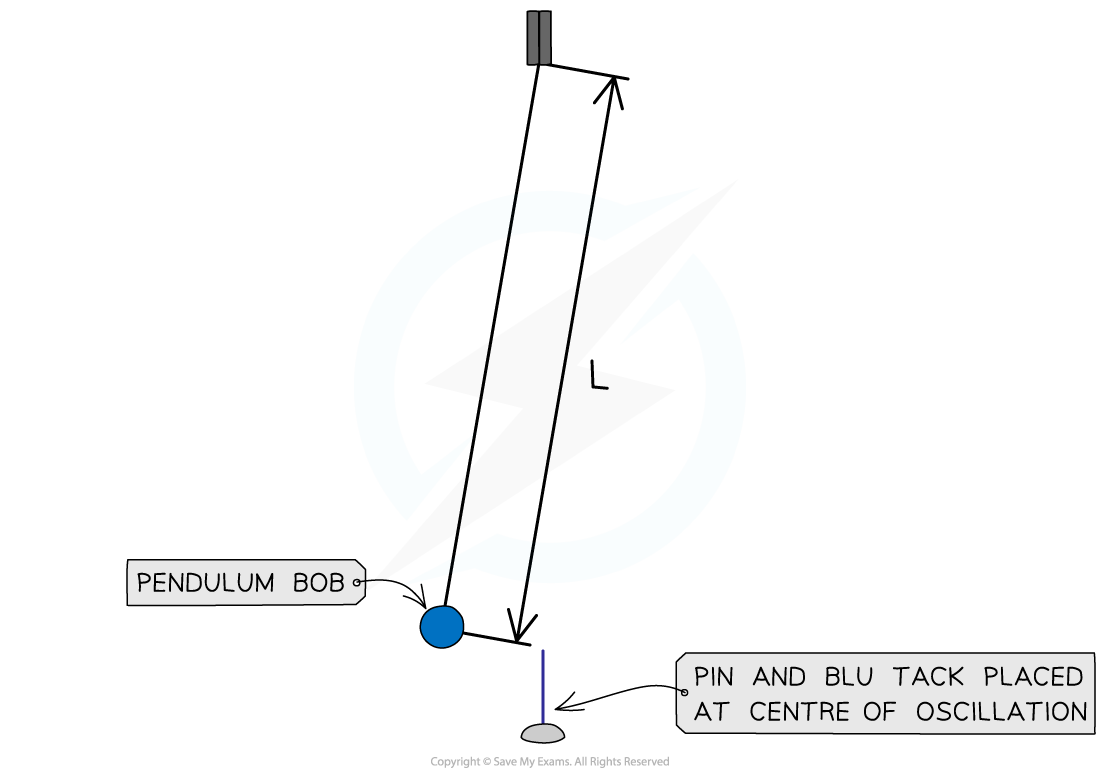
A fiducial marker is used to mark the centre of the oscillation of the pendulum
-
Zero errors must be checked for in both digital and analogue instruments
- E.g., If there is no current through the circuit, an ammeter must read 0 A
-
The common way to reduce unwanted heating effects in circuits is to turn off the power supply in between readings
- As the temperature of a component increases, so does its resistance (e.g., in wires). This will affect the experiment and produce an error in your final result
Worked Example A student wants to determine the radius of a wire for an experiment to calculate its Young Modulus. They measure the radius using a ruler from one part of the wire.
Discuss ways in which the student can reduce the error in this reading.
Answer:
Step 1: Comment on the instrument used
- Since the radius of a wire is on the order of < 1 mm, and has a circular cross section, a micrometer screw gauge should have been used instead
Step 2: Comment on the method
The student did not take any repeat readings
- They should take between 3-5 repeat readings for each value of the radius from the micrometer
Step 3: Suggest improvements to the method
- The experiment assumes the wire is uniform the whole way through (i.e. has the same radius)
- This can be checked by measuring the radius at different points on the wire
Was this revision note helpful?
Build on this topic