Core Practical 7: Investigating Resistivity (Edexcel IAL Physics)
Spec point —
72
Core Practical 7: Investigating Resistivity
Aims of the Experiment
- The aim of the experiment is to determine the resistivity of a length of wire
Variables:
-
Independent variable = Length, L, of the wire (m)
-
Dependent variable = The current, I, through the wire (A)
-
Control variables:
- Voltage across the wire
- The material the wire is made from
Equipment List
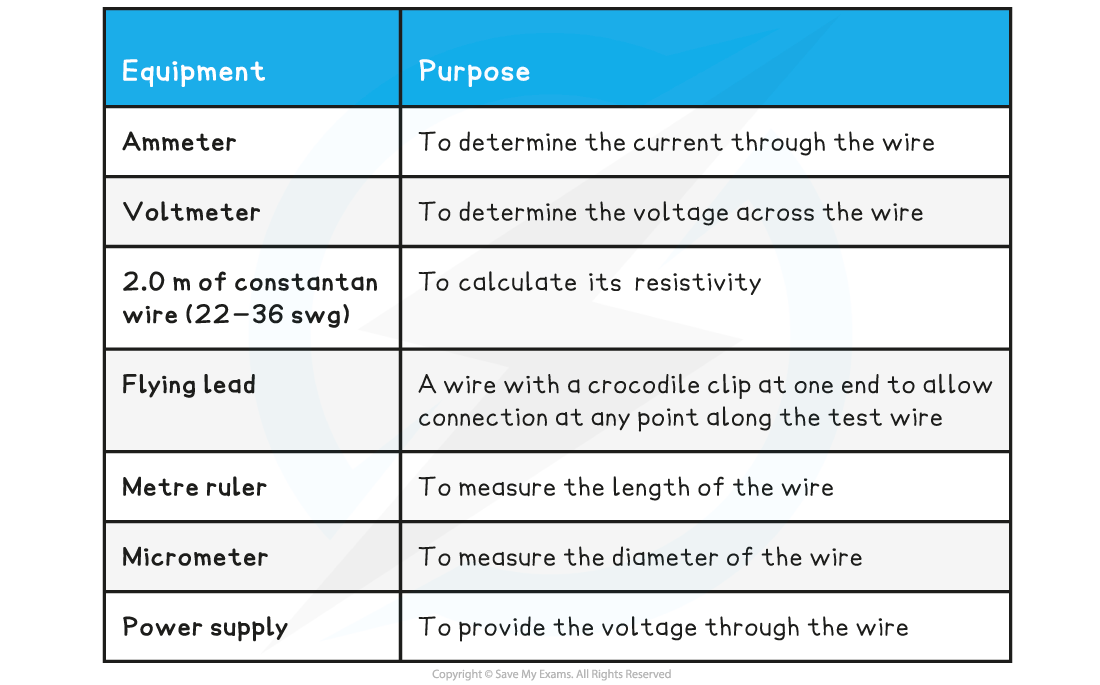
-
Resolution of measuring equipment:
- Metre ruler = 1 mm
- Micrometer screw gauge = 0.01 mm
- Voltmeter = 0.1 V
- Ammeter = 0.01 A
Method
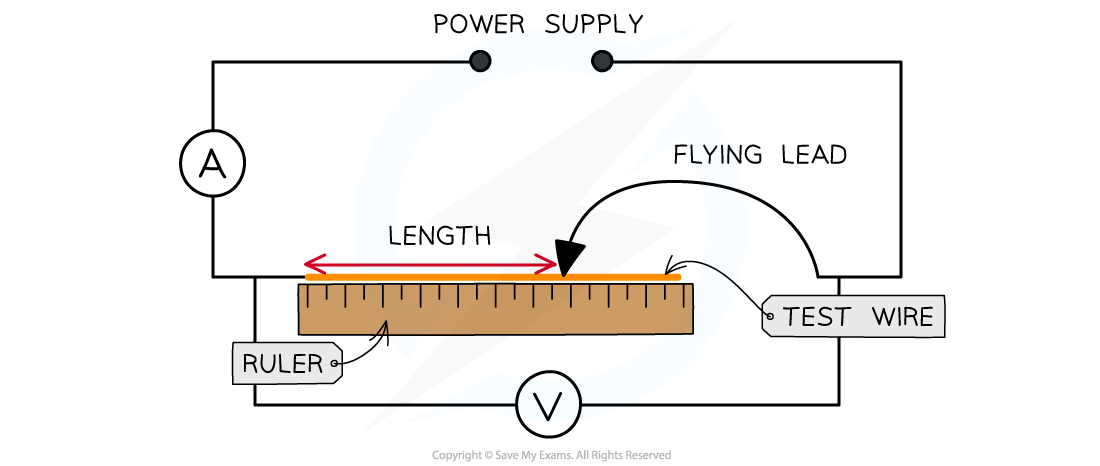
- Measure the diameter of the wire using a micrometer.
- The measurement should be taken between 5-10 times randomly along the wire.
- Calculate the mean diameter from these values
- Set up the equipment so the wire is taped or clamped to the ruler with one end of the circuit attached to the wire where the ruler reads 0.
- The ammeter is connected in series and the voltmeter in parallel with the wire
- Attach the flying lead to the test wire at 0.25 m and set the power supply at a voltage of 6.0 V.
- Check that this is the voltage across the wire on the voltmeter
- Read and record the current from the ammeter, then switch off the current immediately after the reading
- This is to prevent the wire from heating up and changing the resistivity
- Vary the distance between the fixed end of the wire and the flying lead in 0.25 m intervals (0.25 m, 0.50 m, 0.75 etc.) until the full length
- In this example, a 2.0 m wire is used.
- The original length and the intervals can be changed (e.g. start at 0.1 m and increase in 0.1 m intervals), as long as there are 8-10 readings
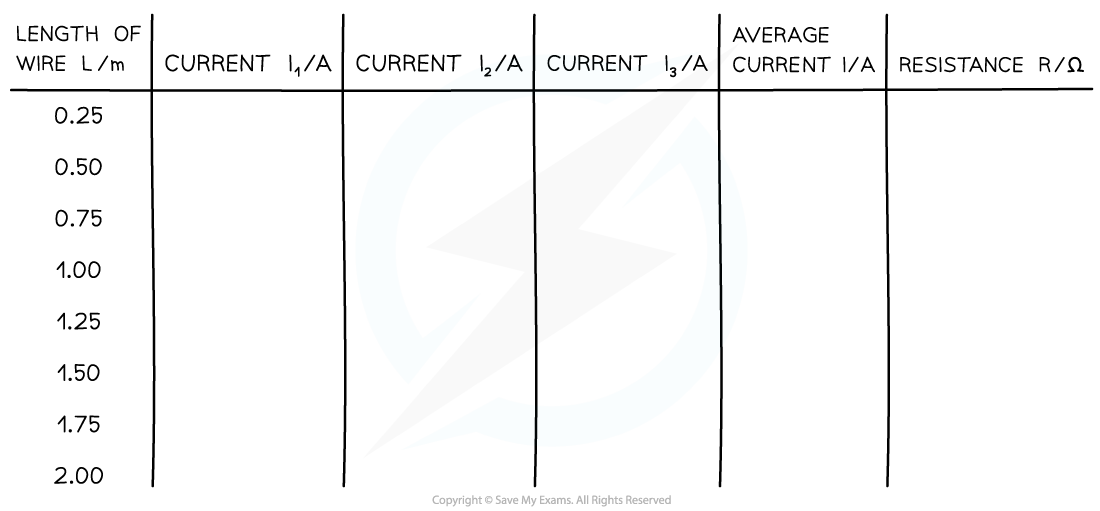
- Record the current for each length at least 3 times and calculate an average current, I
- For each length, calculate the average resistance of the length of the wire using the equation

-
Where:
- R = average resistance of the length of the wire (Ω)
- V = potential difference across the circuit (V)
- I = the average current through the wire for the chosen length (A)
-
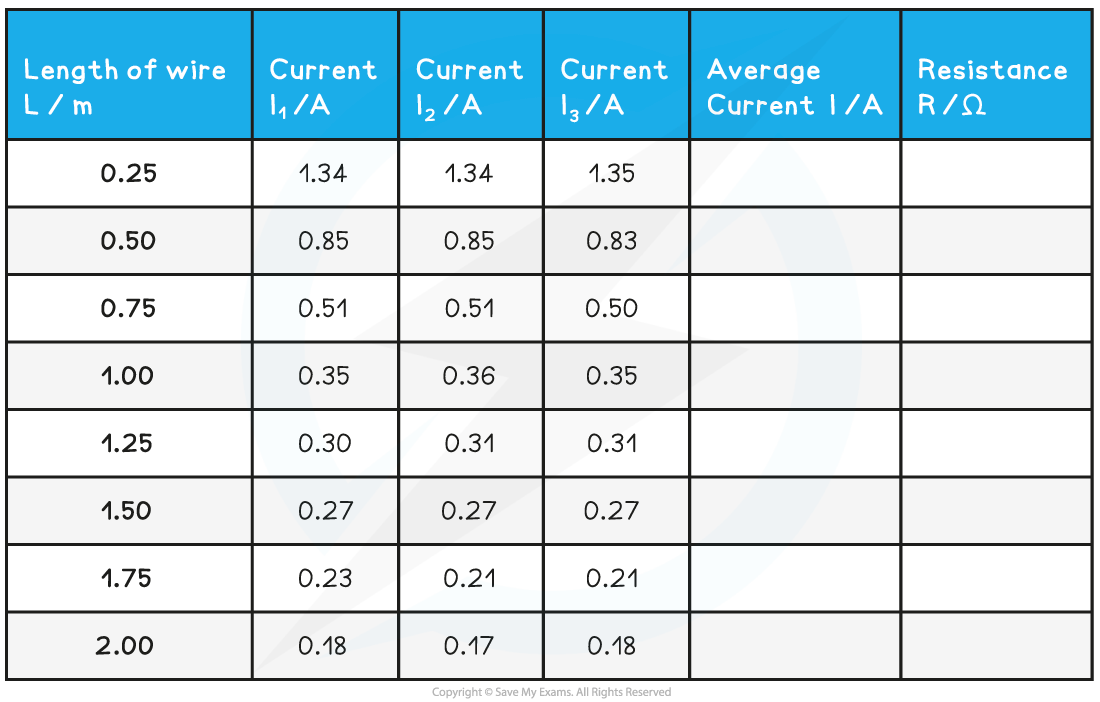
An example of a table of results might look like this:
Analysis of Results
- The resistivity, ρ, of the wire is equal to

-
Where:
- ρ = resistivity (Ω m)
- R = resistance (Ω)
- A = cross-sectional area of the wire (m2)
- L = length of wire (m)
-
Rearranging for the resistance, R, gives:

-
Comparing this to the equation of a straight line: y = mx
- y = R
- x = L
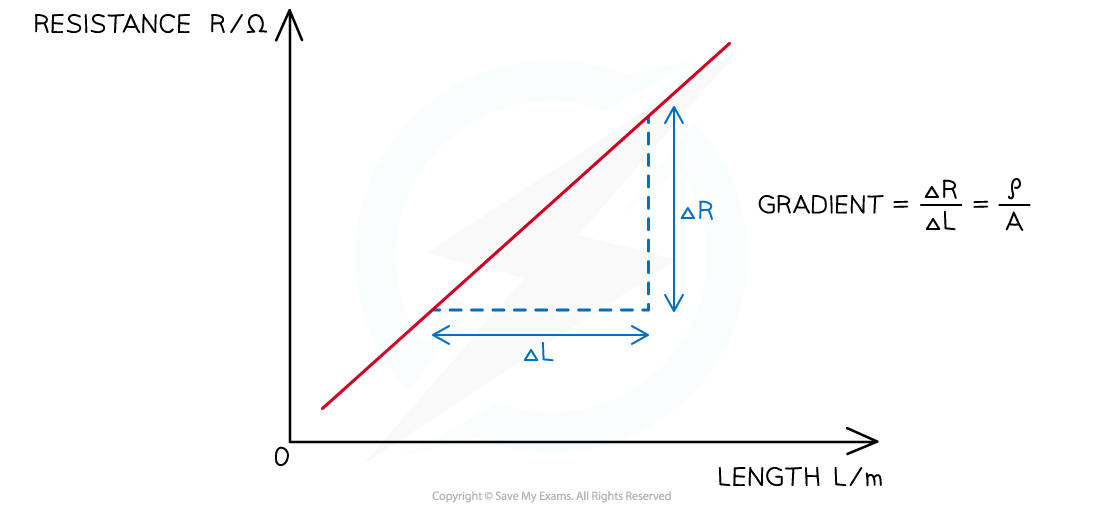
- Gradient, m = ρ / A
-
Therefore, to find resistivity:
- Plot a graph of the length of the wire, L, against the average resistance of the wire
- Draw a line of best fit
- Calculate the gradient
- Multiply the gradient by cross-sectional area, A
ρ = gradient × A
- To calculate the cross-sectional area, A, of the wire

Evaluating the Experiment
Systematic Errors:
-
The end of the wire that is attached to the circuit (not the flying lead) must start at 0 on the ruler
- Otherwise, this could cause a zero error in your measurements of the length
Random Errors:
-
Only allow small currents to flow through the wire
- The resistivity of a material depends on its temperature
- The current flowing through the wire will cause its temperature to increase
- Therefore the temperature is kept constant by small currents
-
The current should be switched off between readings
- So that there isn't a temperature rise
-
Calculate an average diameter
- This will reduce random errors in the reading
- Make at least 5-10 measurements of the diameter of the wire with the micrometer
Safety Considerations
-
When there is a high current, and a thin wire, the wire will become very hot.
- Make sure never to touch the wire directly when the circuit is switched on
-
Switch off the power supply right away if you smell burning
-
Make sure there are no liquids close to the equipment,
- This could damage the electrical equipment
- Or cause a short circuit which will affect the results
Worked Example A student conducts an experiment to find the resistivity of a constantan wire.
They attach one end of the wire to a circuit that contains a 6.0 V battery. The other end of the wire is attached by a flying lead to the wire at different lengths.
They obtain the following table of results:
The following additional data for the wire is:
Calculate the resistivity of the wire.
Answer:
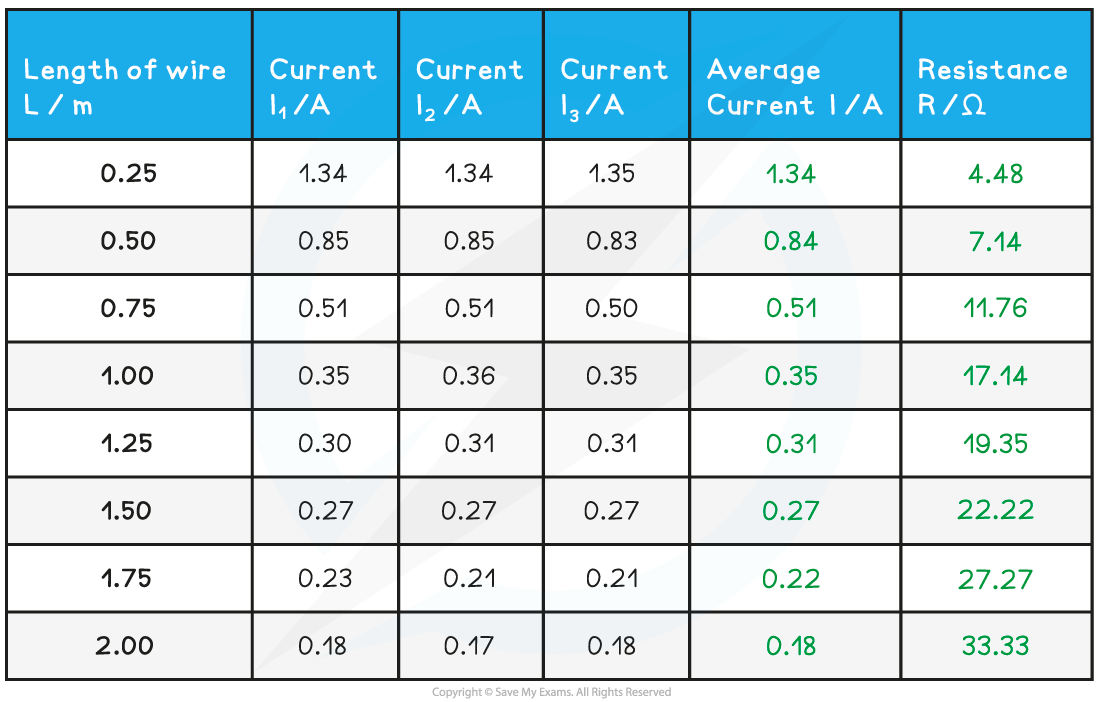
Step 1: Complete the average current and resistance columns in the table
- The resistance is calculated using the equation
Step 2: Calculate the cross-sectional area of the wire from the diameter
- The average diameter is 0.191 mm = 0.191 × 10⁻³ m
- The cross-sectional area is equal to
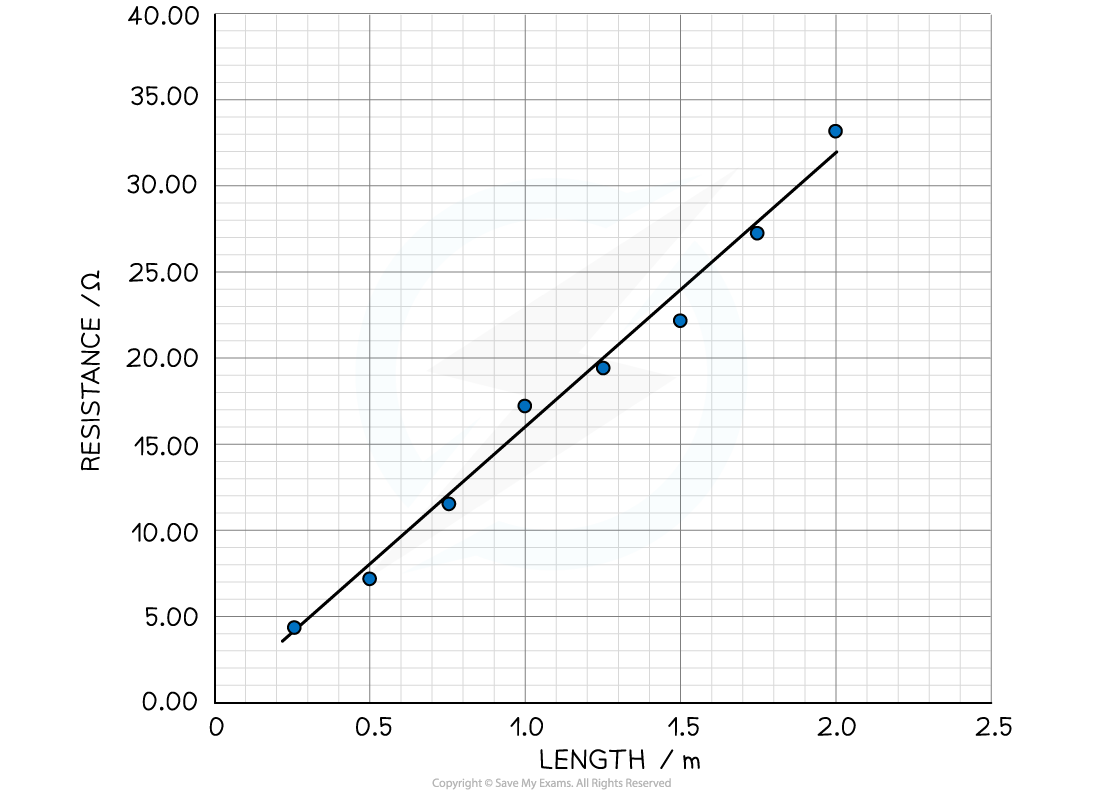
Step 3: Plot a graph of the length L against the resistance R
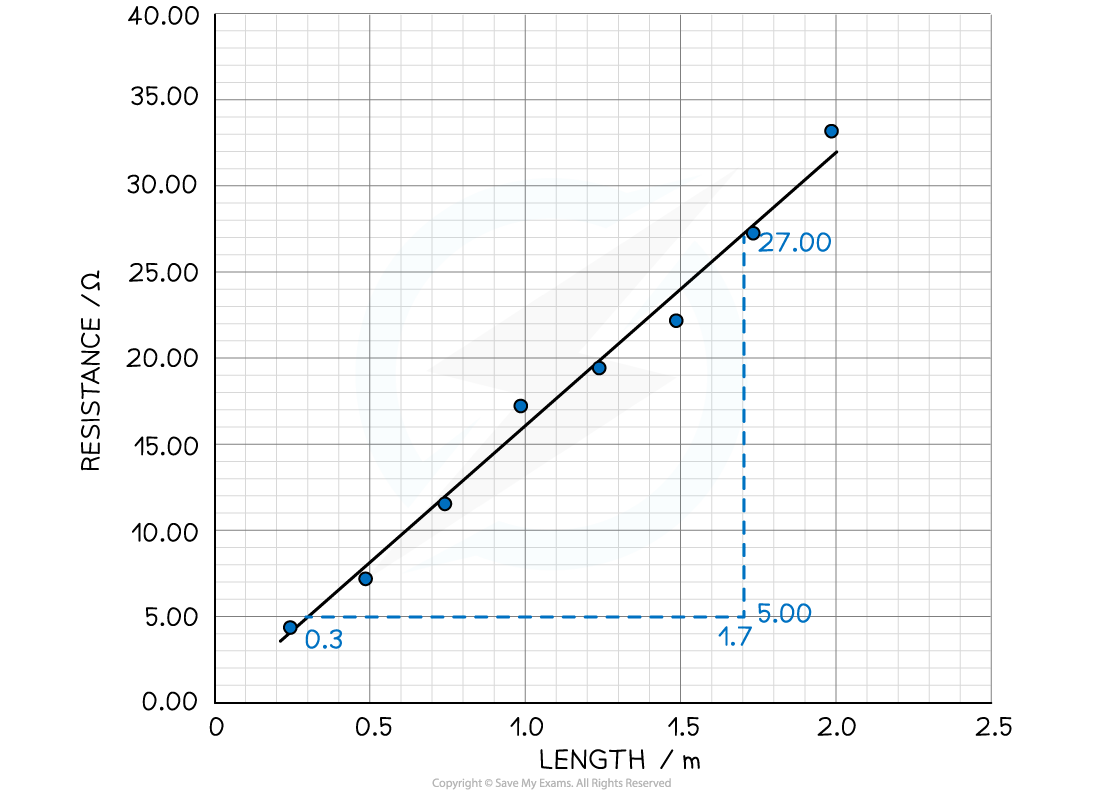
Step 4: Calculate the gradient of the graph
Step 5: Calculate the resistivity of the wire
rho = g r a d i e n t x A = 15.71 x ( 2.87 x 10 ^ - 8 ) = 4.51 x 10 ^ - 7 capital omega m


Was this revision note helpful?
Build on this topic