Angular Velocity (Edexcel IAL Physics)
Spec point —
88
Angular Velocity
-
The angular velocity ω* of a body in circular motion is defined as: The rate of change of angular displacement
-
In other words, angular velocity is the angle swept out by an object in circular motion, per second
-
Angular velocity is a vector quantity and is measured in rad s–1
- Since it is a vector, it has a magnitude (angular speed) and direction
-
Angular velocity is calculated using:
ω = *
-
Where:
- Δθ = change in angular displacement (radians)
- Δt = time interval (s)
-
It is related to linear speed, v by the equation
v = ωr
-
Where:
- v = linear speed, v (m s-1)
- ω = angular speed (rad s-1)
- r = radius of orbit (m)
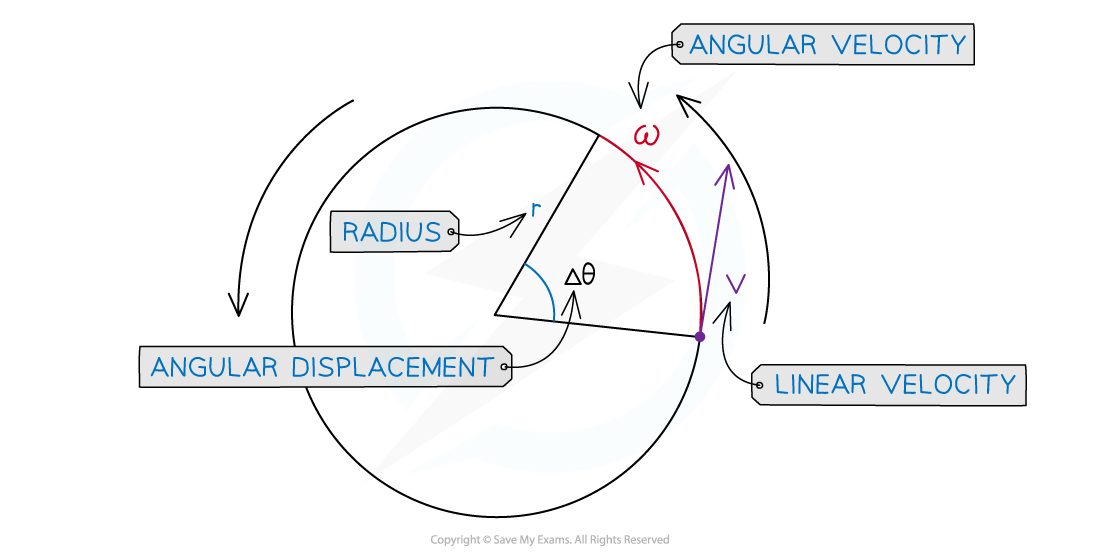
When an object is in uniform circular motion, velocity constantly changes direction, but the speed stays the same
- Taking the angular displacement of a complete orbit or revolution as 2π radians, the angular velocity ω an be calculated using the equation:

-
Where:
- T = the time period (s)
- f = frequency (Hz)
-
This equation shows that:
- The greater the rotation angle θ in a given amount of time T, the greater the angular velocity ω
- An object travelling with the same linear velocity, but further from the centre of orbit (larger r) moves with a smaller angular velocity (smaller ω)
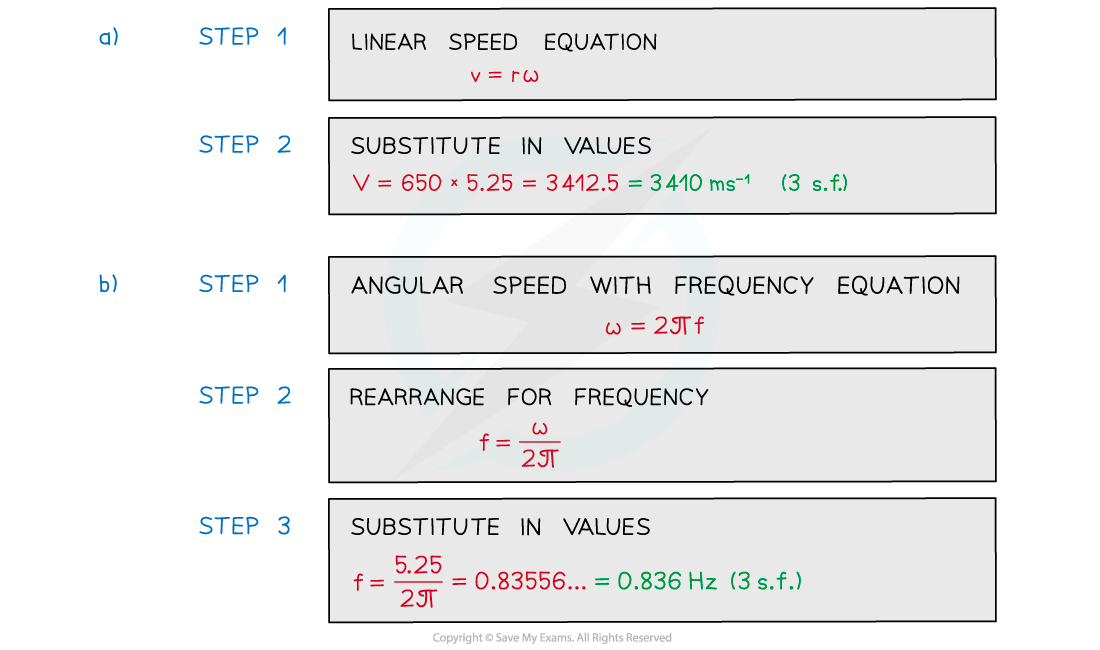
Worked Example A bird flies in a horizontal circle with an angular speed of 5.25 rad s−1 of radius 650 m.
Calculate:
a) The linear speed of the bird
b) The angular frequency of the bird
Answer:
Exam Hint Try not to be confused by similar sounding terms like "angular velocity" and "angular speed". Just like in regular linear motion, you have linear velocity and linear speed: one is a scalar (speed) and the other is a vector (velocity).
In this worked example, the equation v = rω is used to calculate the linear speed. This is fine, because v in this context is just the magnitude of the linear velocity (and similarly, ω is the magnitude of the angular velocity).
Finally, you may sometimes come across ω being labelled as 'angular frequency', because of its relationship to linear frequency f as given by the alternative equation ω = 2*πf. *Remember, the units of ω are rad s–1, whereas the units of f are Hz.
Was this revision note helpful?
Build on this topic