Potential Difference & Conductor Length (Edexcel IAL Physics)
Exam board Pearson Edexcel · IALUpdated 2026-07-02
Spec point —
74
Potential Difference & Conductor Length
Potential difference
- A cell makes one end of the circuit positive and the other negative. This sets up a potential difference across the circuit
- The potential difference across a component in a circuit is defined as:
The energy transferred per unit charge
- The energy is transferred from electrical energy into other forms, depending on the component or device being used
- Potential difference is measured in volts (V), which is equivalent to joules per coulomb (J C−1)
- The potential difference of a power supply connected in series is always shared between all the components in the circuit
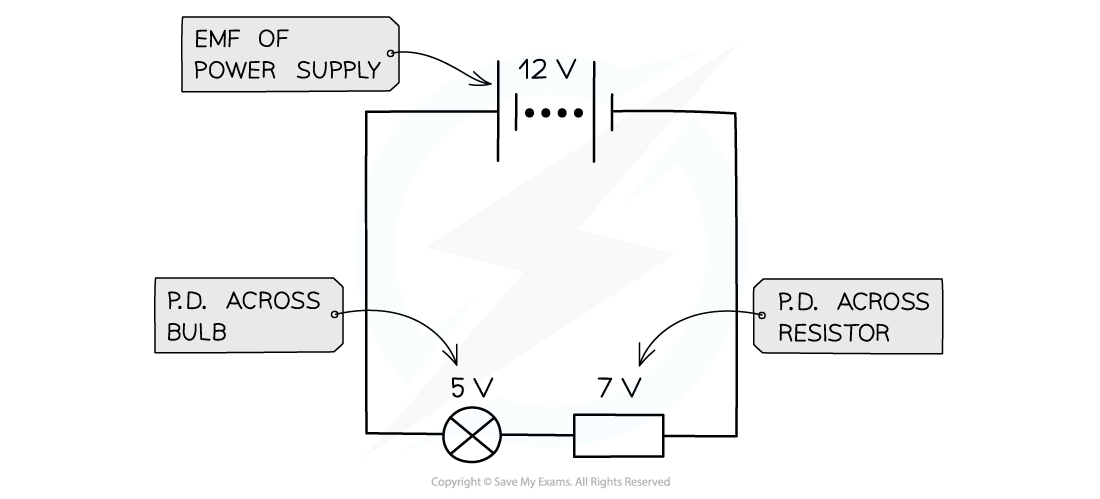
The potential difference is the voltage across each component in a circuit
- Another description of energy transfer is work done
- Therefore, potential difference can also be defined as the work done per unit charge

Potential difference is the work done per unit charge
Measuring potential difference
-
Potential difference or voltage is measured using a voltmeter
- A voltmeter is always set up in parallel to the component being measured
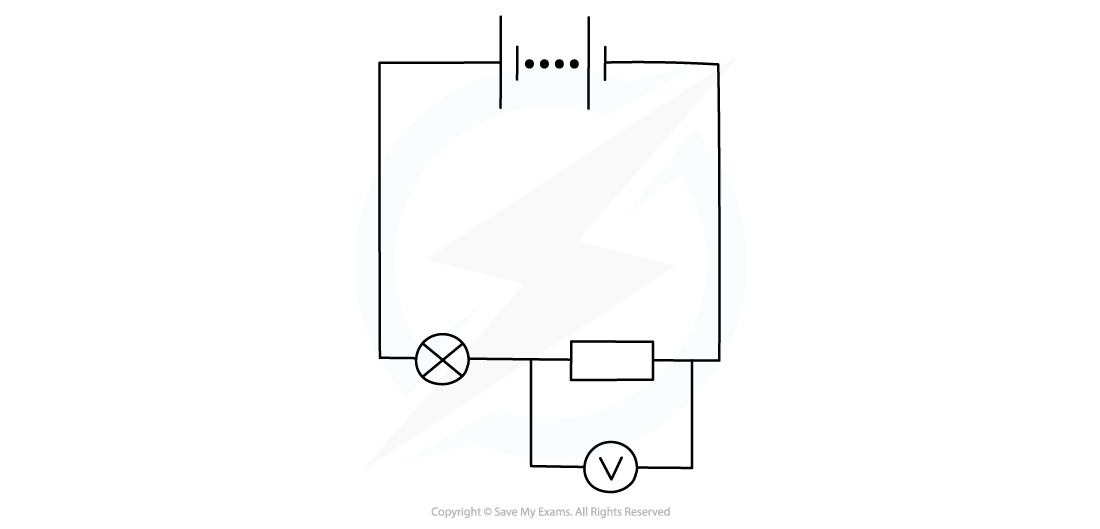
Potential difference can be measured by connecting a voltmeter in parallel between two points in a circuit
Conductor length
- The equation for resistivity is
-
Where:
- R = resistance (Ω)
- ρ = resistivity (Ω m−1)
- l = length (m)
- A = area (m−2)
-
Therefore, as the length of a uniform conductor at constant temperature increases, resistance also increases
-
Voltage and current are linked by Ohm's Law
-
Where
- V = potential difference (V)
- I = current (A)
- R = resistance (Ω)
-
Therefore, as R increases, so must potential difference across the wire
- Potential difference increases uniformly with length
Was this revision note helpful?
Build on this topic