Doppler Shift (Edexcel IAL Physics)
Spec point —
169
Doppler Shift
-
If a wave source is stationary, the wavefronts spread out symmetrically
-
If the wave source is moving, the waves can become squashed together or stretched out
- If the wave source is moving towards an observer the wavefronts will appear squashed
- If the wavefront is moving away from an observer the wavefronts will appear stretched out
-
Therefore, when a wave source moves relative to an observer there will be a change in the observed frequency and wavelength
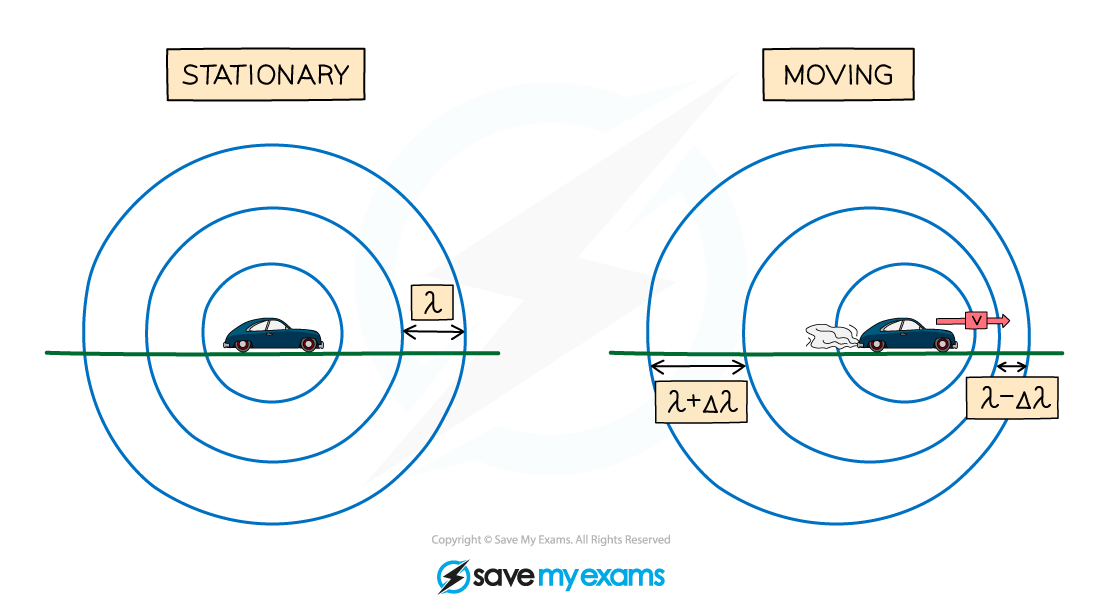
Wavefronts are even in a stationary object but are squashed in the direction of the moving wave source
-
A moving object will cause the wavelength, λ, (and frequency) of the waves to change:
- The wavelength of the waves in front of the source decreases (λ – Δλ) and the frequency increases
- The wavelength behind the source increases (λ + Δλ) and the frequency decreases
-
Note: Δλ means 'change in wavelength'
- The actual wavelength emitted by the source remains the same
- It is only the wavelength that is received by the observer that appears to have changed
-
This effect is known as the Doppler effect or Doppler shift
-
The Doppler effect is defined as: The apparent shift in wavelength occurring when the source of the waves is moving
-
The Doppler effect, or Doppler shift, can be observed using any form of electromagnetic radiation
-
It can be observed by comparing the light spectrum produced from a close object, such as our Sun, with that of a distant galaxy
- The light from the distant galaxy is shifted towards the red end of the spectrum (There are more spectral lines in the red end)
- This provides evidence that the universe is expanding
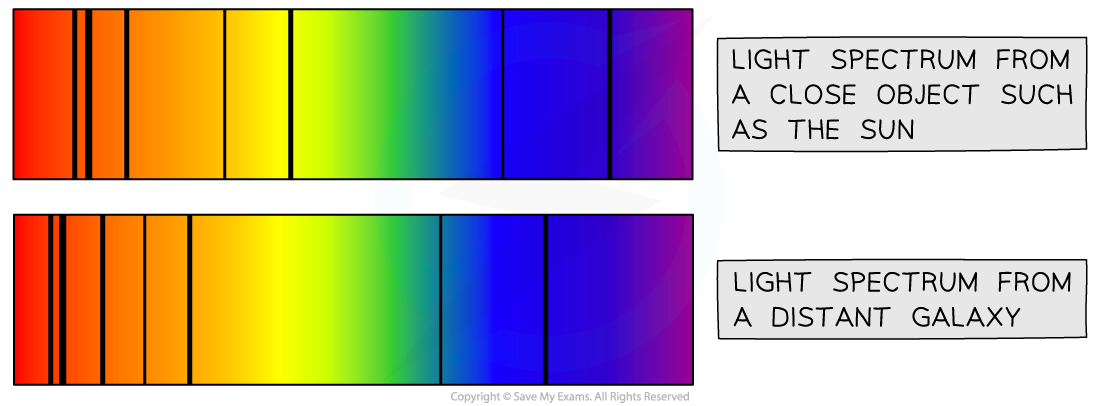
Comparing the light spectrum produced from the Sun and a distant galaxy
Was this revision note helpful?
Build on this topic