The Diffraction Grating Equation (Edexcel IAL Physics)
Spec point —
51
The Diffraction Grating Equation
- A diffraction grating is a plate on which there is a very large number of parallel, identical, close-spaced slits
- When monochromatic light is incident on a grating, a pattern of narrow bright fringes is produced on a screen
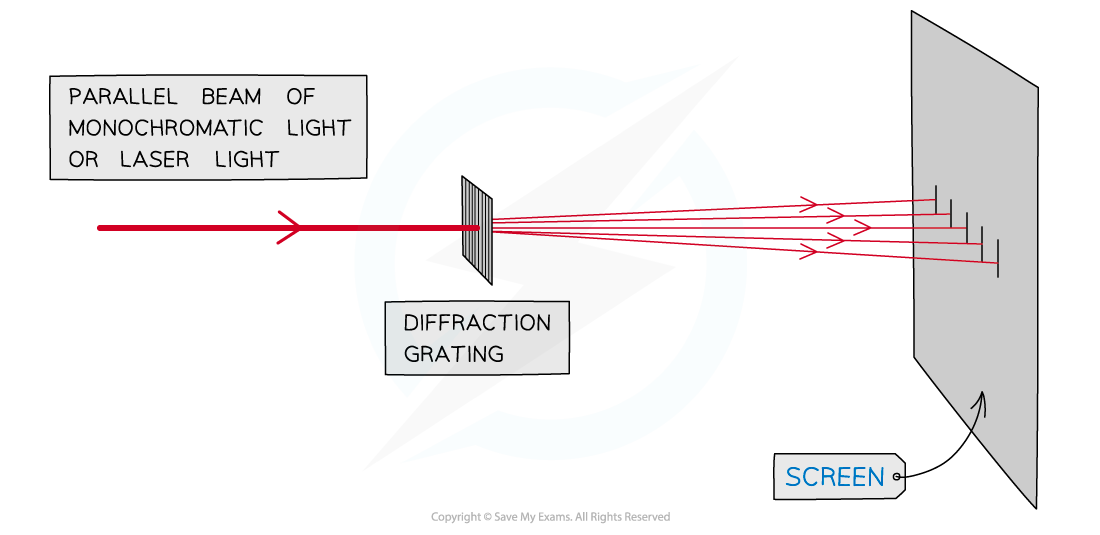
Diagram of diffraction grating used to obtain a fringe pattern
- The angles at which the maxima of intensity (constructive interference) are produced can be deduced by the diffraction grating equation
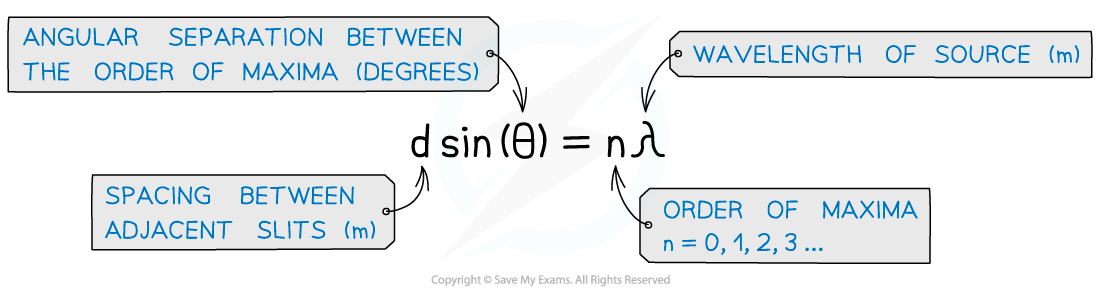
Diffraction grating equation for the angle of bright fringes
- Exam questions sometime state the lines per m (or per mm, per nm etc.) on the grating which is represented by the symbol N
- d can be calculated from N using the equation

Angular Separation
- The angular separation of each maxima is calculated by rearranging the grating equation to make θ the subject
- The angle θ is taken from the centre meaning the higher orders are at greater angles
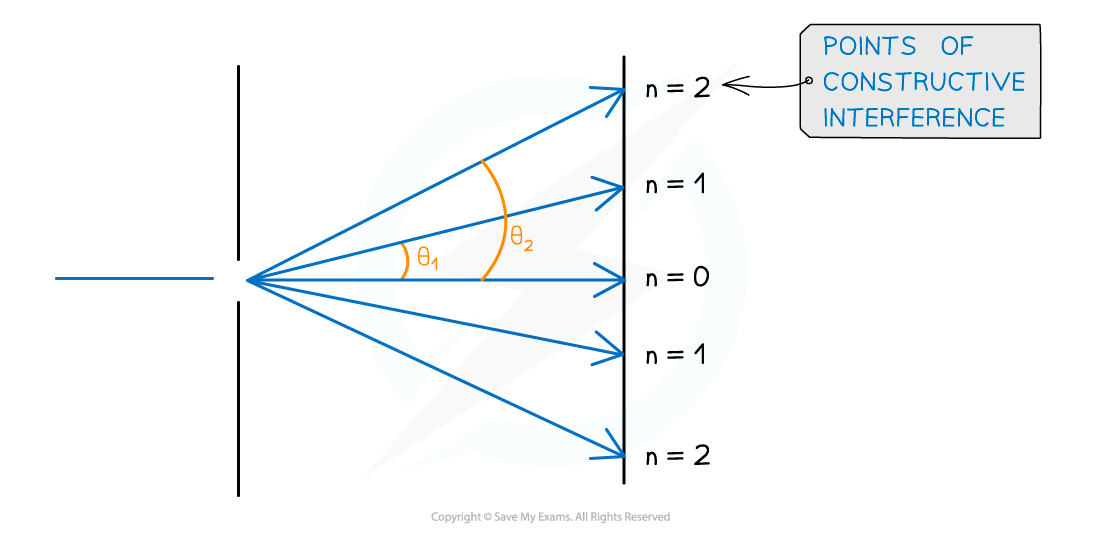
Angular separation
- The angular separation between two angles is found by subtracting the smaller angle from the larger one
- The angular separation between the first and second maxima n1 and n2 is θ2– θ1
Orders of Maxima
-
The maximum angle to see orders of maxima is when the beam is at right angles to the diffraction grating
- This means θ = 90o and sin θ = 1
-
The highest order of maxima visible is therefore calculated by the equation:

-
Note that since n must be an integer, if the value is a decimal it must be rounded down
- E.g If n is calculated as 2.7 then n = 2 is the highest order visible
Worked Example An experiment was set up to investigate light passing through a diffraction grating with a slit spacing of 1.7 µm. The fringe pattern was observed on a screen. The wavelength of the light is 550 nm.
Calculate the angle α between the two second-order lines.
Answer:
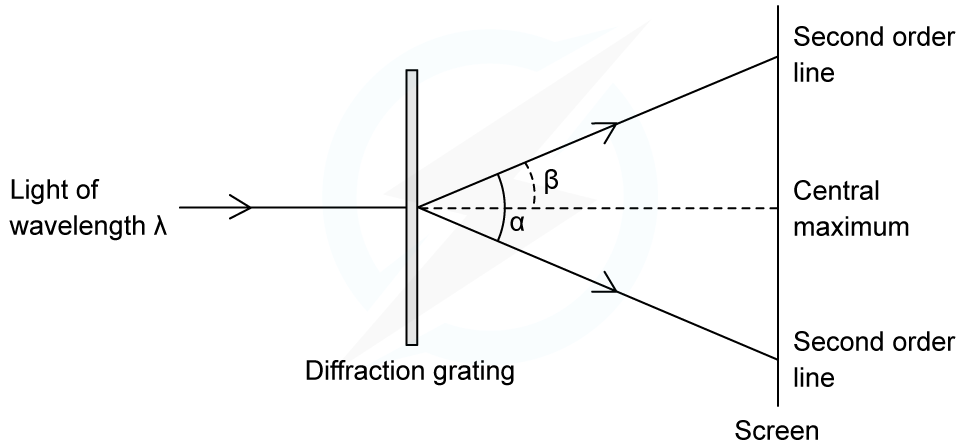
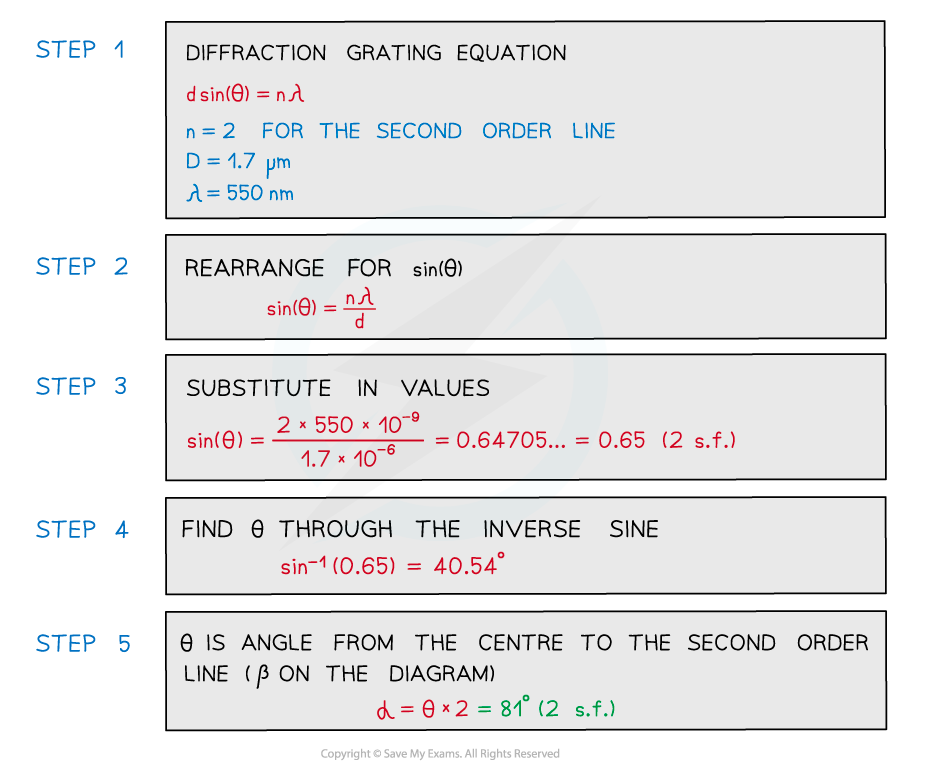
Exam Hint Take care that the angle θ is the correct angle taken from the centre and not the angle taken between two orders of maxima.
Was this revision note helpful?