A student investigated the forces acting on a bracket.
The bracket of weight W was attached to a vertical wall with a hinge at point C. The bracket was held horizontally by a wire attached to the bracket at point A and to the wall at point B. The wire was at an angle θ to the bracket and exerted a force F on the bracket.
The student hung a mass from the bracket at a distance x from the hinge, as shown.
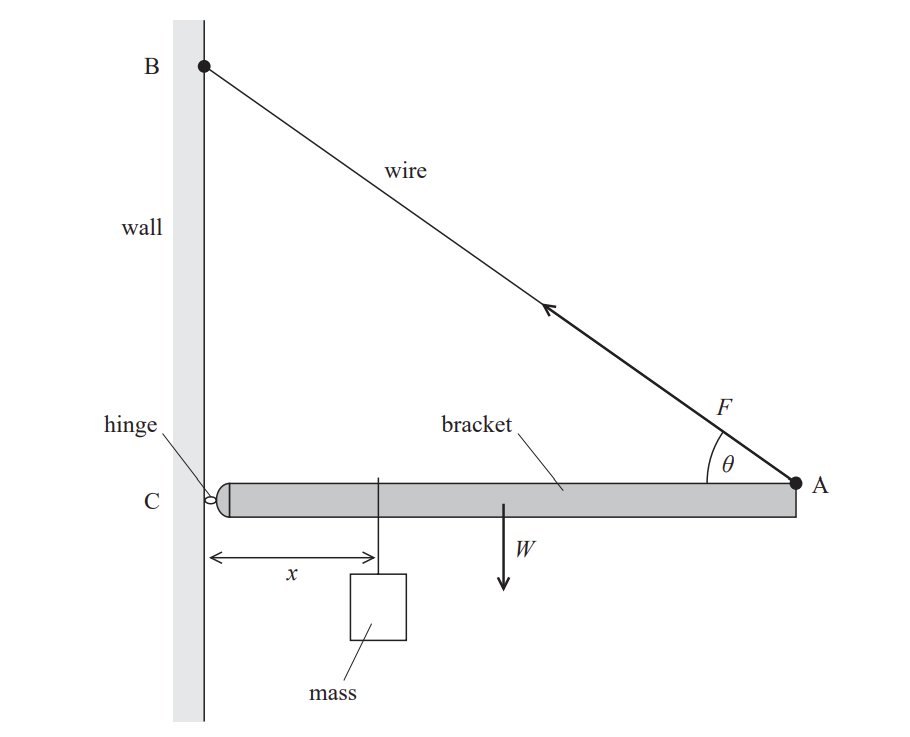
Describe how the student could determine θ using a metre rule.
Describe how the student could check that the bracket was horizontal.
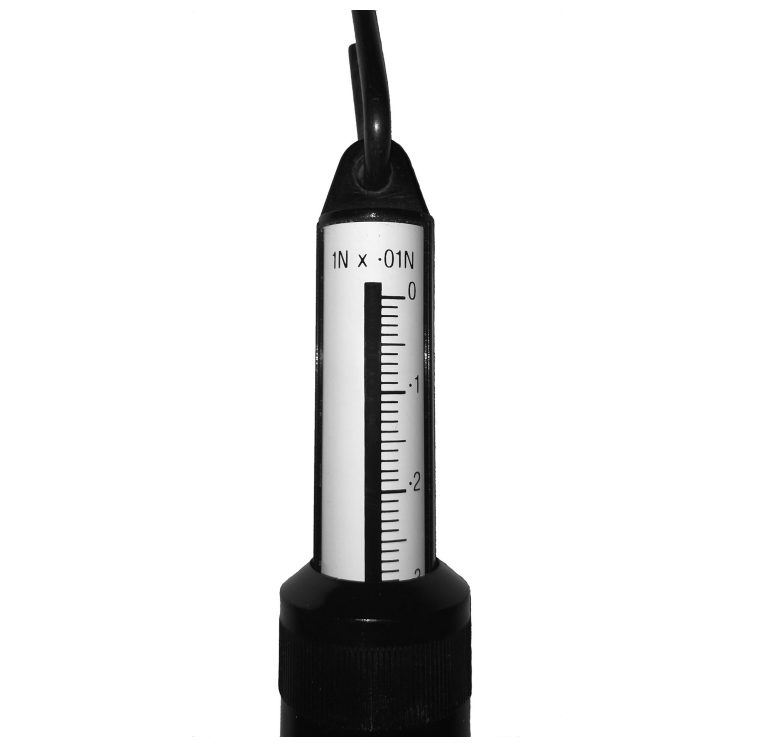
The student adjusted the position of the mass and measured x. For each value of *x *the student made corresponding measurements of F using a force meter.
The results are shown in the table.
| x / cm | Mean F / N |
|---|---|
| 5 | 2 |
| 10 | 2.6 |
| 15 | 3.3 |
| 20 | 4.4 |
| 25 | 5.3 |
| 30 | 6.2 |
| 35 | 7 |
| 40 | 8.1 |
| 45 | 8.8 |
Criticise the recording of these results.
The student plotted a graph of F against x, as shown.
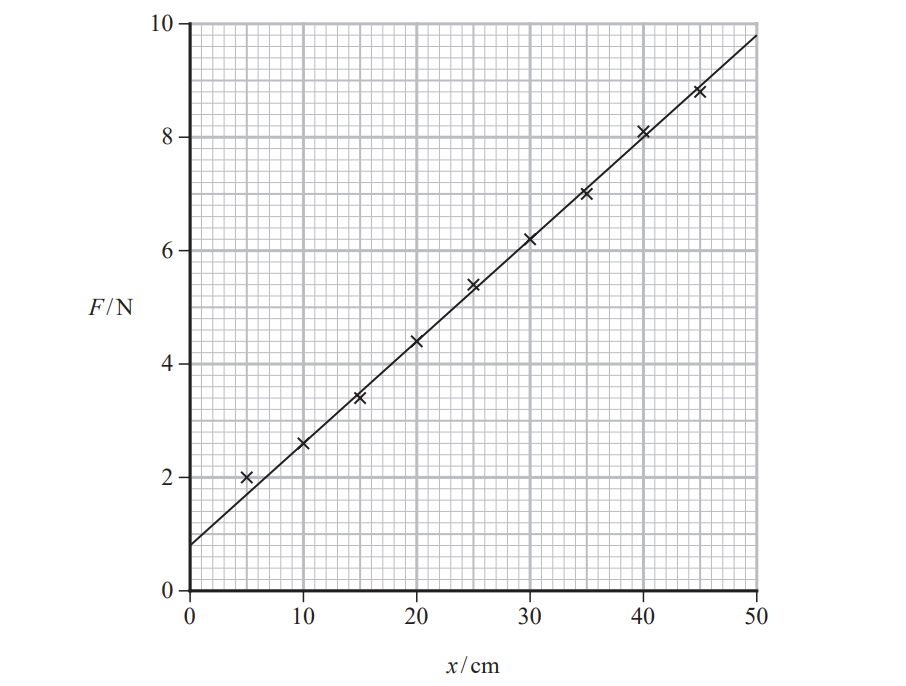
i) The relationship between F and x is
where
l is the length of the bracket
m is the mass hung from the bracket.
Determine a value for W using the graph.
θ = 42°
W = ................................ N (3)
ii) The value of g obtained from the graph is 9.64 m s–2.
The student concluded that the value of g obtained is accurate.
Evaluate the student’s conclusion.
(2 marks)