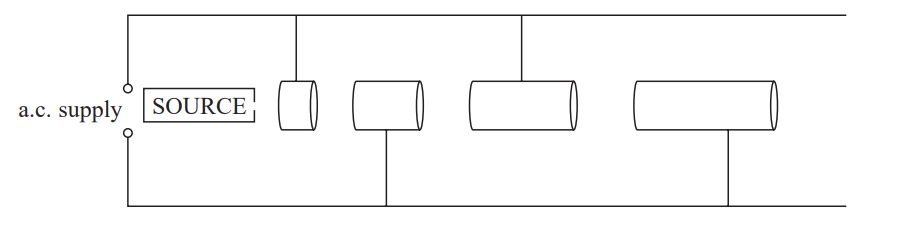
114 marksmedium
2 marks
(a)
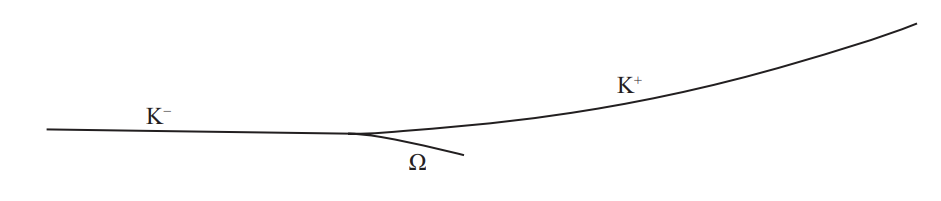
The diagram shows particle tracks in a detector. A negative K meson collided with a stationary proton. An omega baryon and a positive K meson were produced after the impact.
Explain the process that enables a particle detector to detect charged particles.
6 marks
(b)
i) Describe the structure of a baryon and a meson.
(2 marks)
ii) A magnetic field acts in the detector.
State the direction of the magnetic field.
(1 mark)
iii) Deduce the charge and baryon number for the omega particle.
(3 marks)
6 marks
(c)
- The rest mass of the omega baryon is significantly larger than the rest mass of the proton.
Discuss how energy and momentum are conserved during this collision.