Which row of the table identifies what happens to momentum and kinetic energy in an elastic collision?
| Momentum | Kinetic energy | |
|---|---|---|
| A | conserved | conserved |
| B | conserved | not conserved |
| C | not conserved | conserved |
| D | not conserved | not conserved |
Choose your answer

5 questions · 5 marks · ≈ 5 min
Which row of the table identifies what happens to momentum and kinetic energy in an elastic collision?
| Momentum | Kinetic energy | |
|---|---|---|
| A | conserved | conserved |
| B | conserved | not conserved |
| C | not conserved | conserved |
| D | not conserved | not conserved |
Choose your answer

A particle of mass m has kinetic energy Ek and momentum p. A second particle of mass 2m has kinetic energy 2Ek. Both particles are non‐relativistic.
Which of the following is equal to the momentum of the second particle?
Choose your answer
The diagram shows the momentum of two trolleys, X and Y, before a collision. The mass of each trolley is 0.25 kg.

The two trolleys join together after the collision and move on with a velocity of 1 m s−1 .

Which row of the table is correct for this collision?
| Momentum | Elastic or inelastic collision | |
|---|---|---|
| A | conserved | elastic |
| B | conserved | inelastic |
| C | not conserved | elastic |
| D | not conserved | inelastic |
Choose your answer
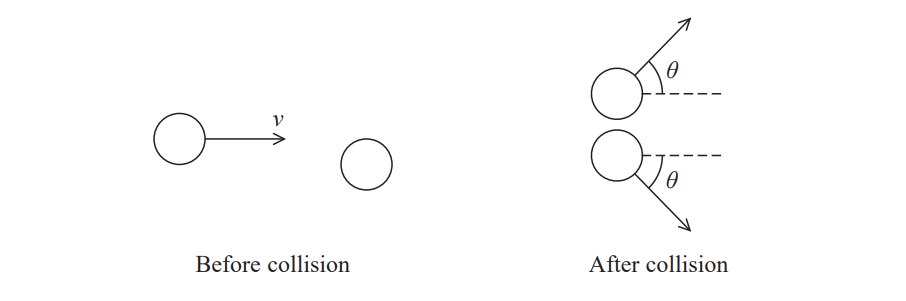
A sphere travelling at speed v collides elastically with an identical sphere which is at rest.
After the collision, both spheres move off at an angle θ to the direction of travel of the first sphere, as shown. The spheres have the same speed as each other.

What is the speed of the spheres after the collision?
Choose your answer
Two trolleys are on a straight, frictionless track. Trolley X has mass and is moving at . It collides with a stationary trolley Y of mass . After the collision the two trolleys stick together.
What is the total kinetic energy transferred to the surroundings during the collision?
Choose your answer