11 markeasy
Which of the following describes a standard candle?
Choose your answer
a star of known distance
a star of known intensity
a star of known luminosity
a star of known mass
7 questions · 7 marks · ≈ 7 min
Which of the following describes a standard candle?
Choose your answer
a star of known distance
a star of known intensity
a star of known luminosity
a star of known mass
Sirius and α-Centauri are two of our closest stars. Sirius has a luminosity about 16 times greater than the luminosity of α-Centauri. Sirius is twice as far away from the Earth as α-Centauri.
The intensity of light from Sirius is Is and the intensity of light from α-Centauri is* I*α .
Which of the following is the value of ?
Choose your answer
4
8
16
The letters W, X, Y and Z represent stars at these positions on the diagram.
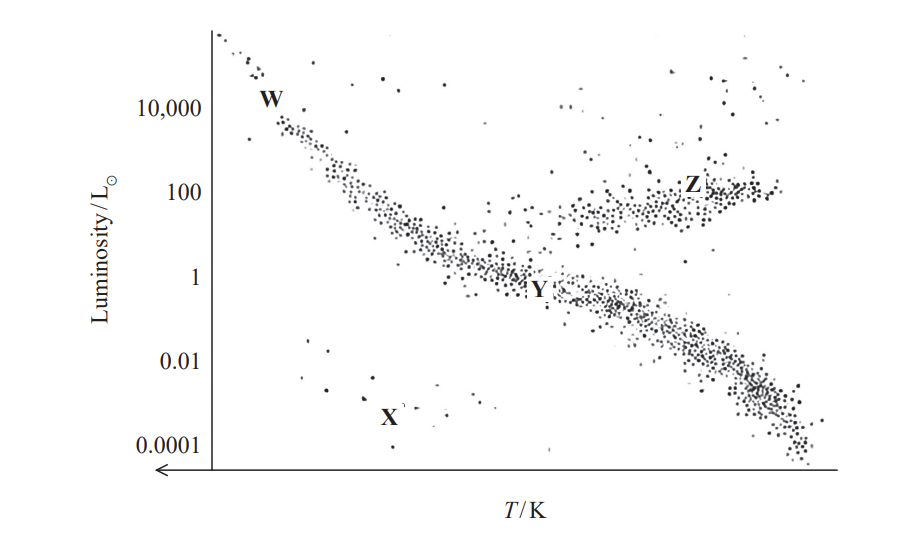
Which of the following is part of a possible evolutionary path of a star?
Choose your answer
W → Y
X → Y
Y → W
Y → Z
Which of the following statements about stars in positions W, X, Y and Z is correct?
Choose your answer
W and Y have the same mass.
W has a lower surface temperature than Z.
Y is more massive than W.
Y has a lower surface temperature than X.
Tau Ceti is one of the closest stars to the Sun. Tau Ceti has a surface temperature of 5300 K and a luminosity of 0.55 LSun, where LSun is the luminosity of the Sun.
Which of the following is the correct description of Tau Ceti?
Choose your answer
main sequence star
red dwarf star
red giant star
white dwarf star
Two stars, P and Q, have approximately the same radius. The surface temperature of star P is twice the surface temperature of star Q.
Star P has a luminosity and star Q has a luminosity .
The ratio is approximately
Choose your answer
2
4
8
16
A red giant star of surface temperature and surface area has a luminosity .
The Sun has a surface temperature of , a surface area of and a luminosity of .
Which row of the table is correct?
| A | |||
|---|---|---|---|
| B | |||
| C | |||
| D |
Choose your answer