for
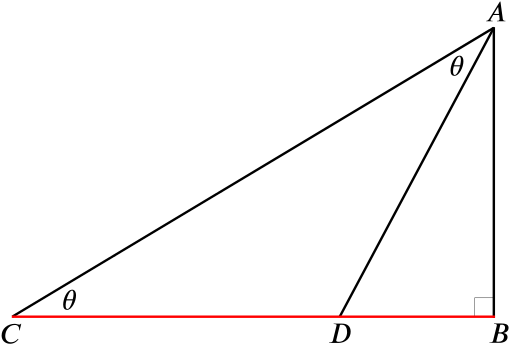
Excerpt: This resource gives students a simple diagram which they can use to deduce the double angle formulae in terms of .
Problem
If we write , then the following equations are true.
Can you use this diagram to obtain these formulae?
For what range of values of does this argument work?
Suggestion
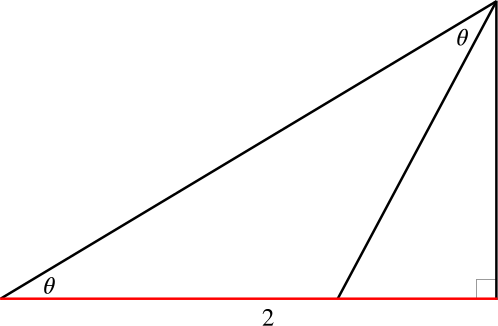
What lengths and angles might be useful to us here? Can you find the missing lengths and angles in terms of ?
Which angle is ?
The relationships are shown using a triangle. Are there any values of for which the diagram does not work? Can you adapt it?
Solution
We have various interesting triangles to consider in this diagram. Let’s study them to see which lengths and angles we can find. In order to talk about the triangle, it will be convenient to label the important points.
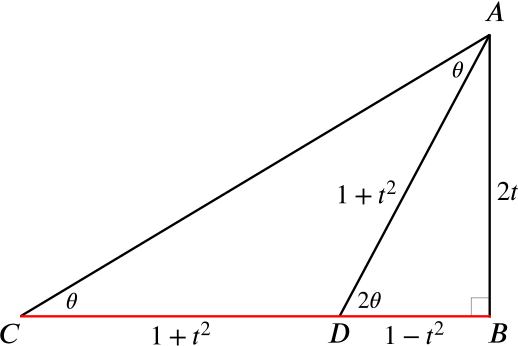
In triangle , since is the right angle, . Since we are told that and we get length .
Let’s say that has length .
We see that we have a triangle with two angles that are both , namely triangle , so this is an isosceles triangle, and so also has length .
Now has length .
Triangle is right-angled, and so we can apply Pythagoras’s theorem: we have . Rearranging this gives , and so .
We now know that , and .
Are there any angles in the diagram that might be ?
, so .
We are now well placed to consider the trig functions applied to , because not only do we have a triangle that contains this angle, but we have a right-angled triangle containing the angle (namely triangle ). So let’s focus on that triangle.
Considering the right-angled triangle , we see that and
Alternative approach
If we know the equations that we are aiming to derive, then we can take a slightly different approach, although this one is a bit more subtle and needs quite a lot of care in order to avoid a circular argument!
As in the last approach, we establish that one of the angles (not the right angle) is and the adjacent side (not the hypotenuse) has length , so the opposite side must have length since we are told that . There is another very obvious right-angled triangle in the diagram, namely . We might hope that it will turn out that is , as that would leave us in good shape to find sine, cosine and tangent of . Given the equations we hope to derive, that would suggest that the hypotenuse should have length and the remaining side length . By the converse of Pythagoras's theorem, we see that , and are indeed the side lengths of a right-angled triangle (since ).
If , then we can draw the diagram given in the question and the argument goes through.
If , then the argument degenerates: point is the same as point , we have , and is not defined anyway.
If , then point lies outside the triangle. Does the argument still work?
We can sketch triangle so that where and . If and and are on a straight line, it puts outside triangle . Can we now use a similar process to above?
Do any lengths keep the same algebraic values?
The angle in triangle is now . How can we use our knowledge of the functions to relate the trigonometric ratios of these angles to , ,