Prove that, if t=tan21θ, then sinθ=1+t22tandcosθ=1+t21−t2.
By expressing sinθ3+cosθ in terms of t, or otherwise, show that this expression cannot have any value between −22 and +22.
Solution
Prove that, if t=tan21θ, then sinθ=1+t22t...
Approach 1: Starting with the left hand side
We can rewrite sinθ by using the double angle formula: sinθ=sin(2(21θ))=2sin21θcos21θ.
In order to get t (which we want in the numerator) into the identity, we can rewrite sin21θ=tan21θcos21θ, which is tcos21θ (where we have used t=tan21θ). Therefore, sinθ=2tcos221θ.
Since we want t in the denominator as well, we write cos221θ=sec221θ1. Using the identity 1+tan221θ=sec221θ, we deduce that cos221θ=1+tan221θ1=1+t21. Therefore sinθ=1+t22t.
We need to show therefore that t2+t2=t+t2 cannot have any value in the given range, where t is any real number except for zero.
The last part is because t=tan21θ can take any real value, but we cannot allow t=0 in this fraction, just as we cannot allow sinθ=0 in the original fraction. We have
sinθ=0⟹tan21θ=0.
Let t+t2=k. Then t2−kt+2=0, and for this to have real roots, the discriminant must be non-negative.
This means that k2≥8, and so k≥22, or k≤−22, as required.
Method 2
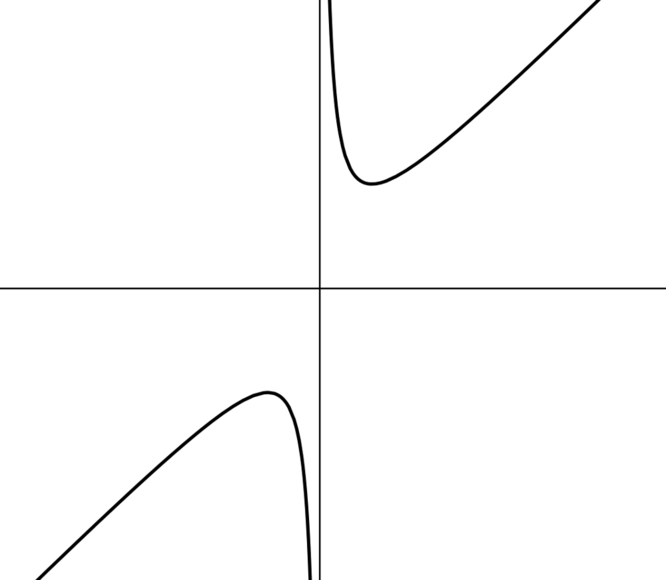
If we sketch a graph of y=t+t2, we see that it has an asymptote at t=0, is positive for t>0 and negative for t<0.
For t>0, it tends to ∞ as t→∞ and as t→0; for t<0, it tends to −∞ as t→−∞ and as t→0. So the graph looks something like this:
We can find the stationary points using calculus.
Writing y=t+t2, we have dtdy=1−t22, sodtdy=0 has solutions t=±2.
When t=2, y=2+22=22; whent=−2, y=−22.
So referring back to our sketch graph, we see that y cannot take anyvalues between −22 and +22.
Method 3
Another calculus-free approach is to use the arithmetic mean–geometric mean (AM–GM) inequality.
This says that if a1 and a2 are positive real numbers, then their arithmetic mean is greater than or equal to their geometric mean.
In other words, 2a1+a2≥a1a2 where a1,a2≥0, with equality if and only if a1=a2.
In our case, if we take n=2 and set a1=t and a2=t2, we find that 2t+t2≥t×t2=2, with equality if and only if t=t2.
Thus for positive values of t, t+t2≥22 with equality if and only if t=t2, that is, if t=2.
For negative values of t, let t=−u, with u positive. Then t+t2=−u−u2=−(u+u2).
Since u+u2≥22, it follows that for negative values of t, t+t2≤−22 with equality if and only if t=−2.
Thus t+t2 cannot take any values between −22 and+22.
Method 4
As a final method, if t is positive, we can write t+t2 as t+t2=(t−t2)2+22. Since a square is always positive or zero, the right hand side must be at least 22, with equality if and only ift=t2.
We can deal with the case of t negative as above.
What could make us think to write t+t2 in such a bizarre way? And what made us think that it would be useful?
To prove the AM–GM inequality for n=2, we first observe that (x−y)2=x2+y2−2xy, so that x2+y2=(x−y)2+2xy≥2xy with equality if and only if x=y.
If we now write x=0a1 andy=0a2, we get a1+a2≥20a1a2, which is, on dividing by 2, the AM–GM inequality for n=2.
So in this approach, we have simply replicated this proof without mentioning the AM–GM inequality!