Sort it out
Excerpt: Students are encouraged to recognise the properties of different sequences, leading them to build and develop their own definitions and classifications of sequences.
Problem
Sort these infinite sequences into groups. (They are available on cards for cutting out.)
-
How will you choose to define the groups?
-
Are there some sequences which belong to more than one group?
Once you have sorted the sequences into groups, write a further sequence for each group.
How else could you have sorted the sequences?
Suggestion
Sort these infinite sequences into groups.
-
How will you choose to define the groups?
-
Are there some sequences which belong to more than one group?
When looking for ways to group the sequences you might ask yourself the following questions.
-
Is each term bigger or smaller than the previous one?
-
How does the difference between adjacent terms change as you go along the sequence?
-
Thinking about a pair of sequences, what is the same and what is different?
-
Can you find a rule for generating the term?
You might find it helpful to plot a graph of a sequence to get a feel for how it is behaving.
Possible groupings
Sort these infinite sequences into groups.
-
How will you choose to define the groups?
-
Are there some sequences which belong to more than one group?
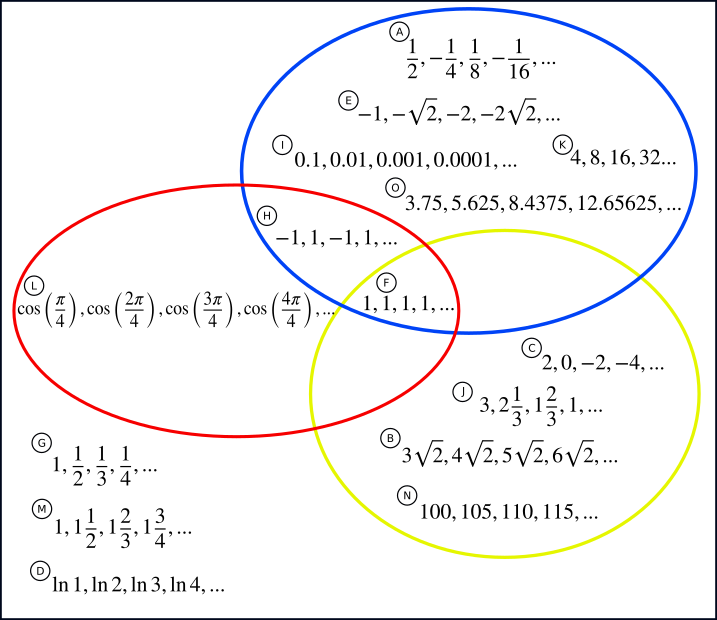
Here is one possible grouping. How do you think this grouping was constructed?
Possible rules
-
Periodic sequences
-
Arithmetic sequences
-
Geometric sequences
Some didn’t seem to fit in any of these groups.
Why can we think of the sequence as both an arithmetic sequence and a geometric sequence? Are there any other sequences that are both arithmetic and geometric?
Can we find a sequence that fits in the empty parts of this grouping diagram?
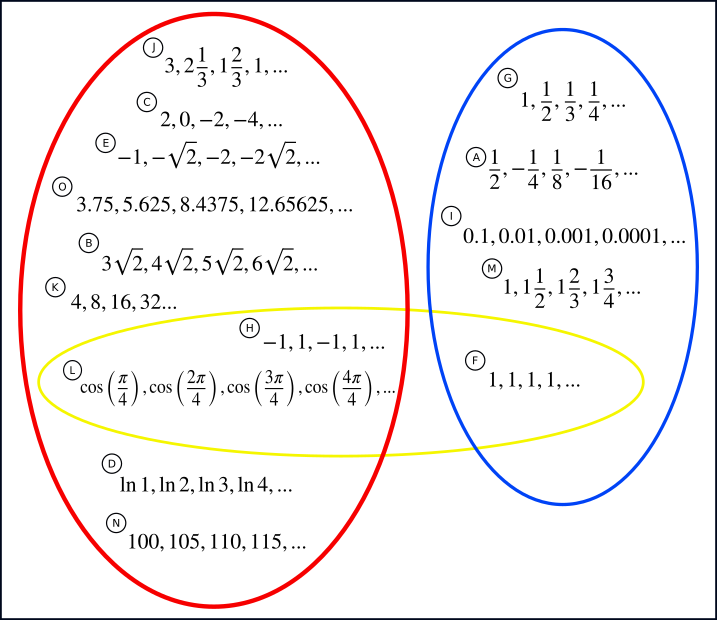
Here is another possible grouping. How do you think this one was constructed?
Possible rules
-
Periodic sequences
-
Divergent sequences
-
Convergent sequences
If we plotted the graphs of the convergent sequences, what would they have in common?
If we plotted the graphs of the divergent sequences, what would they have in common?
Can we find a sequence that fits in the empty parts of this grouping diagram?
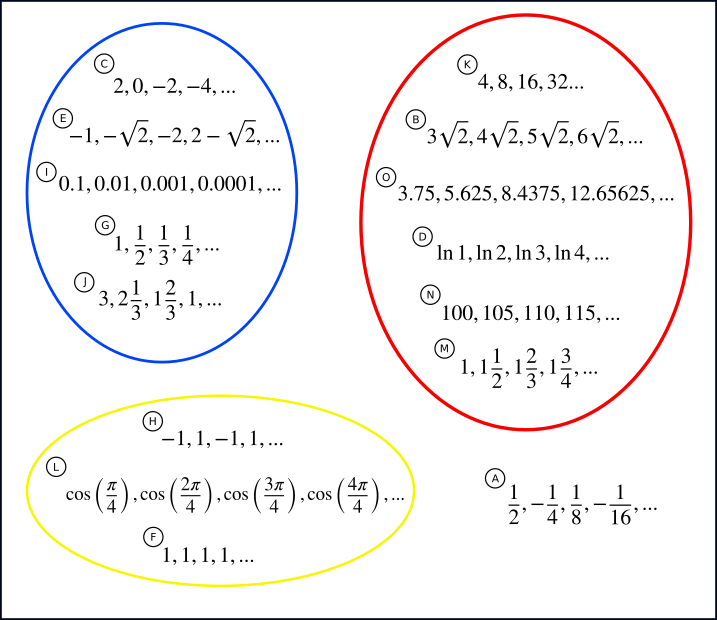
And another… how do you think this one was constructed?
Possible rules
-
Strictly increasing sequences
-
Strictly decreasing sequences
-
Periodic sequences
One didn’t seem to fit in any of these groups.
Why do you think our groupings are labelled strictly increasing and strictly decreasing sequences? (It might help to think about increasing and decreasing functions.)
How would the grouping diagram have changed if we had not used the word strictly in our labelling of our groupings?