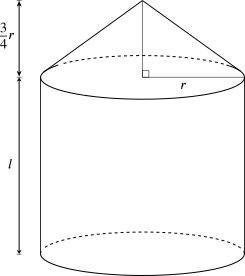
What's the least surface area of this rocket-shaped solid?
Question
A rocket-shaped solid consists of a right circular cylinder of length l and radius r attached at one end to the base of a right circular cone of base radius r and height 43r. If the total volume of the solid is to be 14πcm3, find its least possible surface area.
Solution
The volume of the rocket-shaped solid is the sum of the volumes of the cylinder and the cone.
The volume of the cylinder is πr2l, and the volume of the cone is 31πr2(43r), or 41πr3.
From the question, we must have that
14π=πr2l+41πr3=πr2(l+4r)⟺l=r214−4r.
The surface area of the rocket-shaped solid does not include the base of the cone or the top of the cylinder.
The contribution from the cylinder is thus its bottom disc and curved surface, while the contribution from the cone is just its sloped surface.
For the cylinder, the area of the bottom disc is πr2, while the area of the curved surface is 2πrl, since when uncurled, it’s a rectangle with side lengths 2πr and l.
The area of the sloped part of the cone is
πr
times the slope length; by Pythagoras’ theorem, this length is