Curvy cubics
Excerpt: Students are asked to investigate what the equations of four somewhat different cubic functions could be.
Cubic curves
What gives a cubic curve its curves?
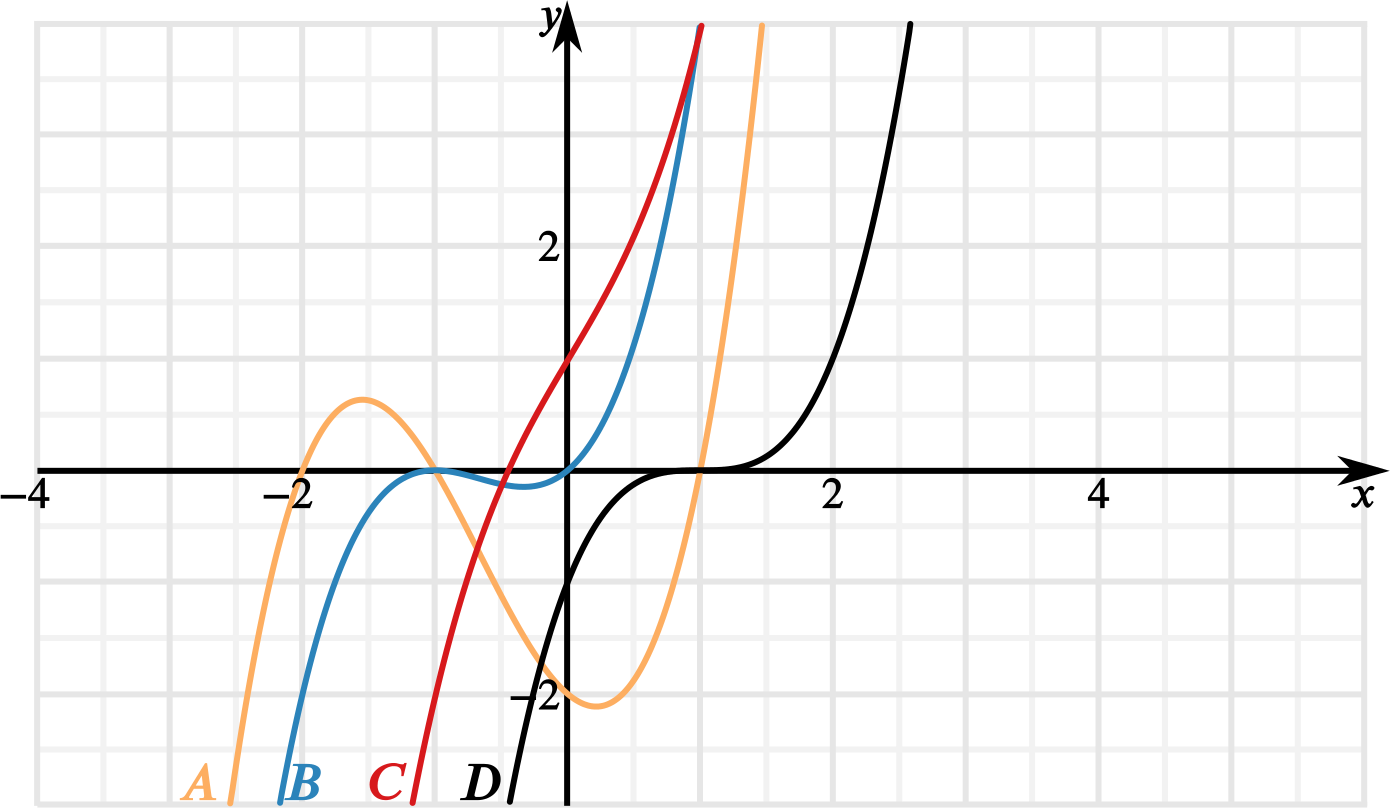
Below are four cubic curves.
Can you form an equation for each?
What does the curve tell you about the properties of the cubic polynomial?
Curves , and
How many pieces of information do we need to determine a straight line? How many pieces of information are needed to determine a quadratic? How many pieces of information are we looking for here in order to determine a cubic?
From previous knowledge about curves and their intersections with the -axis we can say quite a lot about the form their equations might take.
Curve
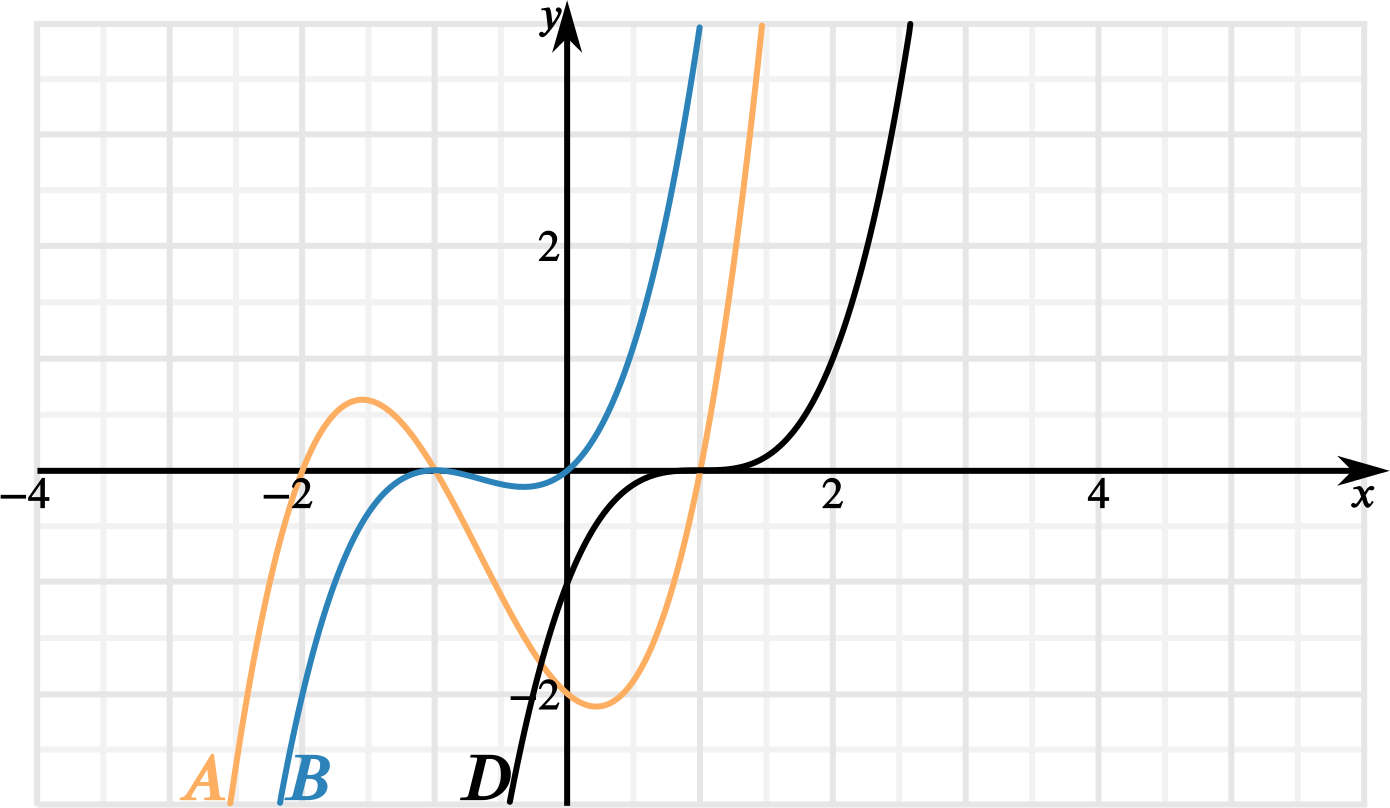
From looking at curve , the orange curve, we see it passes through the points , and . Just as we saw in Can you find… cubic edition, this means we have an equation for this cubic of the form,
We can determine by looking at any point on the curve that is not on the -axis. In this case we can choose the -intercept (when ). This gives .
Here we needed to use four pieces of information to determine an equation of the cubic curve. Do we ever need more than four pieces of information about any cubic to determine an equation for it?
What would the derivative of this function look like and what does that tell us about the shape of the curve?
Curve
From our knowledge of roots and transformations of cubic curves, curve , the black curve, looks like a translation of to .
The equation looks right but we can test to make sure by substituting into the equations and locating the -intercept of curve .
What would the derivative of this function look like and what does that tell us about the shape of the curve?
Curve
From looking at curve , the blue curve, it passes through the point and touches the -axis at . Just as we saw in Can you find… cubic edition, this means we have an equation for this cubic of the form,
We can determine by looking at a point on the curve. When , and so .
What would the derivative of this function look like and what does that tell us about the shape of the curve?
Curve - how can calculus help?
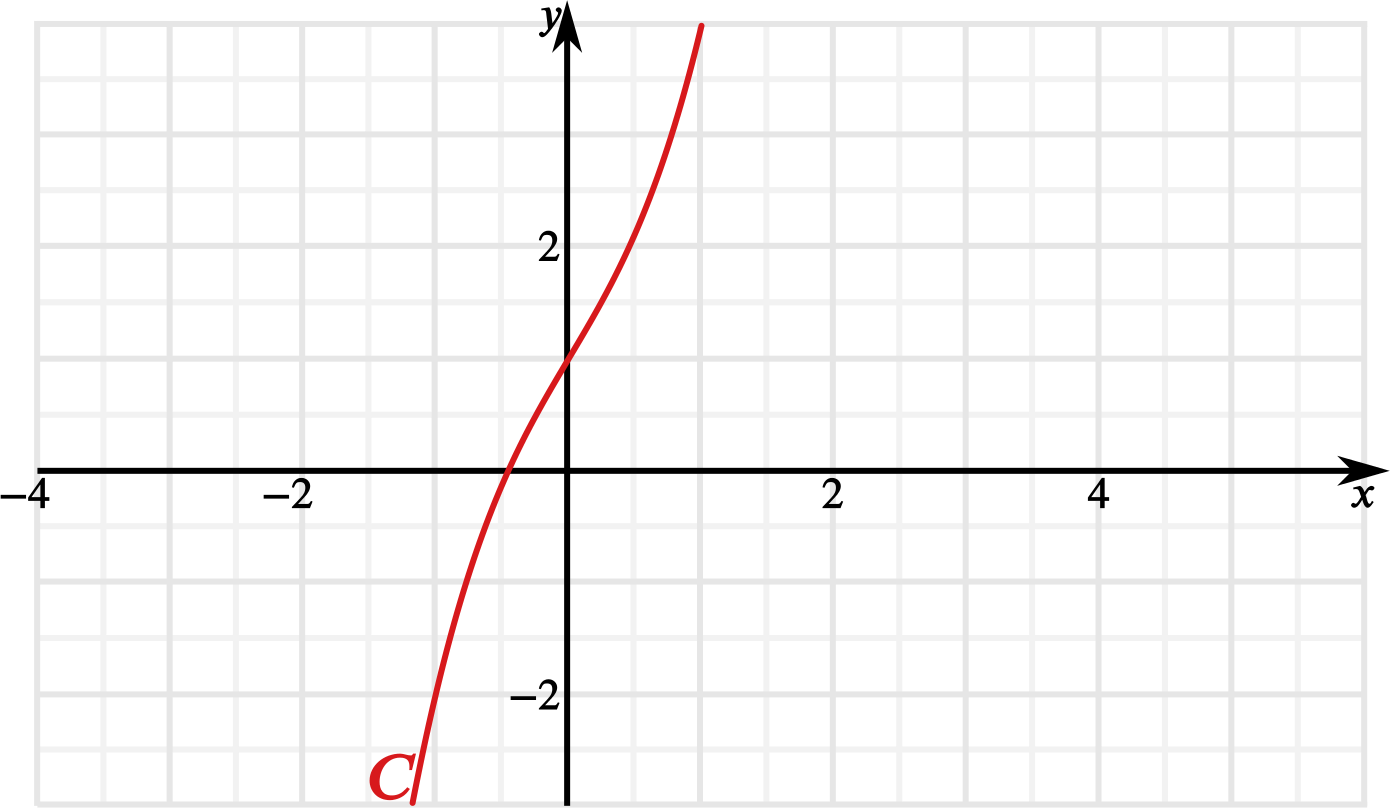
Curve , the red curve, does not look like one of the typical cubic shapes we have seen before. However, it has rotational symmetry about .
It has some similarities to the curve but it does not have the same key feature at .
What are the features of this curve compared to or a translation of it?
A possible response
Curve intersects the -axis once and the -axis at .
As the value for increases, the value for increases.
However, it does not appear to have the same shape as the curve at the point .
We could try to form a set of simultaneous equations to find a cubic equation, but would this be an efficient way to find an equation?
Calculus of curve
The curve has no stationary points.
If a cubic curve given by a function has no stationary points then what do we know about ?
A possible response
We know that the equation has no real solutions. Since is a cubic function, will be a quadratic expression that forms an equation with no real solutions.
So we can use our knowledge of calculus and quadratic equations to help construct a cubic curve with the same properties as curve .
A possible red curve equation
We know that the quadratic equation has no real solutions, so we could take .
Using integration we find that , where is an arbitrary constant.
We could therefore choose as our cubic curve equation, since the curve cuts the -axis at .
Is this an equation of curve ? We may need to manipulate so that it goes through the points and as the curve does.
Have a look back at where the coefficients for your cubic have come from. Can we alter the coefficients without the argument above breaking down?
After using this resource you could take a look at Can you find… curvy cubics edition.