What's the area between fk(x)=x(x−k)(x−2) and the x-axis?
Question
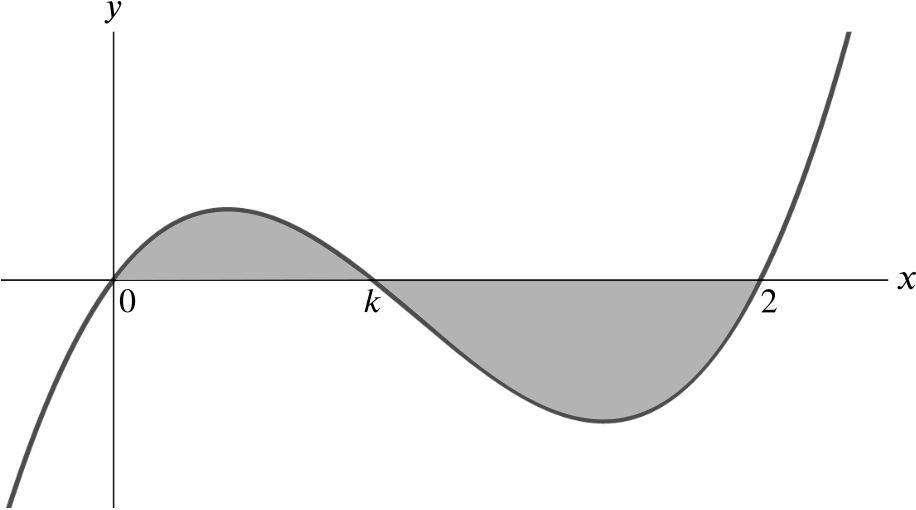
Let 0<k<2. Below is sketched a graph of y=fk(x) where fk(x)=x(x−k)(x−2). Let A(k) denote the area of the shaded region.
- Without evaluating them, write down an expression for A(k) in terms of two integrals.
- Explain why A(k) is a polynomial in k of degree 4 or less. [You are not required to calculate A(k) explicitly.]
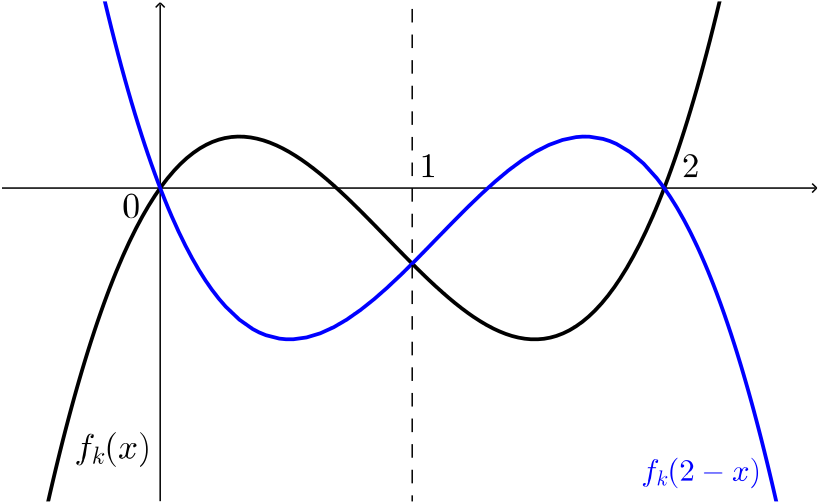
- Verify that fk(1+t)=−f2−k(1−t) for any t.
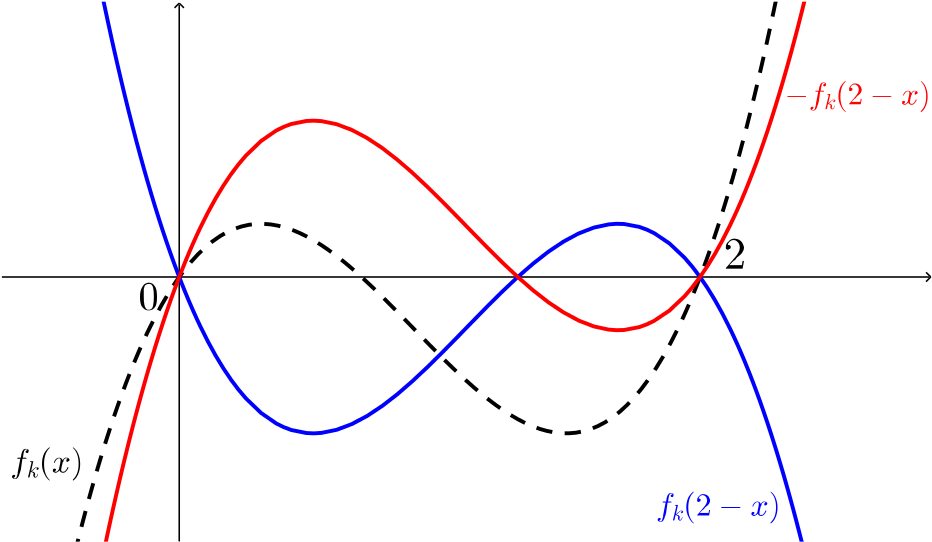
- How can the graph of y=fk(x) be transformed to the graph of y=f2−k(x)? Deduce that A(k)=A(2−k).
- Explain why there are constants a,b,c such that A(k)=a(k−1)4+b(k−1)2+c. [You are not required to calculate a,b,c explicitly.]
Suggestion
How is the value of an integral affected if a function gives negative values (is below the x-axis)?
What is the highest of power of k we can get by integrating f, with the limits given?
What happens if we use part (iii), replacing 1+t with x?
Can we compare f2−k(x) to fk(x)? What do the transformations from part iv) do to the area A(k)?
- Explain why there are constants a,b,c such that A(k)=a(k−1)4+b(k−1)2+c. [You are not required to calculate a,b,c explicitly.]
Can we show A(1+k)=A(1−k)? What implications for symmetry does this have?
Solution
We need to consider the two shaded regions separately, because one is above the x-axis (giving a positive area), and one is below the x-axis (giving a negative area), so we can’t just take the integral ∫02fk(x)dx.
Instead, we have
A(k)=∫0kfk(x)dx−∫k2fk(x)dx,
as the negative sign in front of the second integral cancels out the negative sign of the area between x=k and x=2.
Therefore,
A(k)=∫0kx(x−k)(x−2)dx−∫k2x(x−k)(x−2)dx.
A(k) is certainly a polynomial in k. Could it include a k5 term?
Only if you have an x5 term or a kx4 term after integrating, which means having an x4 term or a kx3 term before integrating.
Neither is possible, by looking at x(x−k)(x−2), and the same argument works for powers of k higher than 5.
Hence A(k) is a polynomial in k of degree at most 4.
Let’s start by thinking about what fk(1+t) and f2−k(1−t) are, given that fk(x)=x(x−k)(x−2).
To find fk(1+t), we need to substitute 1+t for x in the formula for fk(x). This gives us fk(1+t)=(1+t)(1+t−k)(1+t−2).
To find f2−k(1−t), we need to substitute 1−t for x, but we also need to substitute 2−k for k. Therefore f2−k(1−t)=(1−t)(1−t−(2−k))(1−t−2).
Now we can manipulate
−f2−k(1−t)
to try to obtain
fk(1+t).
−f2−k(1−t)=−(1−t)(1−t−(2−k))(1−t−2)=−(1−t)(−1−t+k)(−1−t)=(t−1)(1+t−k)(1+t)by taking a factor of −1 from each bracket=(1+t)(1+t−k)(t−1)by rearranging the order of the brackets.
If we think about what we are aiming for, we can see that the first two brackets involve 1+t, which is a good sign. It would be helpful to rewrite the last bracket in a way that also involves 1+t. We can write t−1 as 1+t−2 which means that
−f2−k(1−t)=(1+t)(1+t−k)(1+t−2)=fk(1+t)as required.
We started from the RHS because it looks messier and we wanted to get it to a simpler expression. We could have started with the LHS.
From part (iii), we have that
fk(1+t)=−f2−k(1−t).
If we substitute t with 1−x, the above equation becomes equivalent to
−fk(2−x)=f2−k(x).
Now, fk(2−x) is the reflection of fk(x) in the line x=1.
A second transformation is now required because of the minus sign in front of fk. This is a reflection in the x-axis.
Together these transformations are the same as a rotation 180∘ around the point (1,0).
In fact, combining two reflections always gives you a rotation about the point where the two mirror lines intersect.
As we can see in the sketch above, since we’re rotating 180∘ around a point on the x axis, the area between the graph and the x-axis remains the same for fk and f2−k, i.e. A(k)=A(2−k).
Or else we could say that since both of the reflections preserve the shaded area, combining them does too.
We know that A(k)=A(2−k), so A(1−k)=A(2−(1−k))=A(1+k), and so y=A(k) is symmetrical about the line k=1.
So if we translate y=A(k) by 1 to the left, then it is even, so if we express A(k) as powers of (x−1), only even powers are possible.
Therefore we have A(k)=a(k−1)4+b(k−1)2+c for some constants a,b,c.