If , can we show lies on a circle?
Problem
A variable point on the circle has coordinates , and is the fixed point .
If is the point on such that , find the coordinates of , and show that the locus of is another circle. Calculate the coordinates of the centre of this circle and the length of its radius.
Show that the condition for the two circles to intersect at right angles is .
Suggestion
We can experiment with this GeoGebra applet for this problem.
Download GeoGebra file
As we move the point around its circle, what happens to ?
Try with in different positions along the axis. What if is outside the circle?
You can change the value of by sliding along the line.
The point lies some way along the line . Can you find the equation of this line?
How could we use the fact ? Could we find the lengths of the two line segments and ?
Alternatively, is there a way of using without knowing the lengths of the line segments?
Could we find the coordinates of as a function of ? ( is defined in the question.)
For the second part, this GeoGebra tool might help.
Download GeoGebra file
We can now drag the point , the centre of the second circle (the point is not shown here).
When the two circles intersect at right angles, what can we say about the triangle whose vertices are the centres of the two circles and one of their points of intersection?
Solution
Approach 1
We begin by sketching the circle of radius about the origin, the point and the point . We will consider the line and a point such that .
Here we have drawn the diagram in the case where . Would our answer be any different if we had or ?
Let the co-ordinates of be and consider the lengths we know in the following diagram. As we are given co-ordinates, we will add horizontal and vertical lines from .
By corresponding angles, the triangles with hypotenuses and have the same three angles and so are similar. Hence the ratios of the opposite sides, adjacent sides and hypotenuses are equal and so
This rearranges to give
and hence
We want to show that this sweeps out a circle as varies from to .
We currently have equations for and in terms of and so, to show that this is a circle, we can start by trying to eliminate and expressing the locus in terms of just and .
The easiest way to do this is to use the identity . Rearranging our expressions for and gives that
Substituting this in to our identity and dividing through by the common factor gives
and so the locus of is a circle with centre and radius .
Approach 2
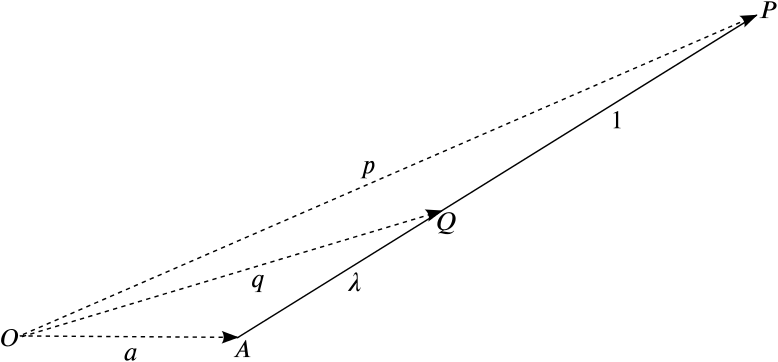
Consider the stripped down diagram of the problem.
We let the point have position vector , the vector and the (currently unknown) point the vector .
Travelling along the vector from to we follow the vector equation where .
It’s given that , so point is along the line from point .
Therefore, if we let
we will be at point
so we can then find its coordinates:
so, using the same definition of
and
from before we again find that
so again
which leads to the same conclusion.
Show that the condition for the two circles to intersect at right angles is .
The two circles intersect at right angles if and only if there is a right-angled triangle formed by the points , and one of the intersection points, which we will have labelled .
The triangle is a right-angled triangle if and only if the lengths of the sides obey Pythagoras’s theorem: as required.