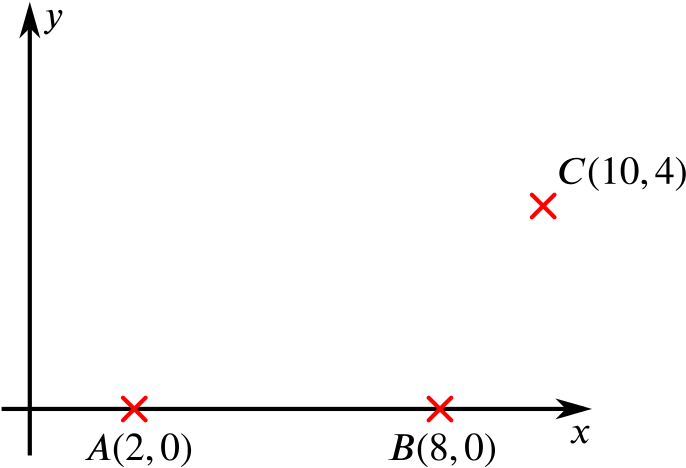
Can we find the tangents to this circle from the origin?
Question
Find the equation of the circle through the points , , and , and prove that it touches the -axis.
Without the use of tables [or calculators] or measurement, find the equation of the other tangent to this circle from the origin.
Suggestion
Might the resource Finding circles help us here?
How can we decide whether a line is tangent to a circle, or misses it completely, or cuts through it?
Solution
Find the equation of the circle through the points , , and …
Given any three points that do not lie on a straight line, there is a unique circle passing through these three points, whose centre is the circumcentre of the triangle.
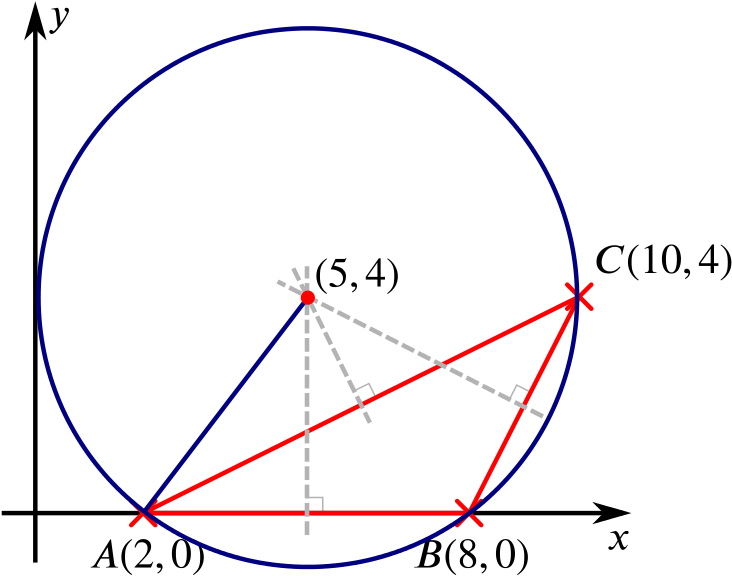
The circumcentre can be found at the intersection of the perpendicular bisectors of the three sides.
The circumcentre of
Our three points are , , and .
The line segment between and is part of the -axis, with midpoint .
So the perpendicular bisector of the side is the line .
The line segment between and has gradient and midpoint .
So the perpendicular bisector of the side is the line with gradient and passing through the point .
Substituting this information into the general equation for a line , we find that the perpendicular bisector of the side is the line .
The perpendicular bisector of side , which turns out to be the line , also goes through the circumcentre.
Substituting into , we get .
So these two perpendicular bisectors intersect at the point , making this the circumcentre.
Now we can find the radius of the circle—simply find the distance between the centre and one of the points given.
The distance between and is .
So the circle passing through these three points has centre and radius . This means that it has equation
An alternative method might argue that we know that , the centre of the circle, lies on , so let’s say is .
We also know that ; this equation enables us to find , and the rest follows.
… and prove that it touches the -axis.
The centre is at (5,4) and the radius is 5, so the circle must touch the y-axis.
Any line passing through the origin that is not the -axis must have equation for some real number .
We want to find an such that and intersect at exactly one point.
Substituting
into
and expanding, we get a quadratic equation in
:
For to be a tangent to the circle, this quadratic equation must have only one root, that is, its discriminant must be zero.
The discriminant of the quadratic equation is .
The equation has a repeated root if, and only if, the discriminant is zero.
Now
So is the equation of this tangent.
Note that in general we would expect to have two solutions for from .
When the origin is outside the circle, there are exactly two tangents to the circle from .
Here, however, one of our tangents is the -axis, that has infinite gradient.
We could see the equation as having one solution for that is infinite.