Finding the Optimal Solution (Edexcel IAL Maths)
Objective Line
Spec point —
5.2
What is the objective line?
-
The objective function (for an LP problem with two decision variables) is of the form
-
Rearranged, this is of the form ''
-
So for a particular value of , there is a straight line graph
- This is the objective line
-
How does an objective line indicate where the optimal solution is?
-
In a linear programming problem, is usually unknown
- It is the quantity that is to be maximised or minimised
-
In maximisation problems, increasing the value of
- 'moves' the objective line away from the origin
- and towards the upper boundaries of the feasible region
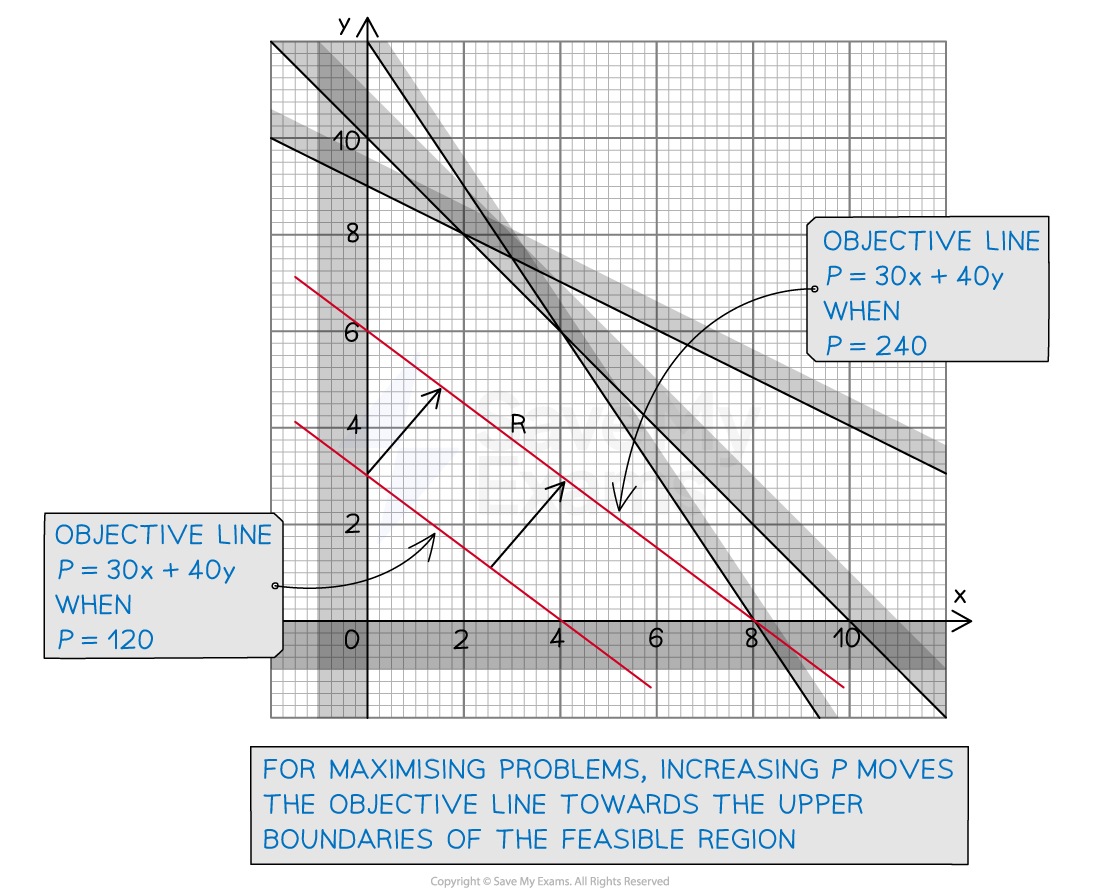
-
In minimisation problems, decreasing the value of
- 'moves' the objective line closer to the origin
- and towards the lower boundaries of the feasible region
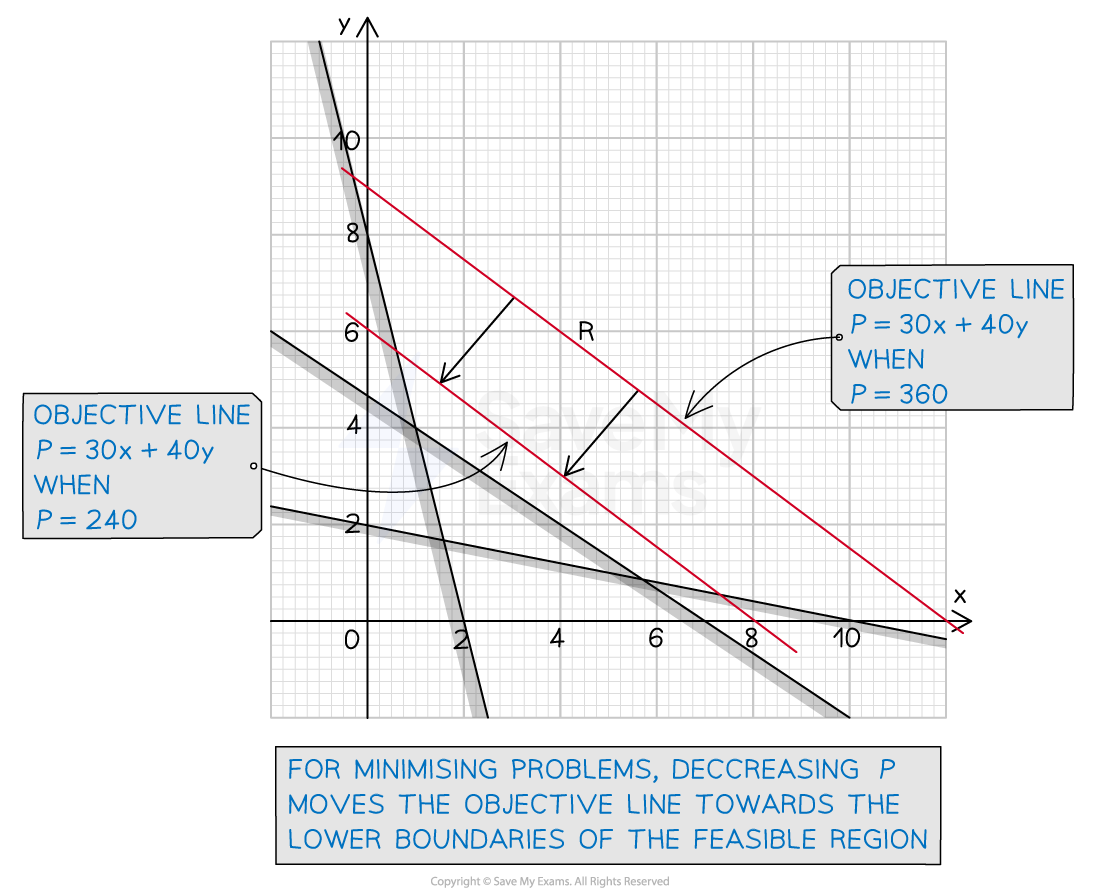
-
Therefore, the optimal solution to a linear programming problem occurs
- when an objective line passes through a vertex of the feasible region
-
The vertex at which this occurs will depend on the gradient of the objective line
How do I find the optimal solution to a linear programming problem using an objective line?
-
Whether maximising or minimising, for the objective function
-
Choose a value of that is a multiple of and
-
Plot the objective line
- This is usually easiest by considering the two points where and where
-
Using your ruler, keep it parallel to the objective line just drawn
- Move it away from the origin for a maximisation problem
- Move it towards the origin for a minimisation problem
-
The last vertex of the feasible region that your ruler passes through will be the optimal solution to the problem
-
Exam Hint
- To show your working (and understanding) draw an objective line each time your ruler passes through a vertex of the feasible region
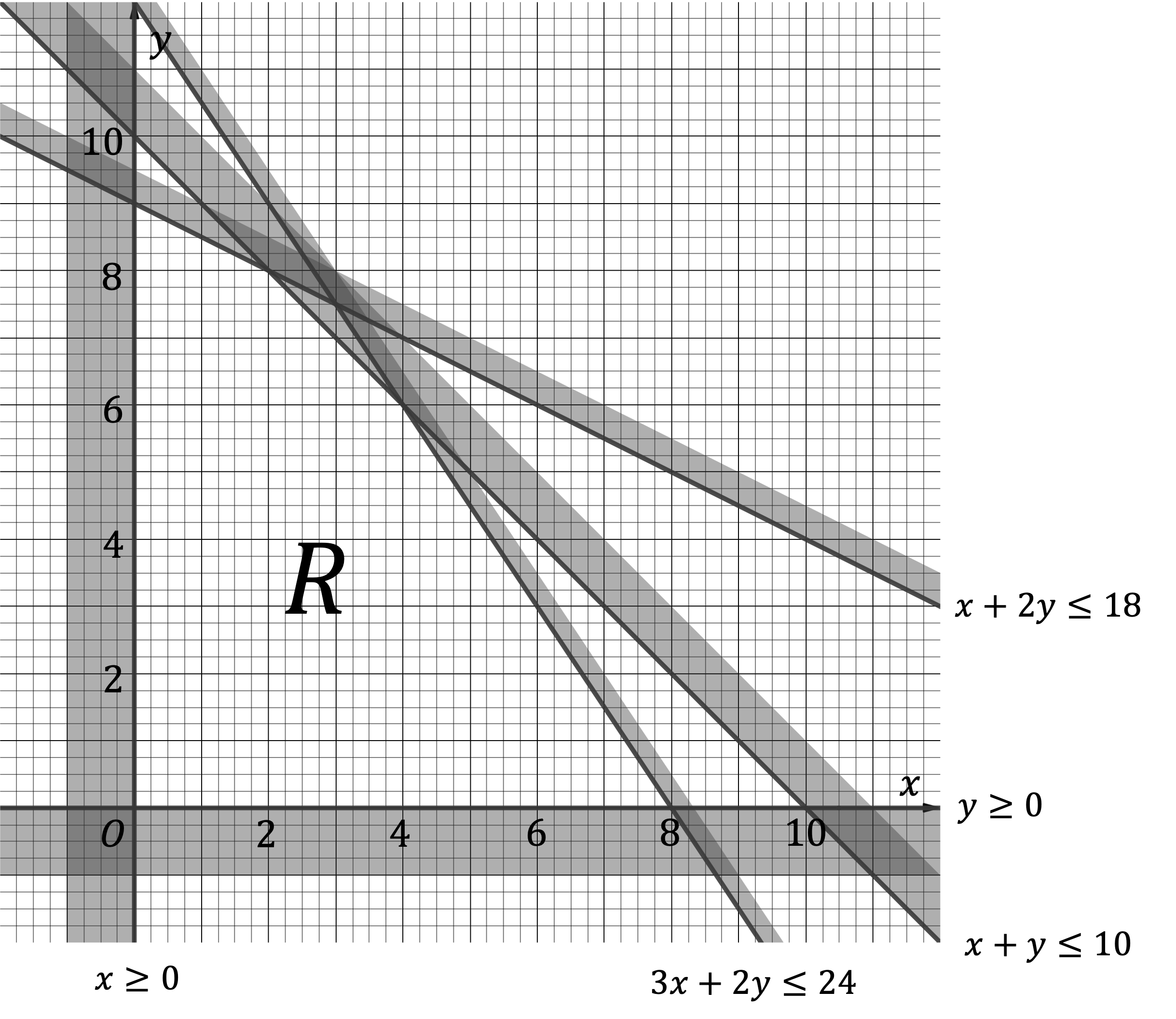
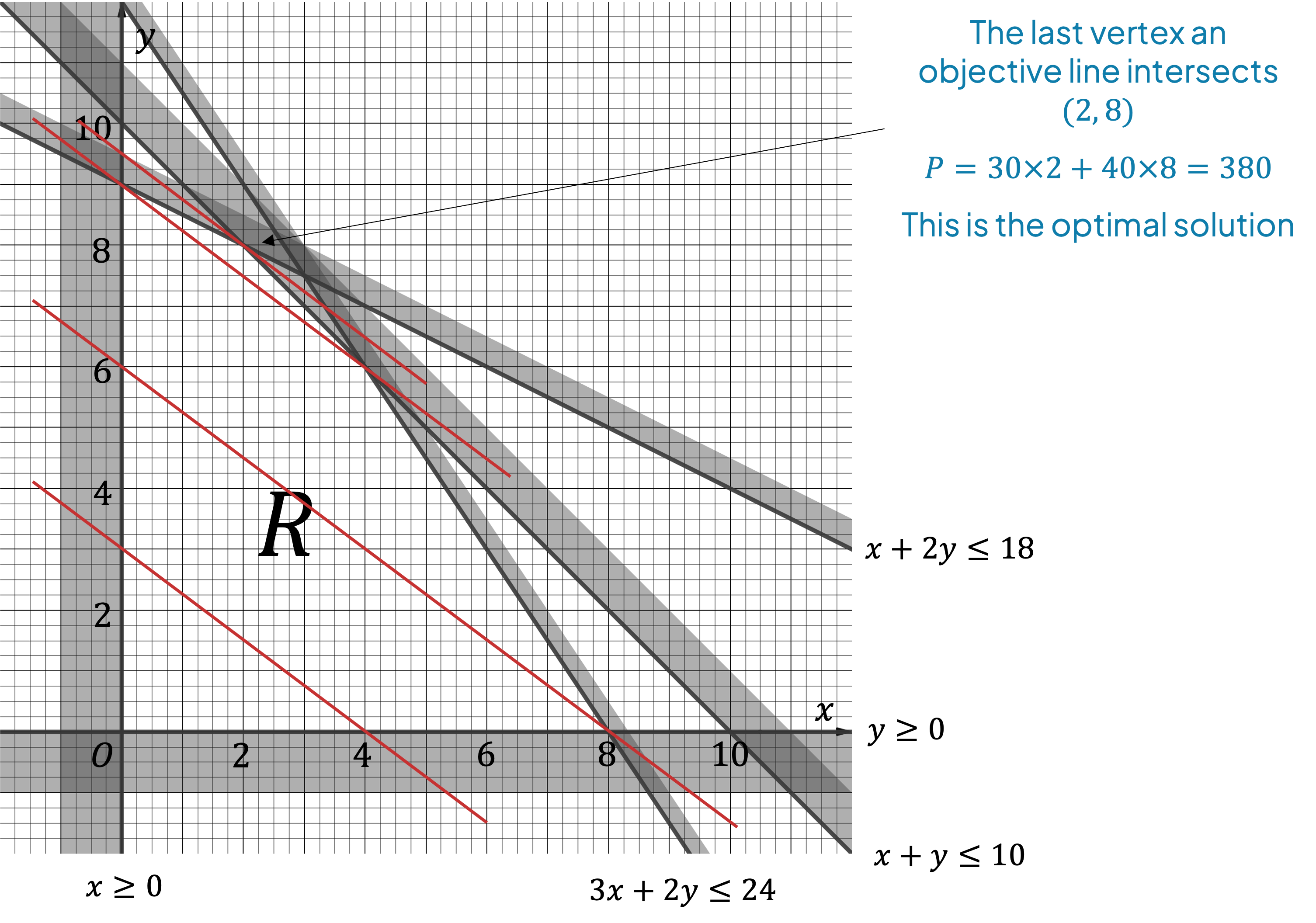
Worked Example The constraints of a linear programming problem and the feasible region (labelled ) are shown in the graph below.
The objective function, is to be maximised.
Showing your method clearly, use the objective line method to determine the optimal solution to the problem.
Answer:
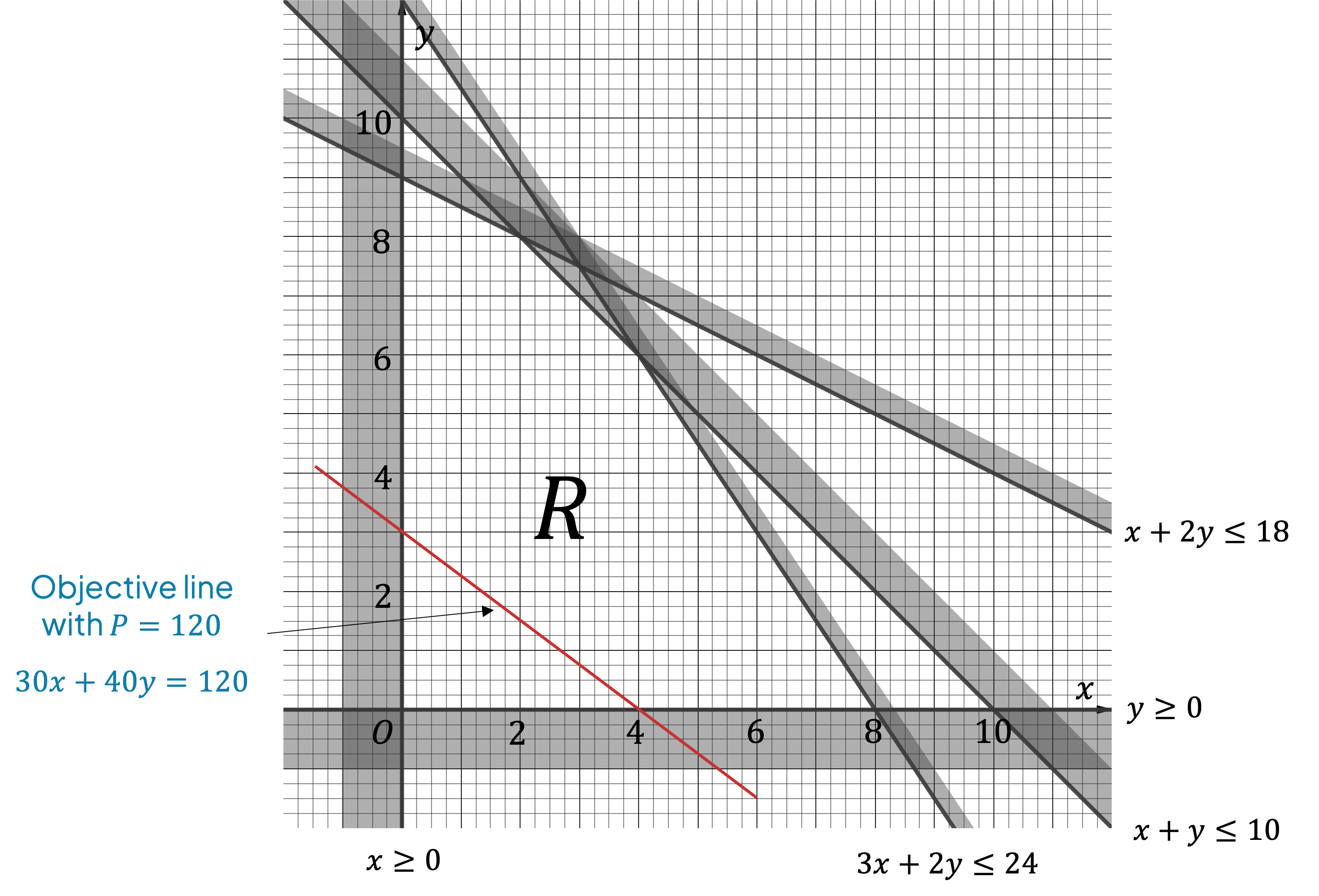
To get started, choose a value of that is both a multiple of 30 and 40, e.g. 120 Now plot the objective line with equation Rearrange if you prefer, but by choosing a multiple of 30 and 40, it is easy to see this line will pass through the points (0, 3) and (4, 0)
After plotting an initial line, slide your ruler parallel and 'up' the graph away from the origin (maximising problem) Draw an objective line when your ruler passes through a vertex of the feasible region - (8, 0), (4, 6) and (2, 8)
The optimal solution is the last vertex the objective line passes through - which in this case is (2, 8)
Final answer: The optimal solution isandis maximised at
Vertex Method
Spec point —
5.2
What is the vertex method?
-
The vertex method is a way to find the optimal solution to a linear programming problem
-
The optimal solution to a linear programming problem lies on a vertex of the feasible region
-
By finding the coordinates of these vertices, the decision variables values can be deduced
-
The maximum or minimum objective function can be determined
- by substituting each of these sets of decision variables into the objective function
How do I find the optimal solution from the vertex method?
-
STEP 1 Find the coordinates of each vertex of the feasible region
-
If the plot of the region is accurate, these may be able to be read directly from the graph
-
On less accurate diagrams, some vertices may be obvious
- such as the origin or any vertices along an axis
-
Otherwise find the vertices by solving each pair of the inequalities as simultaneous equations
- E.g. For the inequalities and
- Solve the simultaneous equations and
-
-
STEP 2 Substitute the coordinates of each vertex into the objective function and evaluate it
-
STEP 3 Determine which set of decision variables lead to the maximum or minimum objective function as required by the problem
- This will be the optimal solution
Exam Hint
In maximising problems where the origin is a vertex of the feasible region
It is usually obvious that the origin will not be the optimal solution
- It is still a vertex of the feasible region however, so should be included in your list of vertices
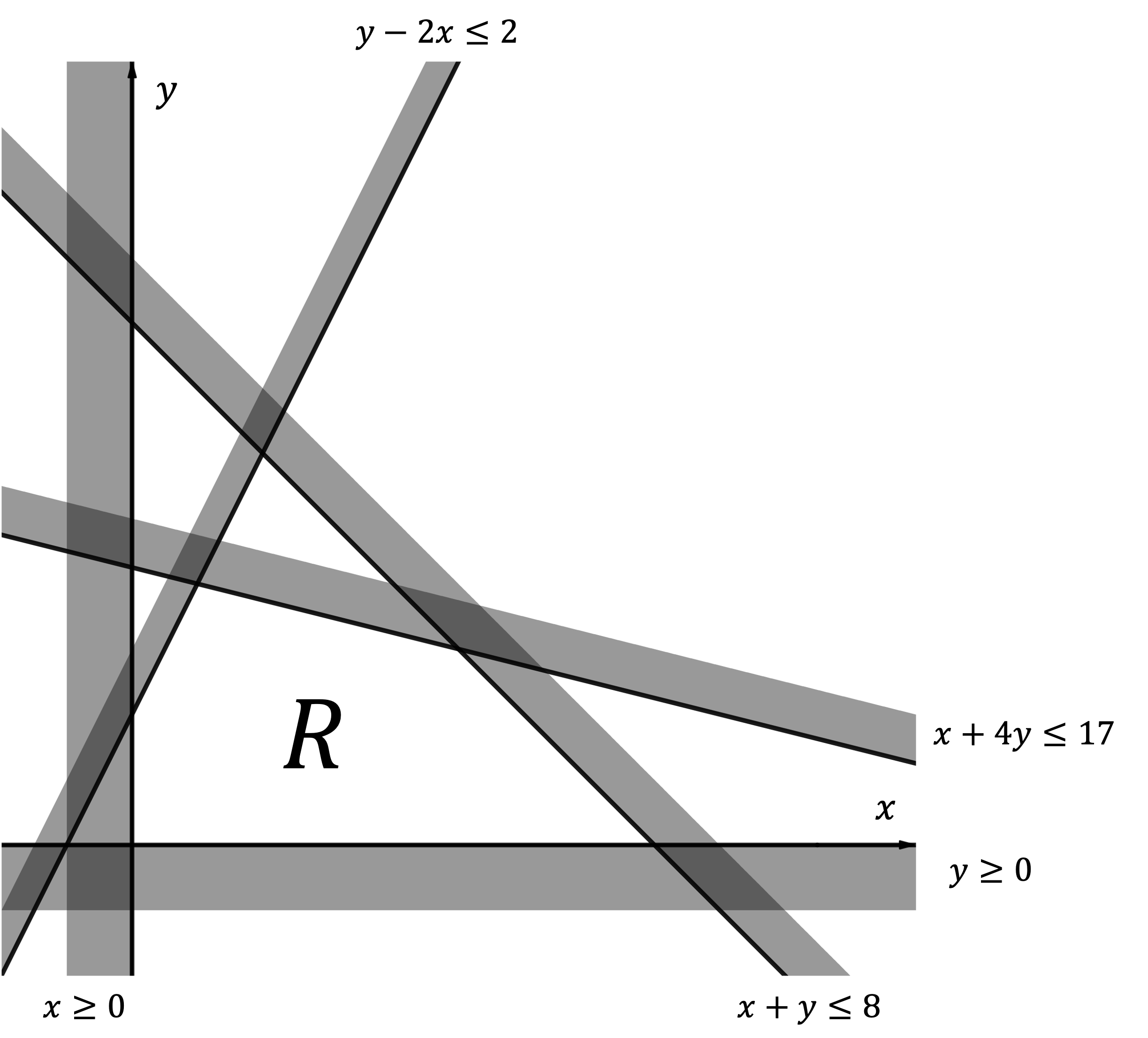
Worked Example The graph below shows the feasible region, labelled , of a linear programming problem where the objective function is to maximise subject to the constraints shown on the graph.
Use the vertex method to solve the linear programming problem.
Answer:
- STEP 1 Find the coordinates of each vertex of the feasible region Three of them should be obvious to spot!
For the two vertices that are not obvious, solve the appropriate simultaneous equations (Your calculator may have a simultaneous equation solver that you can use)
bold italic y bold minus bold 2 bold italic x bold equals bold 2 bold comma bold space bold italic x bold plus bold 4 bold italic y bold equals bold 17 y equals 2 plus 2 x 9 x equals 9
- STEP 2 Find for each pair of and values Writing them out in a table can help keep track and make the optimal solution stand out
0 0 0 0 2 5 × 2 = 10 8 0 2 × 8 = 16 1 4 2 × 1 + 5 × 4 = 22 5 3 2 × 5 + 5 × 3 = 25
- STEP 3 The maximum value is 25, which occurs when and
Final answer: The optimal solution isgiving a maximum value of
Was this revision note helpful?
Build on this topic