Planning Reaction Schemes (Edexcel IAL Chemistry)
Reaction Schemes
Spec point —
20.3
-
A large number of organic products are made from a few starting compounds using appropriate reagents and conditions
-
Knowing how organic functional groups are related to each other is key to the synthesis of a given molecule
-
The main functional groups you need to know are
- Alkanes
- Alkenes
- Haloalkanes
- Nitriles
- Amines
- Alcohols
- Carbonyls (aldehydes & ketones)
- Hydroxynitriles
- Carboxylic acids
- Esters
- Acyl chlorides
- Primary and secondary amides
Aliphatic Reaction Pathways
- The key interconversions between functional groups are summarised here:
Aliphatic Reactions Table
| Reactant | Product | Reagents | Reaction |
|---|---|---|---|
| Alkene | Haloalkane | X2 / HX | Electrophilic addition |
| Alkene | Alcohol | Steam + H2SO4 / heat | Hydration |
| Alkene | Alkane | Hydrogen + Ni catalyst / 150 oC | Electrophilic addition / hydrogenation |
| Alcohol | Alkene | Al2O3 or conc. H2SO4 / heat | Elimination / dehydration |
| Alcohol | Haloalkane | NaX + H2SO4 / reflux | Nucleophilic substitution |
| Haloalkane | Alcohol | NaOH (aq) / reflux | Nucleophilic substitution |
| Alkane | Haloalkane | Halogen / UV light | Free radical substitution |
| Primary alcohol | Aldehyde | K2Cr2O7 / H2SO4 / distil | Oxidation |
| Secondary alcohol | Ketone | K2Cr2O7 / H2SO4 / Heat | Oxidation |
| Primary alcohol | Carboxylic acid | K2Cr2O7 / H2SO4 / reflux | Oxidation |
| Aldehyde | Primary alcohol | NaBH4 / H2O | Reduction / nucleophilic addition |
| Ketone | Secondary alcohol | NaBH4 / H2O | Reduction / nucleophilic addition |
| Haloalkane | Nitrile | Aqueous ethanolic KCN / Heat | Nucleophilic substitution |
| Halogenoalkane | Amine | NH3 / ethanol | Nucleophilic substitution |
| Nitrile | Carboxylic acid | H2O / HCl | Hydrolysis |
| Aldehyde | Hydroxynitrile | NaCN / H+ | Nuclophilic addition |
| Alcohol | Ester | Carboxylic acid / H2SO4 | Esterification |
| Carboxylic acid | Ester | Alcohol / H2SO4 | Esterification |
| Ester | Carboxylate salt and alcohol | NaOH (aq) | Alkaline hydrolysis |
| Ester | Carboxylic acid | Dilute acid | Acid hydrolysis |
| Carboxylic acid | Acyl chloride | SOCl2 | Chlorination |
| Acyl chloride | Carboxylic acid | H2O | Hydrolysis |
| Acyl chloride | Primary amide | NH3 | Nucleophilic addition elimination |
| Acyl chloride | Secondary amide | Primary amine | Nucleophilic addition elimination |
Aromatic Reaction Pathways
- The key aromatic reactions are summarised here:
Aromatic Reactions Table
| Reactant | Product | Reagents | Reaction |
|---|---|---|---|
| Benzene | Methylbenzene / toluene | CH3Cl / AlCl3 | Alkylation / Electrophilic substitution |
| Benzene | Bromobenzene | Br2 / FeBr3 | Bromination / Electrophilic substitution |
| Benzene | Chlorobenzene | Cl2 / AlCl3 | Chlorination / Electrophilic substitution |
| Benzene | Nitrobenzene | HNO3 / H2SO4 | Nitration / Electrophilic substitution |
| Nitrobenzene | Aminobenzene / phenylamine / aniline | Sn / HCl | Reduction |
| Aminobenzene | 2,4,6-tribromoaminobenzene / 2,4,6-tribromoaniline | Bromine | Electrophilic substitution |
| Benzene | Phenylethanone | CH3COCl / AlCl3 | Acylation / Electrophilic substitution |
| Phenylethanone | 1-phenylethanol | NaBH4 | Reduction |
Designing a Reaction Pathway
-
The given molecule is usually called the target molecule and chemists try to design a synthesis as efficiently as possible
-
Designing a reaction pathway starts by drawing the structures of the target molecule and the starting molecule
-
Determine if they have the same number of carbon atoms
- If you need to lengthen the carbon chain you will need to put on a nitrile group by nucleophilic substitution
-
Work out all the compounds that can be made from the starting molecule and all the molecules that can be made into the target molecule
- Match the groups they have in common and work out the reagents and conditions needed
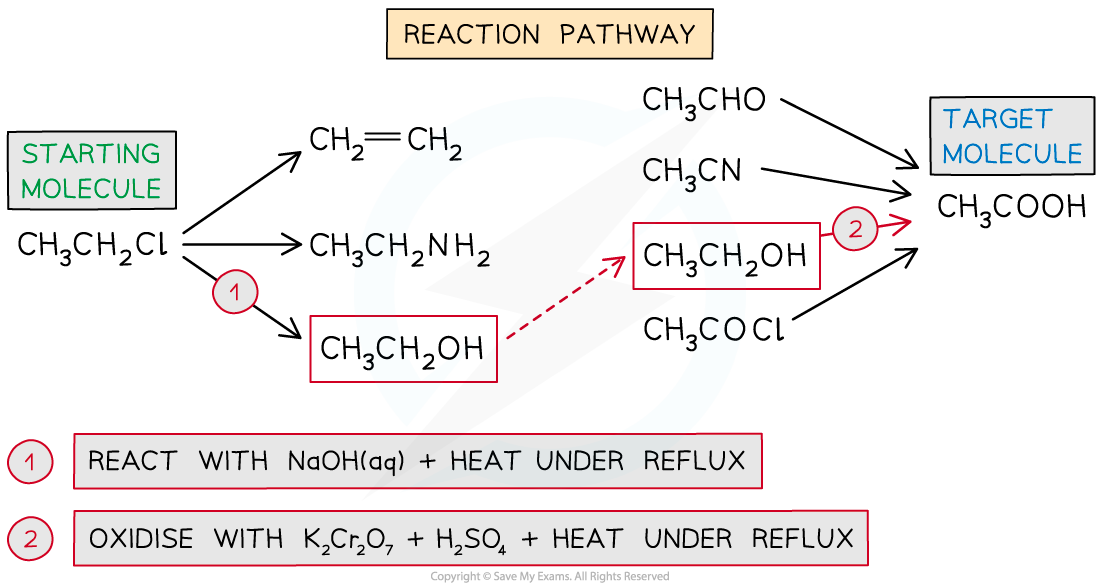
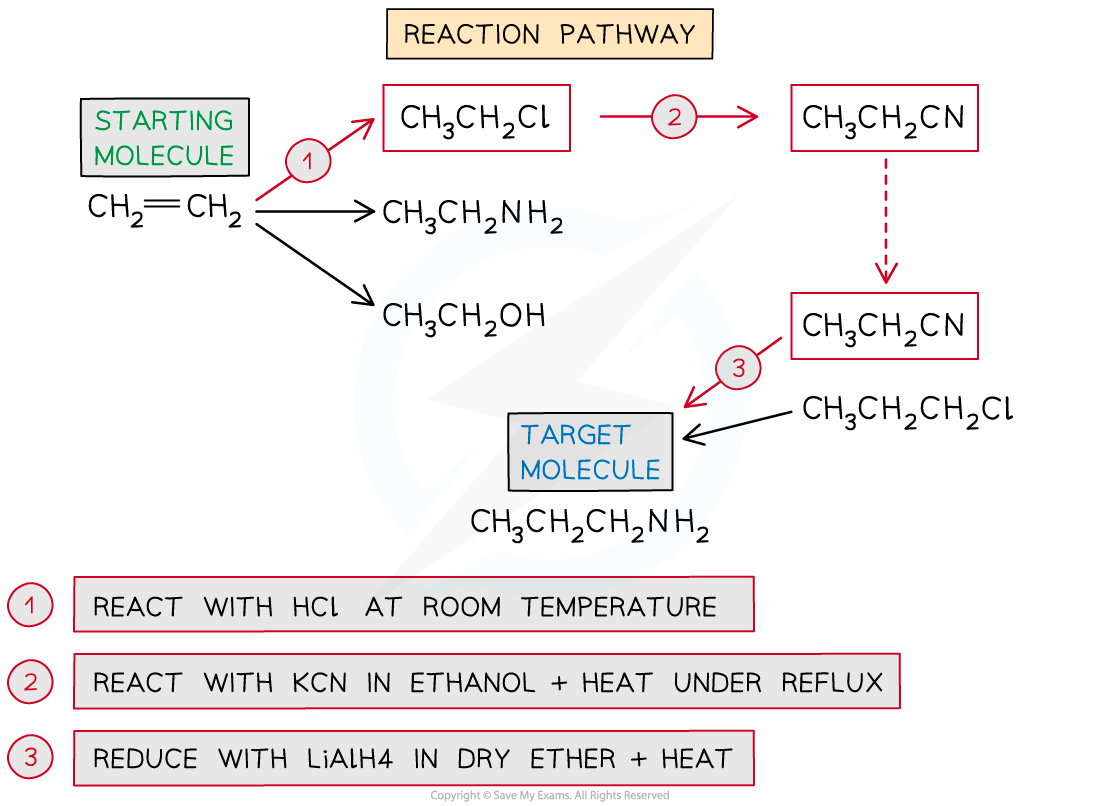
Worked Example Suggest how the following syntheses could be carried out:
a) Chloroethane to ethanoic acid
b) Ethene to 1-aminopropane
Answer 1
Answer 2
Exam Hint You could be required to design a synthesis with up to four steps
Part of this process can include identifying appropriate control measures to reduce risk, based on data about hazards
Was this revision note helpful?
Build on this topic