Electrochemical Cells (Edexcel IAL Chemistry)
Core Practical 12: Investigating Electrochemical Cells
Spec point —
16.6
Measuring the EMF of a cell
-
To measure a cell EMF you will need
- Two small beakers, around 75 cm3 capacity
- Strips of suitable metals such as copper, zinc, iron and silver
- 1.0 mol dm-3 solutions of the metal ions (nitrates, chlorides or sulfates depending on their solubility)
- A high resistance voltmeter (usually a digital multimeter has this)
- Two sets of wires with crocodile clips
- A salt bridge consisting of a strip of filter paper soaked in saturated potassium nitrate
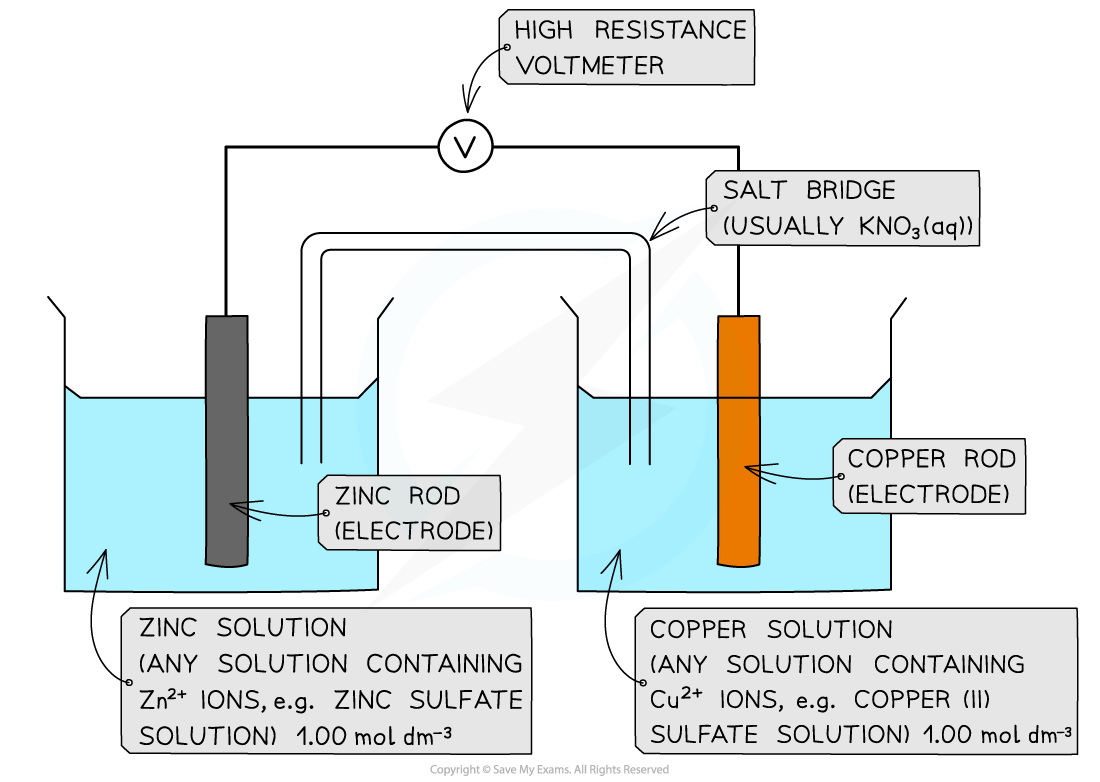
The experimental set up for measuring the EMF of a cell made of two metal / metal ion half cells
The procedure
-
The strips of metals need to be freshly cleaned to remove any oxide coatings
- This can be done with a piece of sandpaper
-
To support the metals, it is easiest to have long strips that can be folded over the side of the beaker and held in place with the crocodile clips
-
Fill up the beakers to about two thirds of the way with the metal ion solutions
-
Using tongs, dip a strip of filter paper into a beaker of saturated potassium nitrate solution and then place it between the two beakers making sure the ends of the strip are well immersed in the solutions
-
Connect the crocodile clips to the voltmeter, wait for a steady reading and record the measurement
Practical tips
- If you don't get a positive reading on the voltmeter swap the terminals around
- Voltmeters will have marked positive and negative terminals (usually in red and black, respectively), so when you get a positive reading this tells you the relative polarity of the metals in the cell
- Change the salt bridge each time, to prevent cross contamination of ions between half cells
Calculating the Theoretical EMF of a Cell
-
The voltage you measure in your experiment can be compared to a theoretical value calculated using standard electrode potentials (E°)
- These values are found in the electrochemical series in your data book.
-
The EMF of a cell is the difference between the E° values of the two half-cells
-
The formula is:
E°(cell) = E°(positive electrode) - E°(negative electrode)
- A simple way to remember this is "most positive E° value minus most negative E° value
Worked Example Calculate the theoretical EMF for a cell made of zinc and iron.
Find the E° values from a data book:
- Fe²⁺(aq) + 2e⁻ ⇌ Fe(s) has an E° = -0.44 V
- Zn²⁺(aq) + 2e⁻ ⇌ Zn(s) has an E° = -0.76 V
Identify the positive and negative electrodes:
The half-cell with the more positive (less negative) E° value will be the positive electrode
- In this case, that is the Fe²⁺/Fe half-cell.
The half-cell with the more negative E° value will be the negative electrode
- This is the Zn²⁺/Zn half-cell.
Apply the formula:
- E°(cell) = E°(positive) - E°(negative)
- E°(cell) = (-0.44) - (-0.76)
- E°(cell) = +0.32 V
This calculation is how the theoretical values in the specimen results table are determined.
Specimen Results
- Here is a set of typical results for this experiment:
| Negative electrode | Positive electrode | EMF / V |
|---|---|---|
| Zn (s) / Zn2+ (aq) | Cu2+ (aq) / Cu (s) | 1.10 |
| Zn (s) / Zn2+ (aq) | Fe2+ (aq) / Fe (s) | 0.32 |
| Fe (s) / Fe2+ (aq) | Cu2+ (aq) / Cu (s) | 0.78 |
| Zn (s) / Zn2+ (aq) | Ag+ (aq) / Ag (s) | 1.56 |
| Cu (s) / Cu2+ (aq) | Ag+ (aq) / Ag (s) | 0.46 |
Analysis
-
It is unlikely you will get very close to the theoretical results as these would be obtained under standard conditions(1.0 mol dm-3 concentration, 298 K temperature)
- This is because these conditions are hard to achieve in a school laboratory
-
However, the relative EMF of cells you construct should match the theoretical values
-
The higher the EMF, the larger the difference in reactivity ('electron pushing power') between the metals
Was this revision note helpful?
Build on this topic