Chirality in Optical Isomers (Edexcel IAL Chemistry)
Exam board Pearson Edexcel · IALUpdated 2026-07-02
Spec point —
15.1
Chirality in Optical Isomers
Optical isomers
-
A carbon atom that has four different atoms or groups of atoms attached to it is called a chiral carbon or chiral centre
- Chira comes from a Greek word meaning hand, so we talk about these molecules having a handedness
-
The carbon atom is described as being asymmetric, i.e. there is no plane of symmetry in the molecule
-
Compounds with one chiral centre (chiral molecules) exist as two optical isomers, also known as enantiomers
-
Just like the left hand cannot be superimposed on the right hand, enantiomers are non-superimposable
- Enantiomers are mirror images of each other
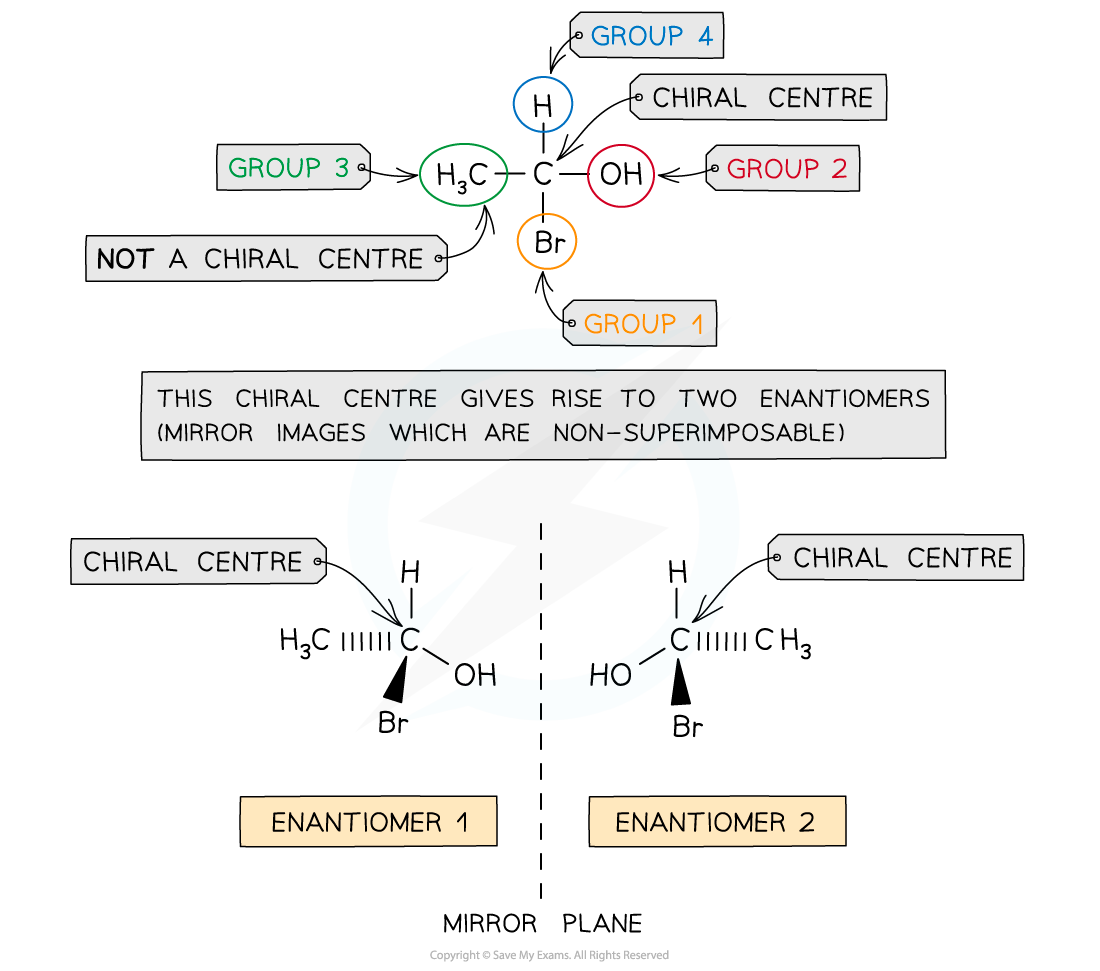
A molecule has a chiral centre when the carbon atom is bonded to four different atoms or group of atoms; this gives rises to enantiomers
- You always obtain two optical isomers from one chiral centre
- Where a molecule has two chiral centres, then there are two pairs of optical isomers
- The isomers will only differ in two characteristics; how they interact with plane polarised light and how they react with other chiral molecules
- If a molecule has three chiral centres there will be eight stereoisomers
- This means the relationship is: number of isomers = 2n where n= the number of chiral centres
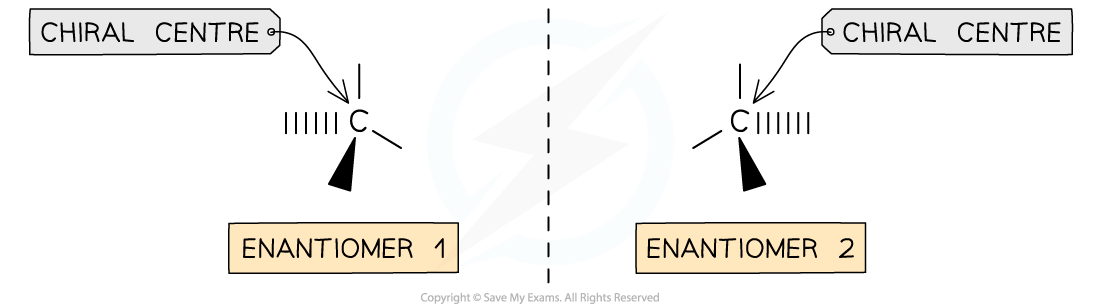
Exam Hint When drawing optical isomers, always draw mirror images including wedge and dashed bonds
Was this revision note helpful?