Reaction Feasibility (Edexcel IAL Chemistry)
Spec point —
12.9
Reaction Feasibility
Summary
-
For ΔStotal* *to be positive and therefore the reaction feasible:
- Both ΔSsystem* and ΔS*surroundings* *are positive
- ΔSsurroundings is positive and ΔSsystem is negative, but ΔSsurroundings > ΔSsystem
- ΔSsurroundings is negative and ΔSsystem is positive, but ΔSsurroundings < ΔSsystem
Feasibility
-
Generally, entropy will increase in the order:
-
solid < liquid < gas
-
Therefore we can determine the change in entropy and the feasibility by considering the change in state of reactants to products
-
Example 1: the reaction between magnesium and oxygen at 293 K is feasible
Mg (s) + O2(g) → MgO (s)
-
This reaction produces a solid from a solid and a gas. Therefore entropy of the system is negative (ΔSsystem < ΔSsurroundings)
-
But since the entropy of the surroundings is very large as this reaction is very exothermic
-
This outweighs the entropy of the system, so the total entropy is positive therefore the reaction is spontaneous
-
Example 2: the reaction between ethanoic acid and ammonium carbonate
2CH3COOH (aq) + (NH4)2CO3 (s) → 2CH3COONH4 (aq) + H2O (l) + CO2 (g)
- This reaction is endothermic, therefore ΔSsurroundings* *is negative
- However, a gas is produced from a solid and liquid, so ΔSsystem is positive
- ΔSsystem > ΔSsurroundings and the reaction is spontaneous
Gibbs free energy
-
We can also use Gibbs free energy to work out if a reaction is feasible or not (this is not required as a part of the course)
-
The feasibility of a reaction is determined by two factors
- The enthalpy and entropy change
-
The two factors come together in a fundamental thermodynamic concept called the Gibbs free energy (G)
-
The Gibbs equation is:
ΔG ꝋ = ΔHreactionꝋ – TΔSsystemꝋ
-
The units of ΔGꝋ are in kJ mol–1
- The units of ΔHreactionꝋare in kJ mol–1
- The units of T are in K
- The units of ΔSsystemꝋ are in J K-1****mol–1(and must therefore be converted to kJ K–1 mol–1by dividing by 1000)
-
For a reaction to be feasible, ΔGꝋ must be equal or less than zero
Temperature & feasibility
- We can look at the the values for ΔH and ΔS to determine whether the reaction is spontaneous / feasible at a given temperature (T)
- The Gibbs equation can explain what will affect the spontaneity / feasibility of a reaction for exothermic and endothermic reactions
Exothermic reactions
-
In exothermic reactions, ΔHreactionꝋ is negative
-
If the ΔSsystemꝋ is positive:

- Both the first and second term will be negative
- Resulting in a negative ΔGꝋ so the reaction is feasible
- Therefore, regardless of the temperature, an exothermic reaction with a positive ΔSsystemꝋ will always be feasible
-
If the ΔSsystemꝋ is negative:
- The first term is negative and the second term is positive
- At very high temperatures, the –TΔSsystemꝋ will be very large and positive and will overcome ΔHreactionꝋ
- Therefore, at high temperatures ΔGꝋ is positive and the reaction is not feasible
-
Since the relative size of an entropy change is much smaller than an enthalpy change, it is unlikely that TΔS > ΔH as temperature increases
-
These reactions are therefore usually spontaneous at normal conditions
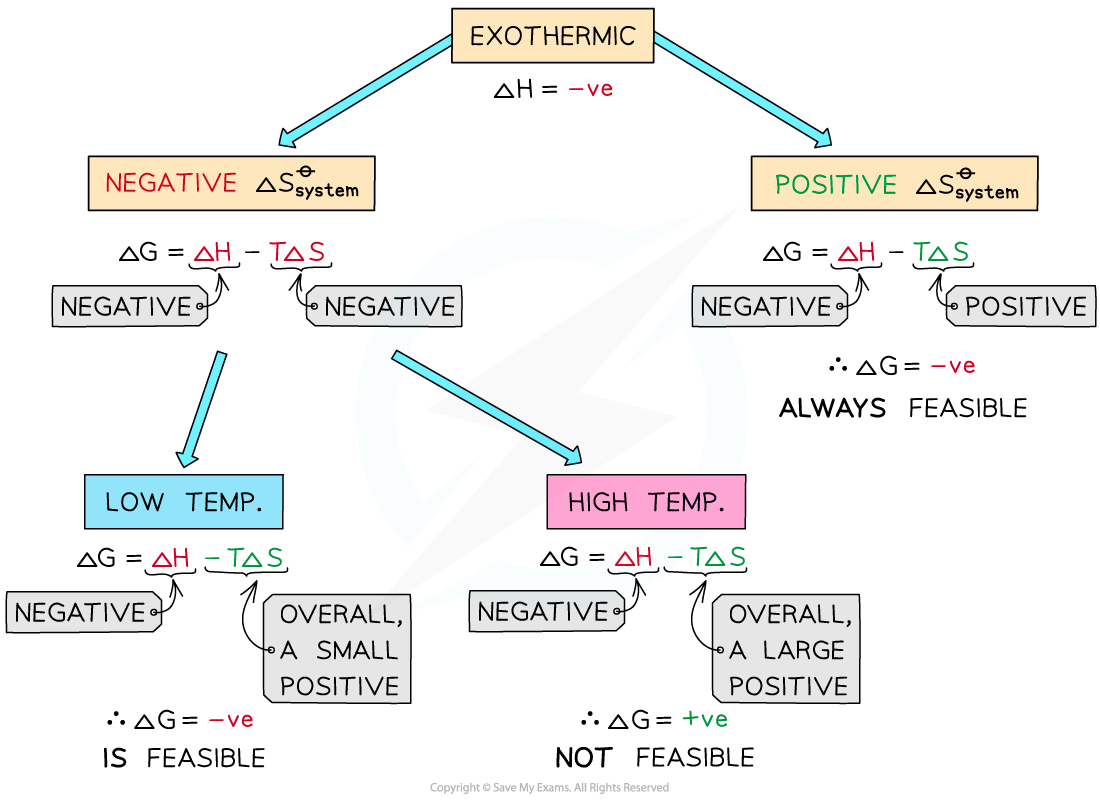
The diagram shows under which conditions exothermic reactions are feasible
Endothermic reactions
-
In endothermic reactions, ΔHreactionꝋ is positive
-
If the ΔSsystemꝋ is negative:
- Both the first and second term will be positive
- Resulting in a positive ΔGꝋ so the reaction is not feasible
- Therefore, regardless of the temperature, endothermic with a negative ΔSsystemꝋ will never be feasible
-
If the ΔSsystemꝋ is positive:
- The first term is positive and the second term is negative
- At low temperatures, the –TΔSsystemꝋ will be small and negative and will not overcome the larger ΔHreactionꝋ
- Therefore, at low temperatures ΔGꝋ is positive and the reaction is not feasible
- The reaction is more feasible at high temperatures as the second term will become negative enough to overcome the ΔHreactionꝋ resulting in a negative ΔGꝋ
-
This tells us that for certain reactions which are not feasible at room temperature, they can become feasible at higher temperatures
- An example of this is found in metal extractions, such as the extraction if iron in the blast furnace, which will be unsuccessful at low temperatures but can occur at higher temperatures (~1500 oC in the case of iron)
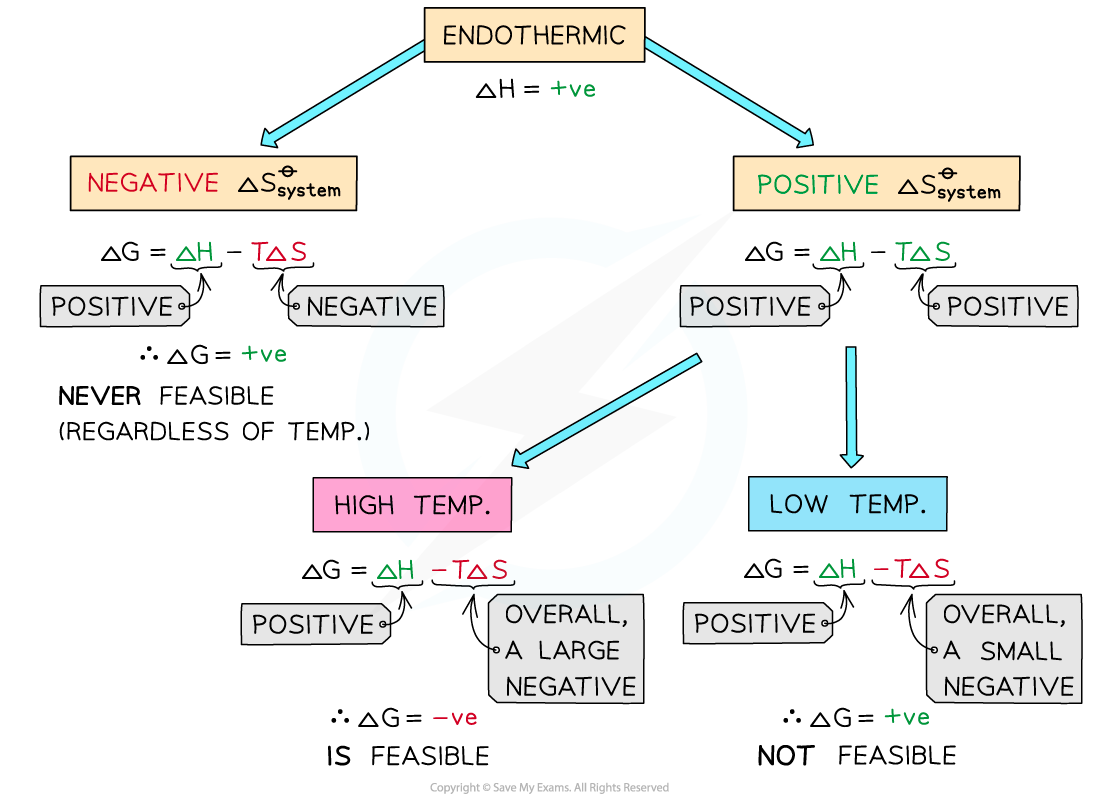
The diagram shows under which conditions endothermic reactions are feasible
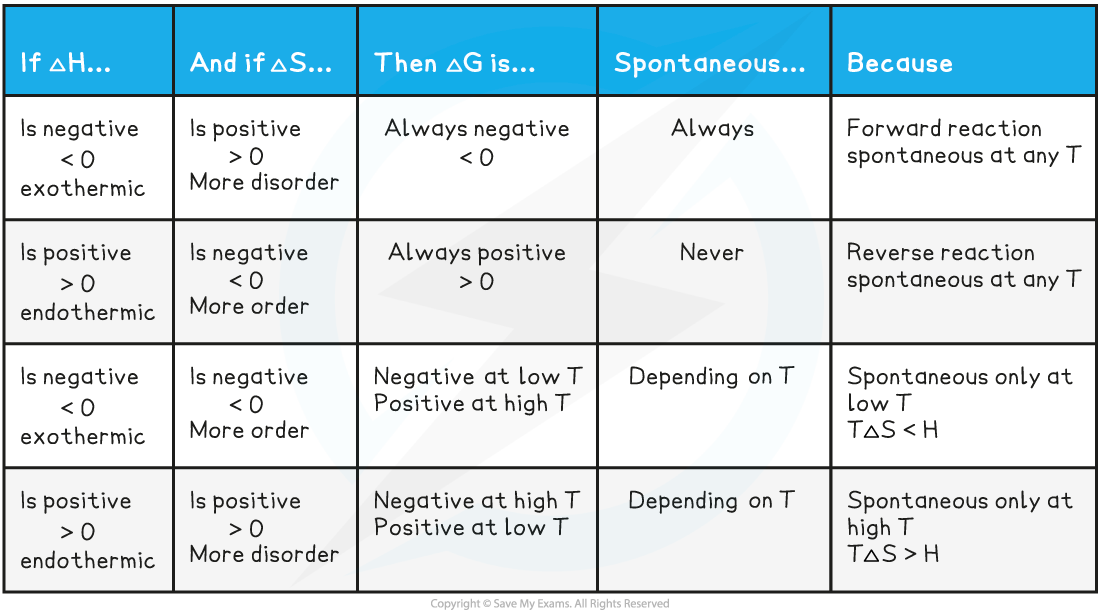
Summary of factors affecting Gibbs free energy
Worked Example The reaction between aluminium oxide and carbon is not feasible at room temperature.
Al2O3 + 3C(s) → 2Al(s) + 3CO2 (g)
Given that ΔH = +1336 kJmol-1 and ΔS= +581 JK-1mol-1 , calculate the temperature at which the reaction becomes feasible.
Answer
- As both ΔH and ΔS are positive, ΔG will become negative if TΔS > ΔH.
- The temperature at which this reaction becomes spontaneous can be calculated. This will be when ΔG = 0.
- If ΔG = 0, then T = ΔH / Δ*S
- T =
- T = 2299 K
*Don't forget to convert this into kJ
Thermodynamic & Kinetic Stability
Spec point —
12.11
Thermodynamic Stability
-
Refers to whether a reaction is feasible under given conditions
-
A reaction is thermodynamically feasible if the Gibbs free energy change (ΔG) is negative ΔG = ΔH−TΔS
-
This means:
- Reactions are more likely to be feasible if enthalpy change (ΔH ) is negative (exothermic)
- Or if entropy change (ΔS ) is positive (increase in disorder)
-
Thermodynamic feasibility does not necessarily mean the reaction will happen quickly
Kinetic Stability
-
Refers to how fast a reaction occurs (i.e. the rate of reaction)
-
Depends on the activation energy (Eₐ):
- Reactions with a high Eₐ are kinetically stable and may not occur at room temperature
-
Even if a reaction is thermodynamically feasible, it might not happen without enough energy to overcome the activation barrier
Examples
-
Combustion of methane, CH4
- Thermodynamically feasible but kinetically stable
- Methane (CH4) will not spontaneously form CO2 and H2O unless ignited (Eₐ is high)
-
Decomposition of hydrogen peroxide at 298 K
-
This reaction is thermodynamically feasible:
H2O2(l) → H2O (l) + ½O2(g)
- The activation energy, Ea, is high, so a catalyst must be used (MnO2)
- If the reaction was left for long enough, the hydrogen peroxide would eventually decompose, however the addition of the MnO2 allows the reaction to take place via an alternative route with a lower Ea
Was this revision note helpful?
Build on this topic