Reaction Mechanisms: Introduction (Edexcel IAL Chemistry)
Reaction Mechanisms - Introduction
Spec point —
10.2
-
Reaction equations tell you about the amount of reactants and products, including their stoichiometry, in a reaction
-
Reaction mechanisms tell you about how the reaction actually takes place
-
In a reaction mechanism, curly arrows show the movement of electrons
-
Curly arrows can be single headed, sometimes called fish-hook arrows or half curly arrows, to show the movement of one electron which can occur when:
- A covalent bond undergoes homolytic fission to form two radicals
- Two radicals terminate forming a covalent bond in the process
- A radical and a covalent compound propagate as part of a reaction, as shown:
-
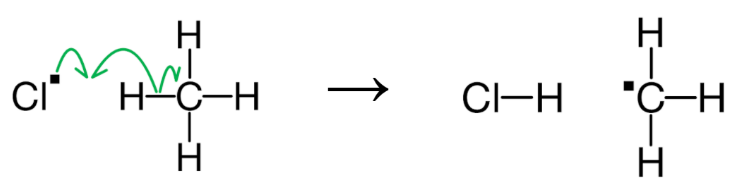
During this propagation step, the unpaired electron from chlorine and one of the electrons from the C-H bond react together to form a new covalent bond and the other electron from the C-H bond moves to form a methyl radical
Exam Hint The use of single headed arrows is not required knowledge Their main use is in free radical reactions which are usually represented using written equations rather than outlined mechanisms
-
Curly arrows can be double headed to show the movement of a pair of electrons, which can occur when:
- A covalent bond undergoes fission to form a positive and a negative ion
- The positive ion is electron deficient and is an electrophile
- The negative ion is electron rich and is a nucleophile
- A lone pair of electrons attacks a positive or δ+ centre and forms a new covalent bond, as shown:
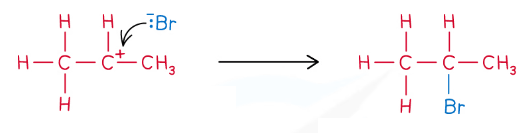
During this step of an addition reaction, the lone pair from the bromide ion reacts with the positive carbocation to form a new covalent bond
-
Curly arrows are a feature of three main types of reaction:
- Addition reactions - where two reactants combine to form one product, e.g. ethene and bromine undergoing addition to form 1,2-dibromoethane
- Substitution reactions - where an atom or group of atoms in a compounds is replaced by another atom or group of atoms, e.g. bromoethane reacting with the hydroxide ion to form ethanol and the bromide ion
- Elimination reactions - where a small molecule is removed from a larger molecule, e.g. ethanol reacting with an acid catalyst to form ethene alongside a small molecule of water which is eliminated
Bond Polarity & Mechanisms
Spec point —
10.5
- Bond polarity can be used to suggest reaction mechanisms
C2H6 + Cl2 → C2H5Cl + HCl
-
A hydrogen atom in ethane is substituted by a chlorine atom
- All of the bonds in the reaction of ethane with chlorine are either non-polar or only slightly polar
- This suggests that the type of bond breaking will be homolytic fission
- The reaction is likely to involve free radicals
- Therefore, the reaction mechanism is likely to be free radical substitution
C2H4 + HBr → C2H5Br
-
The hydrogen bromide is added to the ethene molecule
- The hydrogen bromide molecule contains a polar bond
- This suggests that the type of bond breaking will be heterolytic fission
- The reaction could involve electrophiles or nucleophiles
- The ethene molecule contains a carbon-carbon double bond which will attract an electrophile
- Therefore, the reaction mechanism is most likely to be electrophilic addition
Was this revision note helpful?