Colour in Aqueous ions (Edexcel IAL Chemistry)
Spec point —
17.8
Colour in Aqueous ions
Perception of colour
- Most transition metal compounds appear coloured. This is because they absorb energy corresponding to certain parts of the visible electromagnetic spectrum
- The colour that is seen is made up of the parts of the visible spectrum that aren’t absorbed
- For example, a green compound will absorb all frequencies of the spectrum apart from green light, which is transmitted
- The colours absorbed are complementary to the colour observed
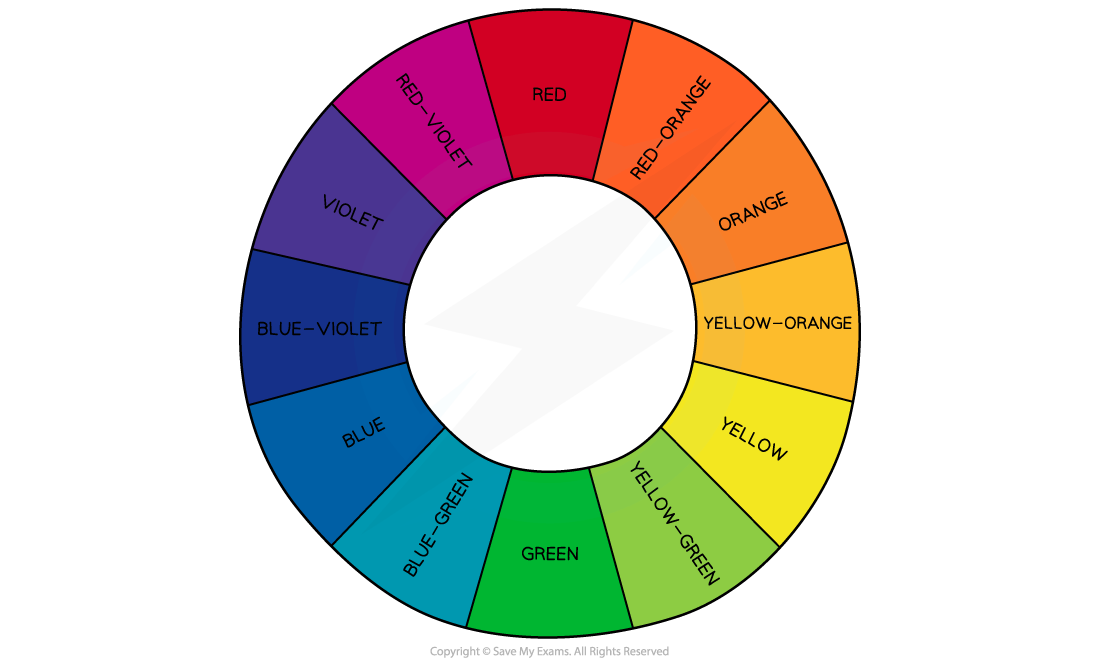
The colour wheel showing complementary colours in the visible light region of the electromagnetic spectrum
-
Complementary colours are any two colours which are directly opposite each other in the colour wheel
- For example, the complementary colour of red is green and the complementary colours of red-violet are yellow-green
Splitting of 3d energy levels
-
In a transition metal atom, the five orbitals that make up the d-subshell all have the same energy.
-
Ions that have completely filled 3d energy levels (such as Zn2+) and ions that have no electrons in their 3d subshells (such as Sc3+) are not coloured
-
Transition metals have a partially filled 3d energy level
-
When ligands attach to the central metal ion the energy level splits into two levels with slightly different energies
- If one of the electrons in the lower energy level absorbs energy from the visible spectrum it can move to the higher energy level
- This process is known as promotion / excitation
-
The amount of energy absorbed depends on the difference between the energy levels
- A larger energy difference means the electron absorbs more energy
-
The amount of energy gained by the electron is directly proportional to the frequency of the absorbed light and inversely proportional to the wavelength
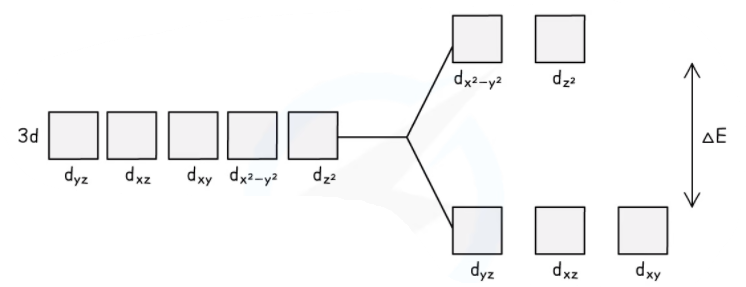
Upon bonding to ligands, the d orbitals of the transition element ion split into sets of orbitals with different energies
Colour Changes in Aqueous ions
Spec point —
17.11
The size of the splitting energy ΔE in the d-orbitals is influenced by the following four factors:
- The size and type of ligands
- The nuclear charge and identity of the metal ion
- The oxidation state of the metal
- The shape of the complex
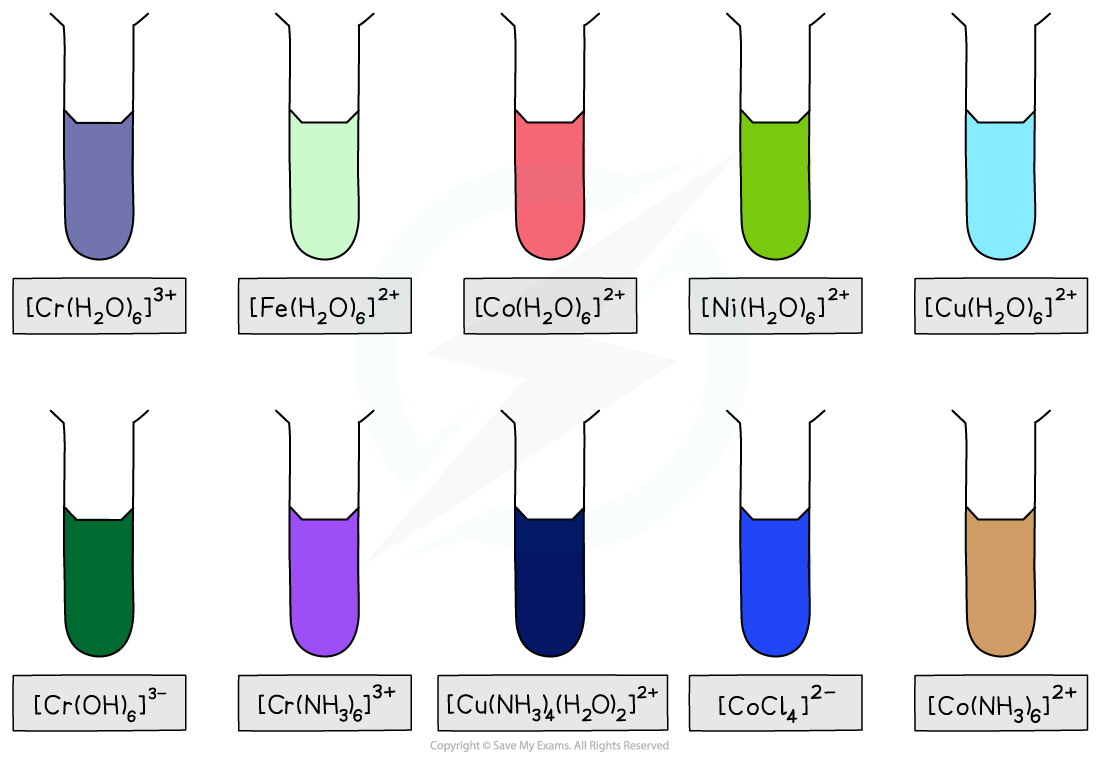
The large variety of coloured compounds is a defining characteristic of transition metals
Size and type of ligand
-
The nature of the ligand influences the strength of the interaction between ligand and central metal ion
-
Ligands vary in their charge density
-
The greater the charge density; the more strongly the ligand interacts with the metal ion causing greater splitting of the d-orbitals
-
The further it is then shifted towards the region of the spectrum where it absorbs higher energy
-
As a result, a different colour of light is absorbed by the complex solution and a different complementary colour is observed
-
This means that complexes with the same transition elements ions, but different ligands, can have different colours
- For example, the [Cu(H2O)6]2+ complex has a light blue colour
- Whereas the [Cu(NH3)4(H2O)2]2+ has a dark blue colour despite the copper(II) ion having an oxidation state of +2 in both complexes
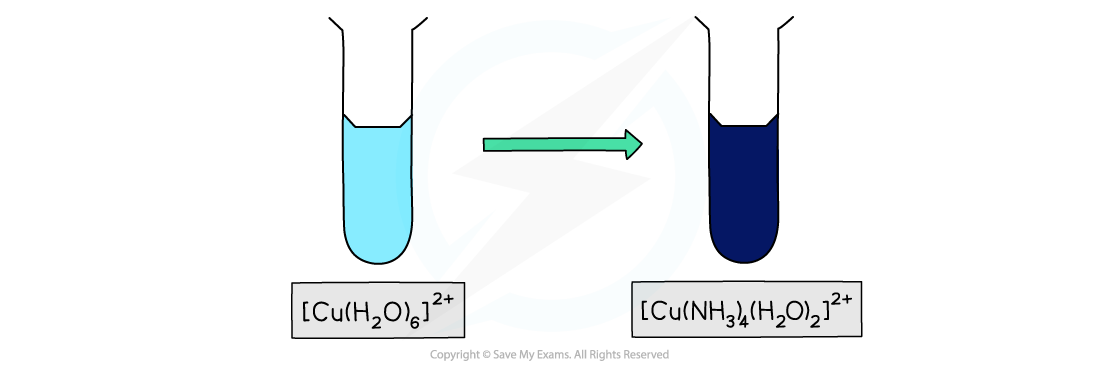
Ligand exchange of the water ligands by ammonia ligands causes a change in colour of the copper(II) complex solution
Oxidation number
-
When the same metal has a higher oxidation number that will also create a stronger interaction with the ligands
-
If you compare iron(II) and iron (III):
- [Fe(H2O)6]2+ absorbs in the red region and appears green
- But, [Fe(H2O)6]3+ absorbs in blue region and appears orange
Coordination number
-
The change of colour in a complex is also partly due to the change in coordination number and geometry of the complex ion
-
The splitting energy, ΔE, of the d-orbitals is affected by the relative orientation of the ligand as well as the d-orbitals
-
Changing the coordination number generally involves changing the ligand as well, so it is a combination of these factors that alters the strength of the interactions
-
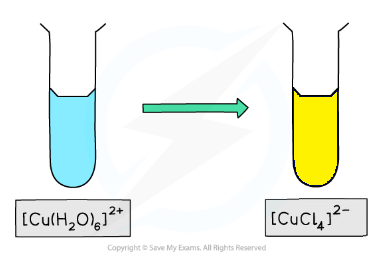
For example, the [Cu(H2O)6]2+ complex has a light blue colour
-
Whereas the [CuCl4]2– has a yellow colour due to the change in the ligand and the change in the coordination number from 6 to 4
- In practice, there would be a change from light blue to green (due to a mixture of both ions) to yellow
-
Since the reaction is reversible, it can also go from yellow, [CuCl4]2–, to green to light blue, [Cu(H2O)6]2+
-
Was this revision note helpful?