Chromium Chemistry (Edexcel IAL Chemistry)
Chromium - Reduction & Oxidation
Spec point —
17.20
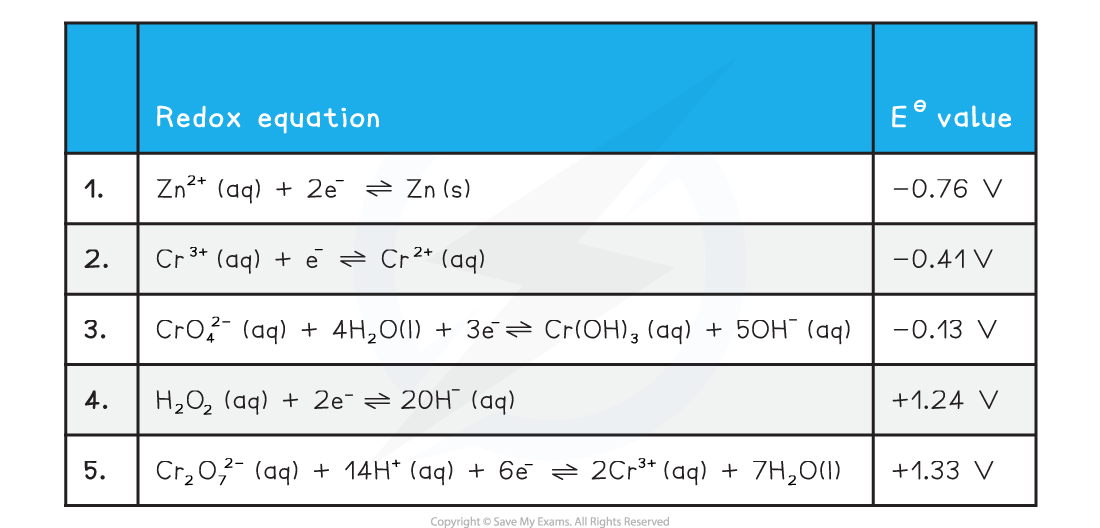
- For chromium we need to consider the following standard electrode potential values
-
The half equations are arranged from the most negative Eθ at the top to the most positive Eθ at the bottom
-
The strongest oxidising agent is the reactant from the electrode reaction with the most positive standard electrode potential
- In this case, the most positive value is + 1.33 V, which means that Cr2O72– (aq) is the strongest oxidising agent
-
The strongest reducing agent is the product from the electrode reaction with the most negative standard electrode potential
- In this case, the most negative value is – 0.76 V, which means that Zn (s) is the strongest reducing agent
-
Oxidation of Cr from +3 to +6 by H2O2
-
The two half equations we need to consider are 3 and 4
-
Chromium is being oxidised from an oxidation number of +6 to +3 in half equation 3
-
So, the two half equations we need to consider are:
-
- CrO42– (aq) + 4H2O (l) + 3e– Cr(OH)3 (aq) + 5OH– (aq) Eθ = – 0.13 V
-
- H2O2 (aq) + 2e– 2OH– (aq) Eθ = + 1.24 V
-
-
Half equation 4 has the most positive standard electrode potential, Eθ, value
- Therefore, this is the reduction reaction
- H2O2 (aq) + 2e– 2OH– (aq)
-
Half equation 3 has the least positive standard electrode potential, Eθ, value
- Therefore, this is the oxidation reaction and needs to be reversed
- Cr(OH)3 (aq) + 5OH– (aq) CrO42– (aq) + 4H2O (l) + 3e
-
We can obtain the overall equation by combining the reduction equation (half equation 4) and the oxidation equation (the reversed half equation 3)
- Remember: When combining half equations, they must have the same number of electrons in both equations | 3H2O2 (aq) + 6e– | | 6OH–(aq) | |---|---|---| | 2Cr(OH)3(aq) + 10OH–(aq) | | 2CrO42–(aq) + 8H2O (l) + 6e– |
- The equal number of electrons on both sides of the equation cancel out and 6OH– (aq) cancel out on both sides to give the overall equation:
2Cr(OH)3 (aq) + 4OH-(aq) + H2O2 (aq)CrO42- (aq) + 8H2O (l)
- This reaction is carried out in alkaline conditions due to the presence of OH- ions in the equation
Reduction of Cr from +6 to +3 by Zn
-
Chromium is being reduced from an oxidation number of +6 to +3 in half equation 5
-
So, the two half equations we need to consider are:
-
- Zn2+ (aq) + 2e– Zn (s) Eθ = – 0.76 V
-
- Cr2O72– (aq) + 14H+ (aq) + 6e– 2Cr3+ (aq) + 7H2O (l) Eθ = + 1.33 V
-
-
Half equation 5 has the most positive standard electrode potential, Eθ, value
- Therefore, this is the reduction reaction
- Cr2O72– (aq) + 14H+ (aq) + 6e– 2Cr3+ (aq) + 7H2O (l)
-
Half equation 1 has the least positive / most negative standard electrode potential, Eθ, value
- Therefore, this is the oxidation reaction and needs to be reversed
- Zn (s) → Zn2+ (aq) + 2e–
-
We can obtain the overall equation by combining the reduction equation (half equation 3) and the oxidation equation (the reversed half equation 1)
- Remember: When combining half equations, they must have the same number of electrons in both equations | Cr2O72– (aq) + 14H+(aq) + 6e– | | 2Cr3+(aq) + 7H2O (l) | |---|---|---| | 3Zn (s) | | 3Zn2+(aq) + 6e– |
- The equal number of electrons on both sides of the equation cancel out to give the overall equation:
Cr2O72-****(aq) + 14H+(aq) + 3Zn (s)2Cr3+ (aq) + 7H2O (l) + 3Zn2+(aq)
- This reaction is carried out under acidic conditions due to the presence of H+ in the equation
Reduction of Cr from +3 to +2 by Zn
-
Chromium is being reduced from an oxidation number of +3 to +2 in half equation 2
-
So, the two half equations we need to consider are:
-
- Zn2+ (aq) + 2e– Zn (s) Eθ = – 0.76 V
-
- Cr3+ (aq) + e– Cr2+ (aq) Eθ = – 0.41 V
-
-
Half equation 2 has the most positive / least negative standard electrode potential, Eθ, value
- Therefore, this is the reduction reaction
- Cr3+ (aq) + e– Cr2+ (aq)
-
Half equation 2 has the least positive standard electrode potential, Eθ, value
- Therefore, this is the oxidation reaction and needs to be reversed
- Zn (s) Zn2+ (aq) + 2e–
-
We can obtain the overall equation by combining the reduction equation (half equation 2) and the oxidation equation (the reversed half equation 1)
- Remember: When combining half equations, they must have the same number of electrons in both equations | 2Cr3+ (aq) + 2e– | | 2Cr2+(aq) | |---|---|---| | Zn (s) | | Zn2+(aq) + 2e– |
- The equal number of electrons on both sides of the equation cancel out to give the overall equation:
2Cr3+ (aq) + Zn (s)2Cr2+(aq) + Zn2+ (aq)
- As this reaction is a further step from the previous reduction this reaction is also carried out under acidic conditions
Colour changes of chromium
- Another approach to transition metal chemistry is to look at the reactions of transition metal ions and complexes with various reagents
- This information is sometimes presented in the form of a reaction scheme:
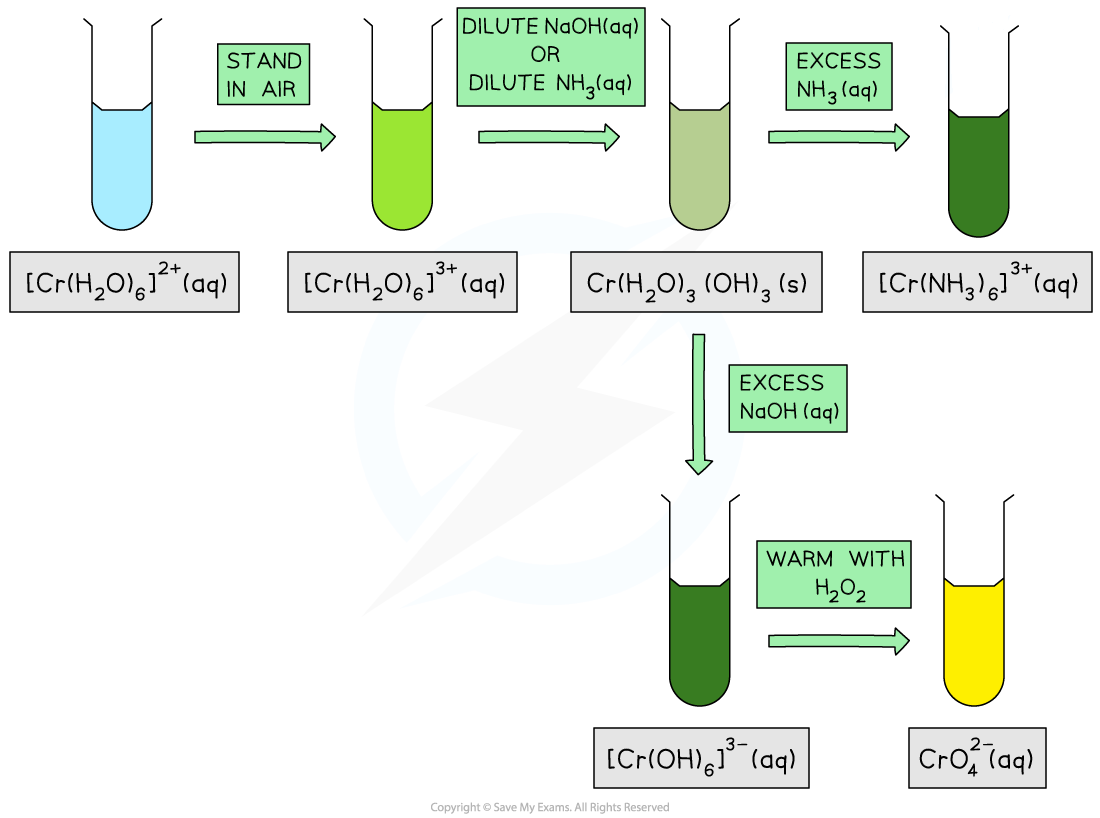
Reaction scheme outlining the colour changes associated with the reactions of different chromium species
-
You would be expected to know:
- The formula and corresponding state, (aq) or (s), of the transition metal species
- The colour of the transition metal species
- The reagents and conditions required to convert one transition metal species into another
- How to write the equation for the conversion of one transition metal species into another
-
For example:
- A green solution of hexaaquachromium(III) ions, [Cr(H2O)6]3+ (aq), will react with dilute NaOH (aq) to form a grey-green precipitate of Cr(H2O)3(OH)3 (s)
- [Cr(H2O)6]3+ (aq) + 3OH- (aq) → [Cr(H2O)3(OH)3] (s) + 3H2O (l)
Dichromate(VI) & Chromate(VI) Equilibrium
Spec point —
17.21
- The chromate CrO42- and dichromate Cr2O72- ions can be converted from one to the other by the following equilibrium reaction
2CrO42-(aq) + 2H+ (aq) ⇌ Cr2O72-(aq) + H2O (l)
-
Chromate(IV) ions are stable in alkaline solution, but in acidic conditions the dichromate(VI) ion is more stable
-
Addition of acid will push the equilibrium to the dichromate
- This results in a colour change from yellow to orange
-
Addition of alkali will remove the H+ ions and push the equilibrium to the chromate
-
This is not a redox reaction as both the chromate and dichromate ions have an oxidation number of +6
- This is an acid base reaction
Was this revision note helpful?