Qualitative Tests (Edexcel IAL Chemistry)
Reactions & Ionic Equations
Spec point —
8.19
Test Tube Reactions
-
Simple test tube reactions can be done to identify the following ions:
- Ammonium ions (NH4+)
- Carbonate ions (CO32-) and hydrogencarbonate ions (HCO3-)
- Sulfate ions (SO42-)
-
If the sample to be tested is a solid, then it must be dissolved in deionised water and made into an aqueous solution
Testing for Ammonium Ions
- About 10 drops of a solution containing ammonium ions, such as ammonium chloride, should be added to a clean test tube
- About 10 drops of sodium hydroxide should be added using a pipette
Overall equation: NH4Cl (aq) + NaOH (aq) → NH3(g) + H2O (l) + NaCl (aq)
Ionic equation: NH4+(aq) + OH-(aq) → NH3(g) + H2O (l)
- The test tube should be swirled carefully to ensure that it is mixed well
- The test tube of the solution should then be placed in a beaker of water, and the beaker of water should be placed above a Bunsen burner, so that it can become a water bath
- As the solution is heated gently, fumes will be produced
- A pair of tongs should be used to hold a damp piece of red litmus paper near the mouth of the test tube, to test the fumes
- The red litmus paper will change colour and become blue in the presence of ammonia gas
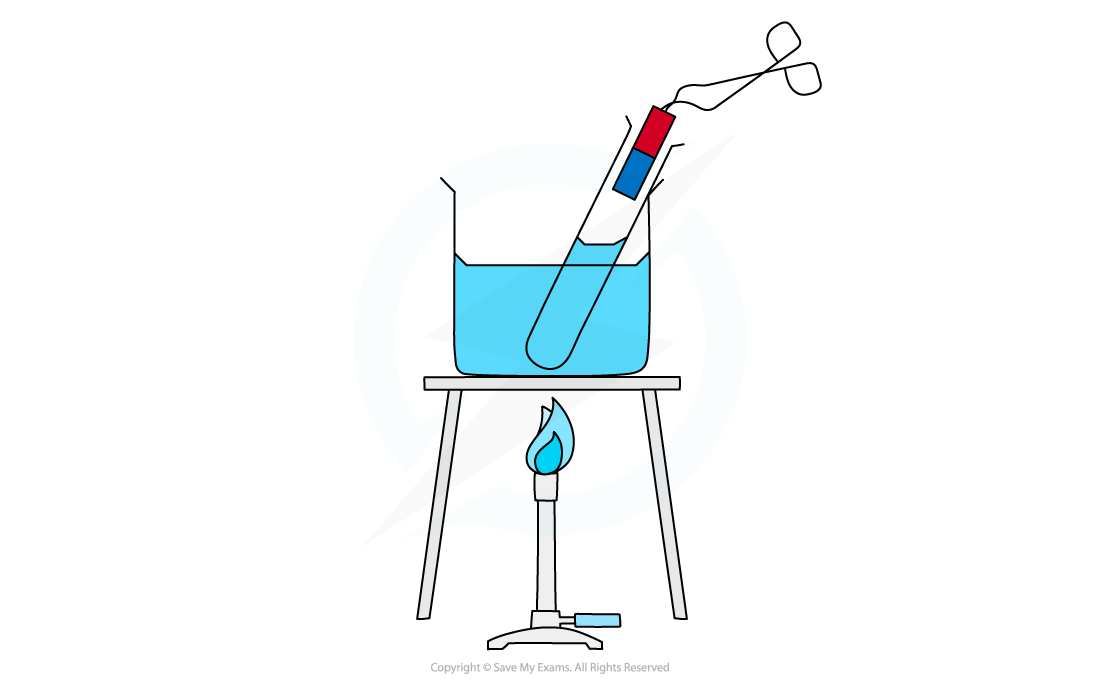
Damp red litmus paper turning blue in the presence of ammonia gas
- Alternatively NH3 can be tested for as it will form a white smoke if reacted with fumes of hydrogen chloride (from concentrated hydrochloric acid)
- The white smoke formed is ammonium chloride
NH3(g) + HCl (g) → NH4Cl (s)
Testing for Carbonate Ions
- A small amount (around 1 cm3) of dilute hydrochloric acid should be added to a test tube using a pipette
- An equal amount of sodium carbonate solution should then be added to the test tube using a clean pipette
Overall equation: 2HCl (aq) + Na2CO3(aq) → 2NaCl (aq) + CO2(g) + H2O (l)
Ionic equation: 2H+(aq) + CO32-(aq) → CO2(g) + H2O (l)
-
As soon as the sodium carbonate solution is added, a bung with a delivery tube should be attached to the test tube
- The delivery tube should transfer the gas which is formed into a different test tube which contains a small amount of limewater (calcium hydroxide solution)
-
Carbonate ions will react with hydrogen ions from the acid to produce carbon dioxide gas
-
Carbon dioxide gas will turn the limewater milky
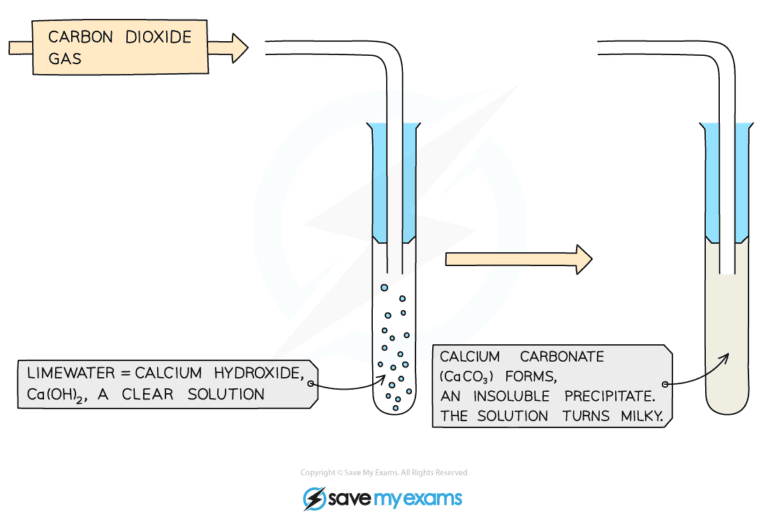
When carbon dioxide gas is bubbled into limewater it will turn cloudy as calcium carbonate is produced
- A similar reaction is seen with sodium hydrogen carbonate, but the equations are:
Overall equation: HCl (aq) + NaHCO3(aq) → NaCl (aq) + CO2(g) + H2O (l)
Ionic equation: H+(aq) + HCO3-(aq) → CO2(g) + H2O (l)
Testing for Sulfate Ions
Acidify the sample with dilute hydrochloric acid and then add a few drops of aqueous barium chloride If a sulfate is present then a white precipitate of barium sulfate is formed:
Ba2+(aq) + SO42-(aq) → BaSO4(s)
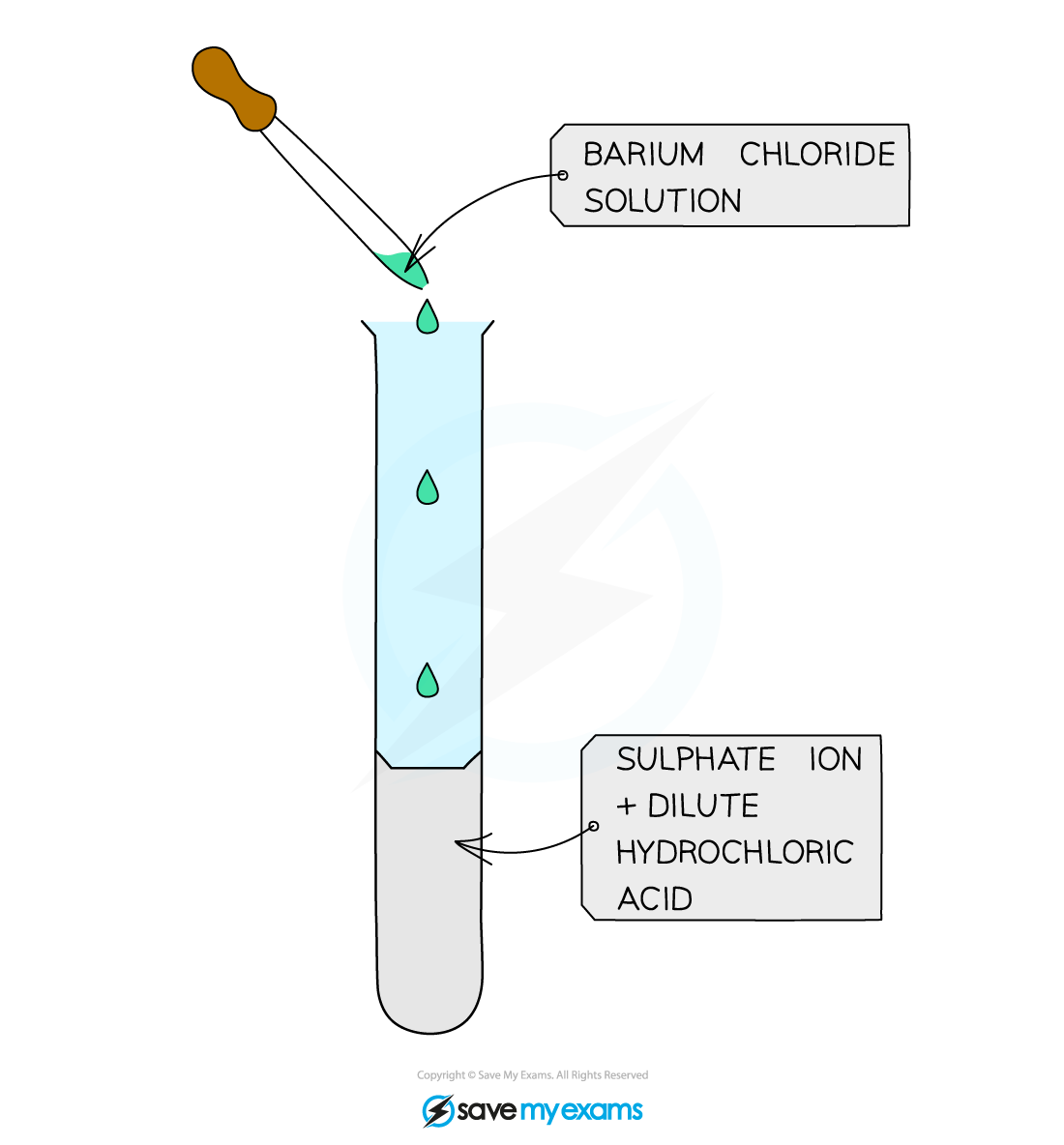
A white precipitate of barium sulfate is a positive result for the presence of sulfate ions
Exam Hint HCl is added first to remove any carbonates which may be present and would also produce a precipitate and interfere with the results.
Was this revision note helpful?