Intermolecular Forces - Introduction (Edexcel IAL Chemistry)
Spec point —
7.1
Intermolecular Forces - Introduction
Intramolecular forces
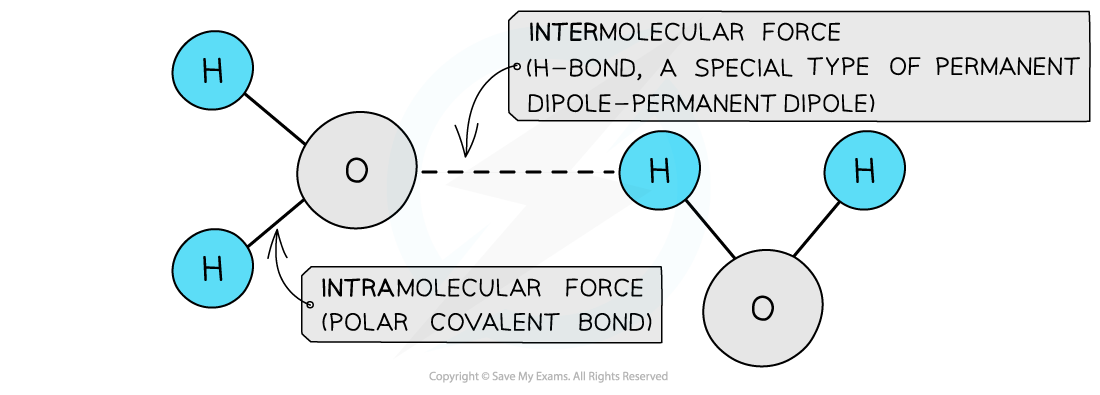
- Intramolecular forces are forces within a molecule and are usually covalent bonds
- Covalent bonds are formed when the outer electrons of two atoms are shared
- Single, double, triple and co-ordinate bonds are all types of intramolecular forces
Intermolecular forces
-
Molecules also contain weaker intermolecular forces which are forces between the molecules
-
There are three types of intermolecular forces:
-
Induced dipole – dipole forces also called van der Waals or London dispersion forces
-
Permanent dipole – dipole forces are the attractive forces between two neighbouring molecules with a permanent dipole
-
Hydrogen Bonding are a special type of permanent dipole - permanent dipole forces
-
Intramolecular forces are stronger than intermolecular forces
- For example, a hydrogen bond is about one tenth the strength of a covalent bond
-
The strengths of the types of bond or force are as follows:
-
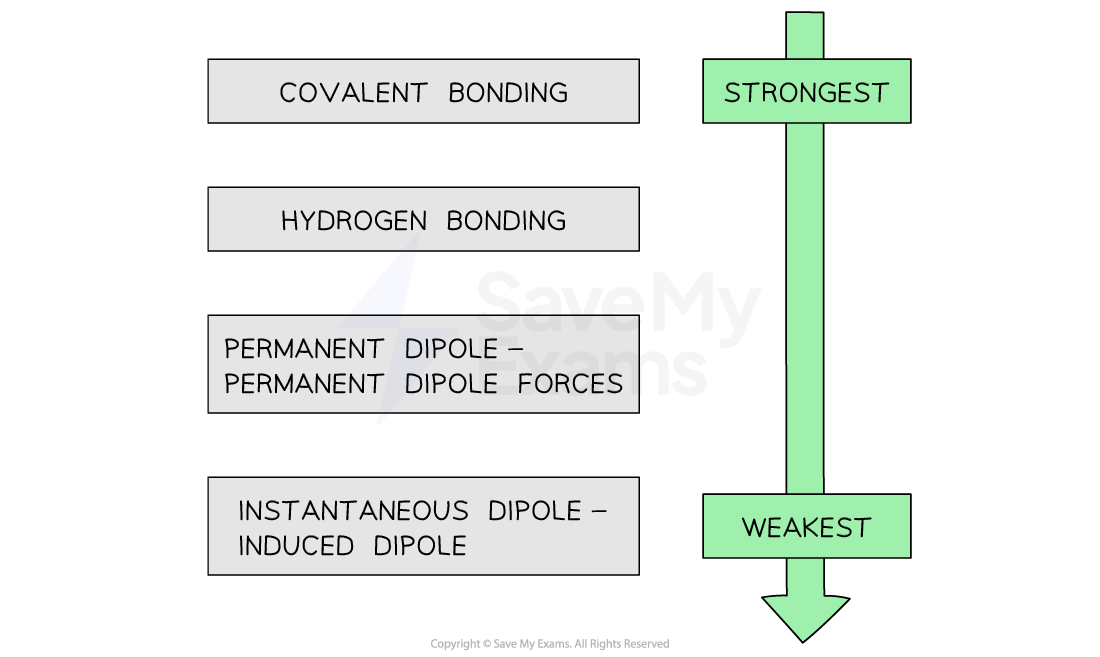
The varying strengths of different types of bonds
Induced dipole-dipole forces:
-
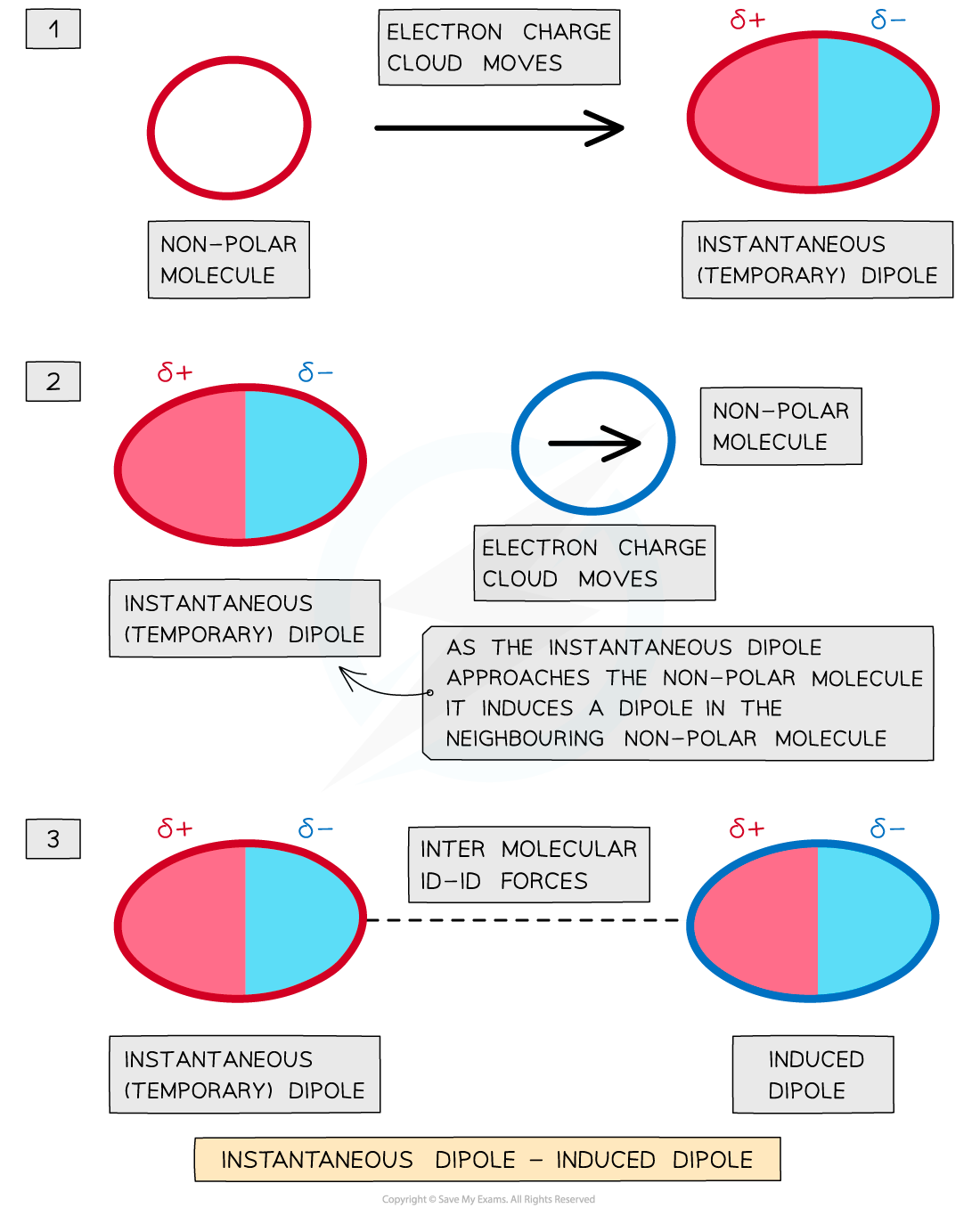
Induced dipole - dipole forces exist between all atoms or molecules
- They are also known as London dispersion forces
- They are also known as London dispersion forces
-
The electron charge cloud in non-polar molecules or atoms are constantly moving
-
During this movement, the electron charge cloud can be more on one side of the atom or molecule than the other
-
This causes a temporary dipole to arise
-
This temporary dipole can induce a dipole on neighbouring molecules
-
When this happens, the δ+ end of the dipole in one molecule and the δ- end of the dipole in a neighbouring molecule are attracted towards each other
-
Because the electron clouds are moving constantly, the dipoles are only temporary
Relative strength
-
For small molecules with the same number of electrons, permanent dipoles are stronger than induced dipoles
- Butane and propanone have the same number of electrons
- Butane is a nonpolar molecule and will have induced dipole forces
- Propanone is a polar molecule and will have permanent dipole forces
- Therefore, more energy is required to break the intermolecular forces between propanone molecules than between butane molecules
- So, propanone has a higher boiling point than butane
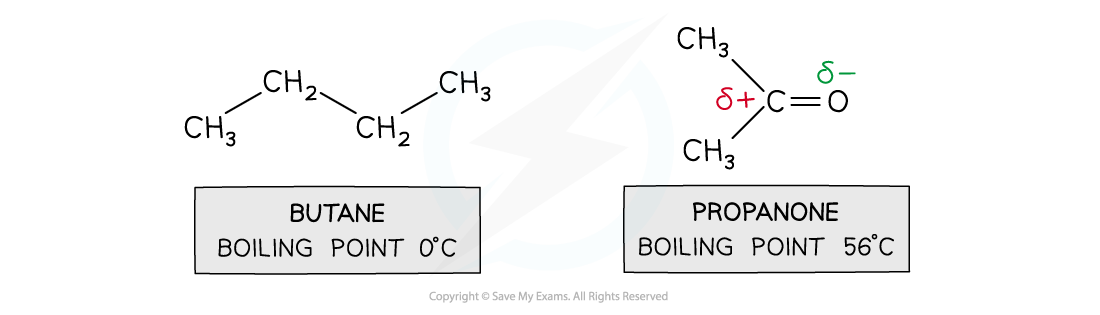
Pd-pd forces are stronger than id-id forces in smaller molecules with an equal number of electrons
Permanent dipole - dipole forces:
- Polar molecules have permanent dipoles
- The molecule will always have a negatively and positively charged end
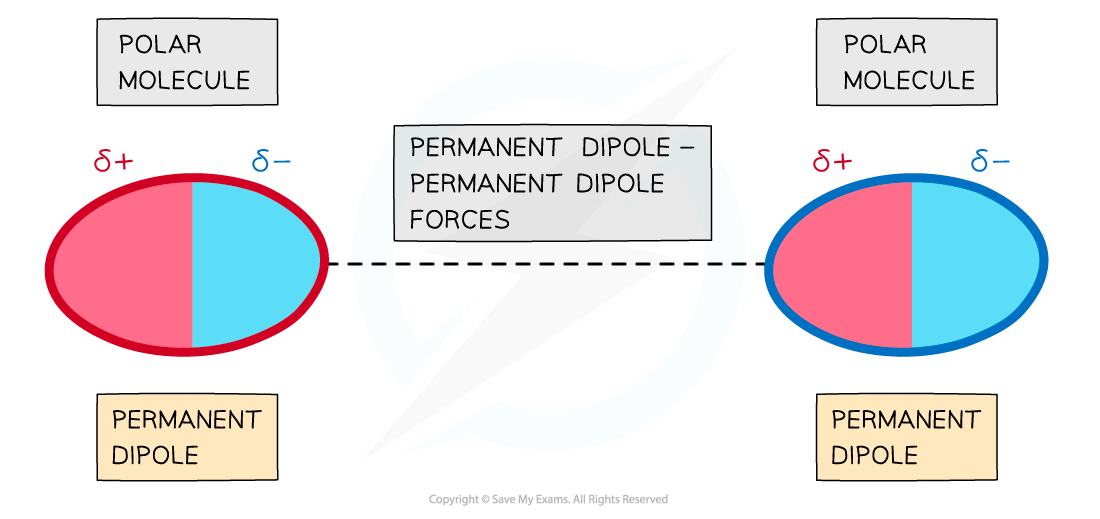
- Forces between two molecules that have permanent dipoles are called permanent dipole - dipole forces
- The δ+ end of the dipole in one molecule and the δ- end of the dipole in a neighbouring molecule are attracted towards each other
Hydrogen bonding
-
Hydrogen bonding is the strongest form of intermolecular bonding
- Intermolecular bonds are bonds between molecules
- Hydrogen bonding is a type of permanent dipole – permanent dipole bonding
-
For hydrogen bonding to take place the following is needed:
- A species which has an O, N or F(very electronegative) atom bonded to a hydrogen
-
When hydrogen is covalently bonded to an O, **N **or F, the bond becomes highly polarised
-
The H becomes so δ+ charged that it can form a bond with the lone pair of an O, N or F atom in another molecule
-
For example, in water
- Water can form two hydrogen bonds, because the O has two lone pairs
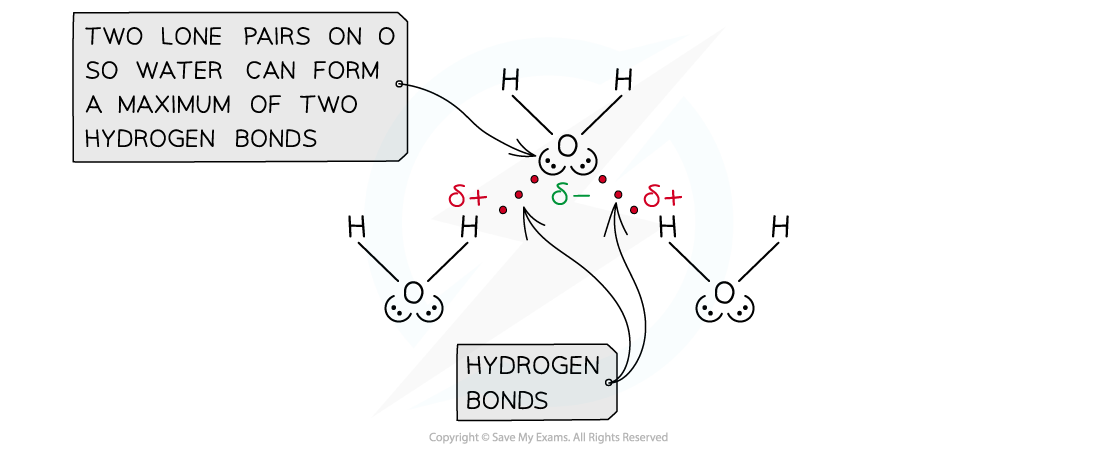
Hydrogen bonding in water
Exam Hint Make sure to use a dashed, straight line when drawing your intermolecular forces! Hydrogen bonds should start at the lone pair and go right up to the delta positive atom - it must be really clear where your H bond starts and ends.
Was this revision note helpful?
Build on this topic