Alkenes - Introduction (Edexcel IAL Chemistry)
Spec point —
5.1
Alkenes - Introduction
-
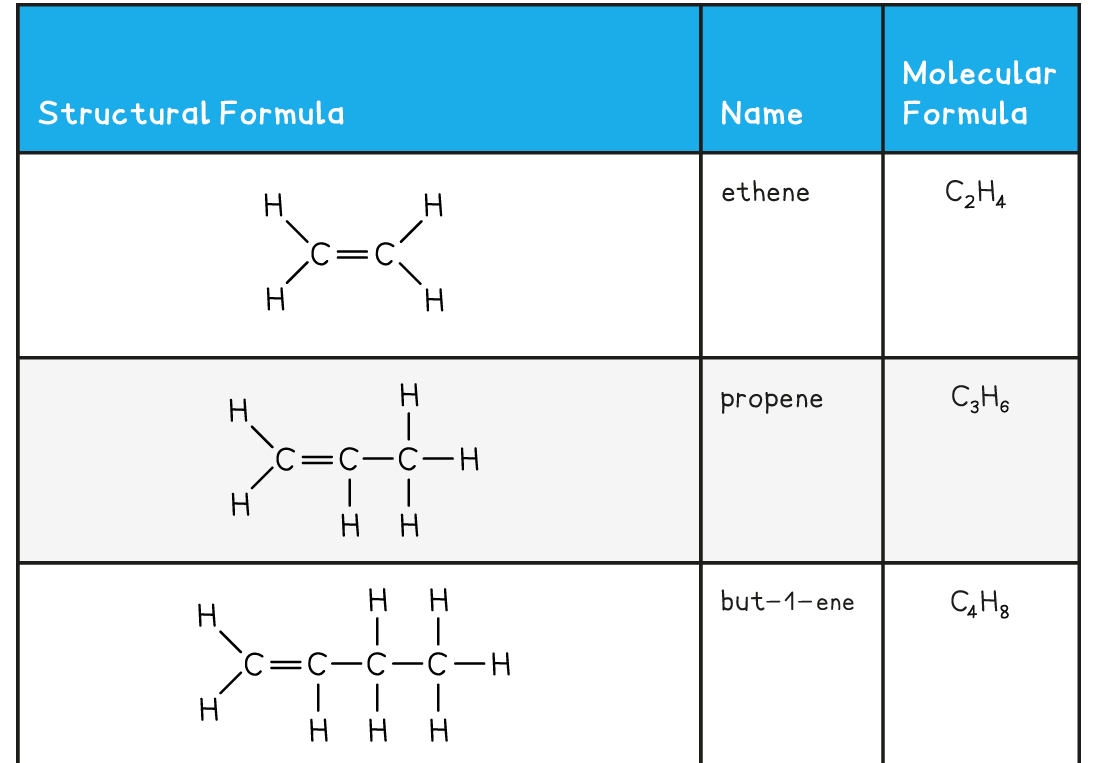
All alkenes contain a double carbon bond, which is shown as two lines between two of the carbon atoms i.e. C=C
-
All alkenes contain a double carbon bond, which is the functional group and is what allows alkenes to react in ways that alkanes cannot
-
Alkenes have the general molecular formula CnH2n
-
They are said to be unsaturated hydrocarbons
- They contain carbon-carbon double bonds
- They are made up of hydrogen and carbon atoms only
-
Alkenes are named using the nomenclature rule alk + ene
-
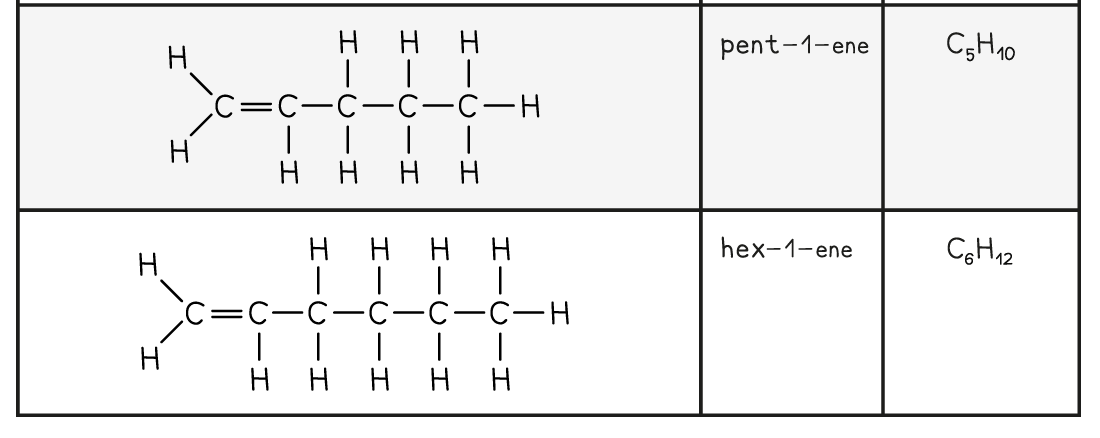
In molecules with a straight chain of 4 or more carbon atoms, the position of the C=C double bond must be specified
-
The carbon atoms on the straight chain must be numbered, starting with the end closest to the double bond
-
The lowest-numbered carbon atom participating in the double bond is indicated just before the -ene:
The First Five Members of the Alkene Family
Bonding in Alkenes
-
Each carbon atom has four electrons in its outer shell (electronic configuration: 1s22s22p2)
-
Carbon atoms share these four electrons in four covalent bonds with other atoms to achieve a full outer shell configuration
-
These electrons are found in orbitals within the respective atoms
-
When forming a covalent bond, the orbitals overlap in such a way to form two types of bonds
- Sigma bonds (σ)
- Pi bonds (π)
-
When carbon atoms use only three of their electron pairs to form a σ bond, each carbon atom will have a p orbital which contains one spare electron
-
When the p orbitals of two carbon atoms overlap with each other, a π bond is formed (the π bond contains two electrons)
-
The two orbitals that form the π bond lie above and below the plane of the two carbon atoms to maximise bond overlap
σ bonds
- Sigma (σ) bonds are formed from the end to end overlap of atomic orbitals
- s orbitals overlap this way as well as p orbitals
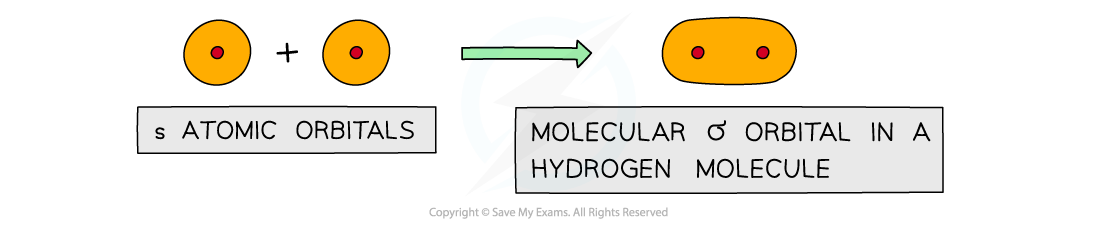
Sigma orbitals can be formed from the end to end overlap of s orbitals
- The electron density in a σ bond is symmetrical about a line joining the nuclei of the atoms forming the bond
- The pair of electrons is found between the nuclei of the two atoms
- The electrostatic attraction between the electrons and nuclei bonds the atoms to each other
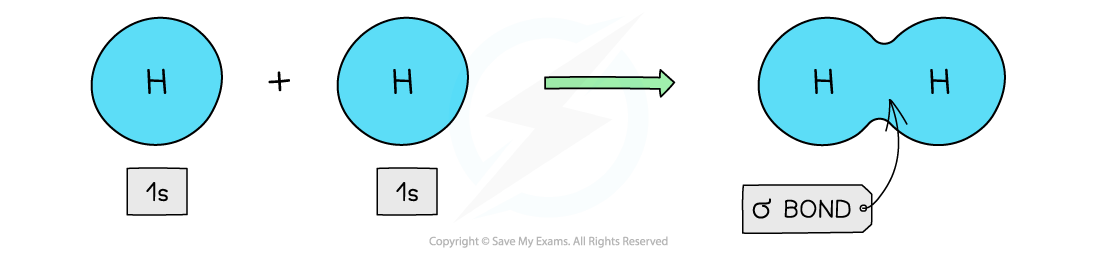
Hydrogen
- The hydrogen atom has only one s orbital
- The s orbitals of the two hydrogen atoms will overlap to form a σ bond
π bonds
- Pi (π) bonds are formed from the sideways overlap of adjacent p orbitals
- The two lobes that make up the π bond lie above and below the plane of the σ bond
- This maximises overlap of the p orbitals
- A single π bond is drawn as two-electron clouds, one arising from each lobe of the p orbitals
- The two clouds of electrons in a π bond represent one bond containing two electrons
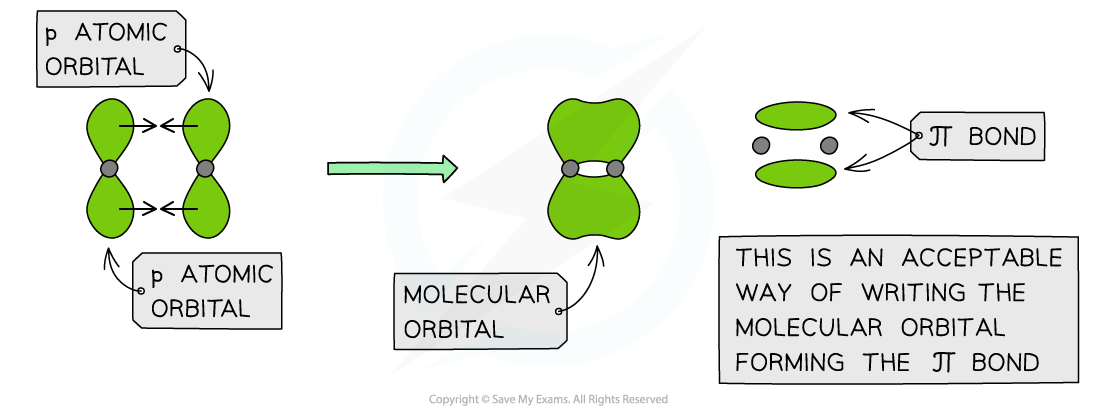
π orbitals can be formed from the sideways overlap of p orbitals
Ethene
-
Each carbon atom uses three of its four electrons to form σ bonds
- Two σ bonds are formed with the hydrogen atoms
- One σ bond is formed with the other carbon atom
- The fourth electron from each carbon atom occupies a p orbital which overlaps sideways with another p orbital on the other carbon atom to form a π bond
- This means that the C-C is a double bond: one σ and one π bond
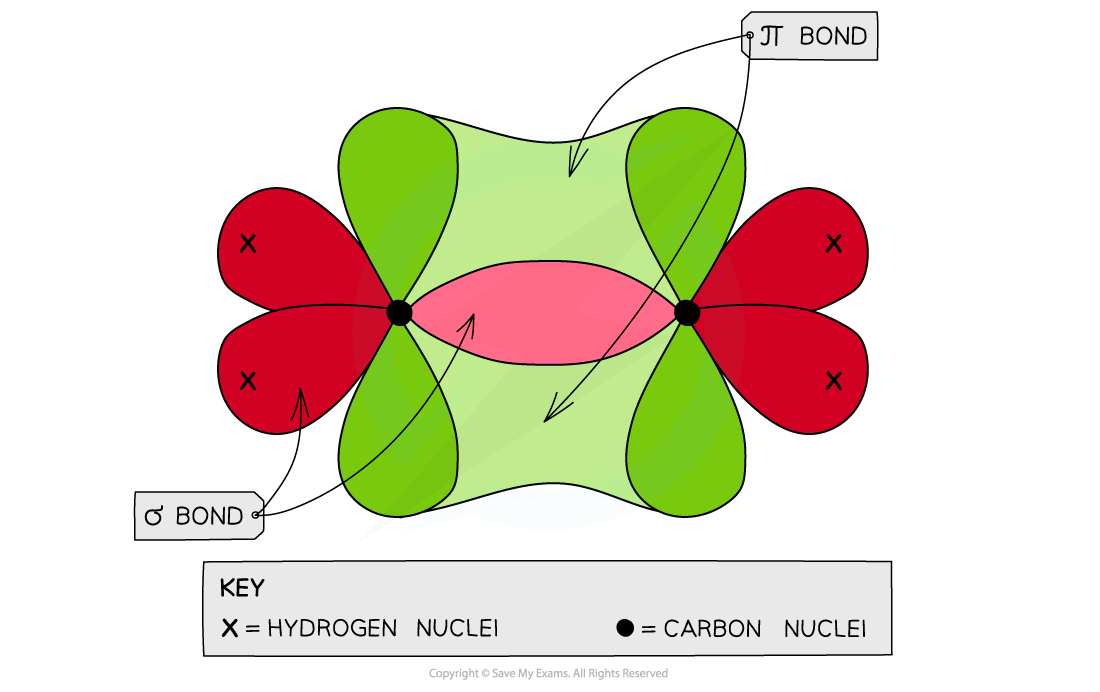
Each carbon atom in ethene forms two sigma bonds with hydrogen atoms and one σ bond with another carbon atom. The fourth electron is used to form a π bond between the two carbon atoms
Was this revision note helpful?
Build on this topic