Other Reactions of the Halogens (Edexcel IAL Chemistry)
Spec point —
8.27
Other Reactions of the Halogens
Concentrated sulfuric acid
- Chloride, bromide and iodide ions react with concentrated sulfuric acid to produce toxic gases
- These reactions should therefore be carried out in a fume cupboard
- The general reaction of the halide ions with concentrated sulfuric acid is:
H2SO4(l) + X-(aq) → HX(g) + HSO4-(aq)
(general equation)
Where X- is the halide ion
Reaction of chloride ions with concentrated sulfuric acid
- Concentrated sulfuric acid is dropwise added to sodium chloride crystals to produce hydrogen chloride gas
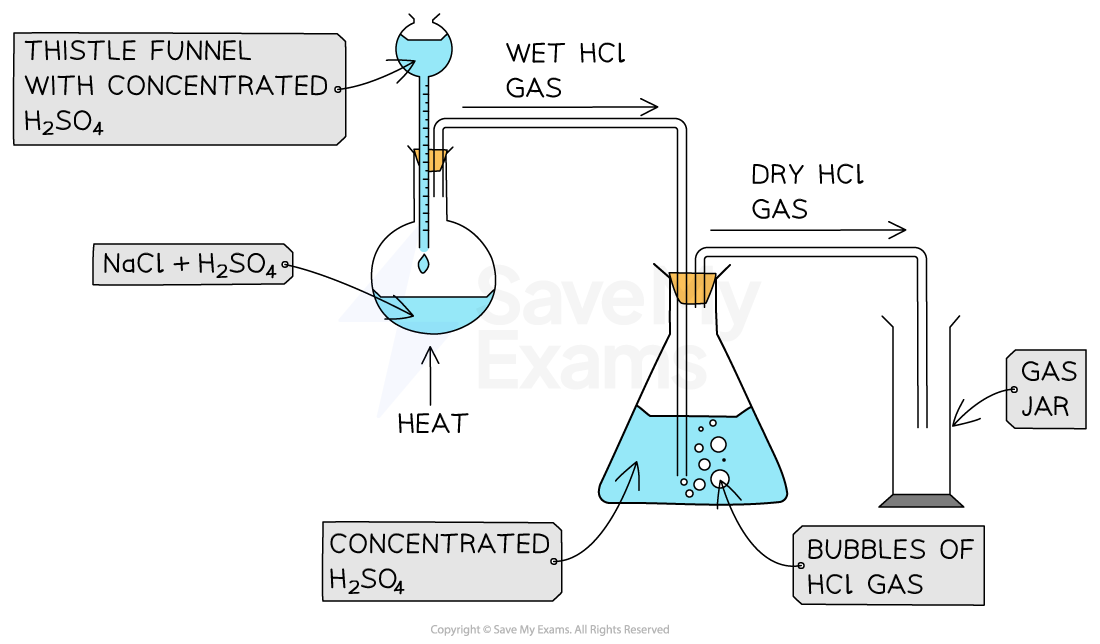
Apparatus set up for the reaction of sodium chloride with concentrated sulfuric acid
- The reaction that takes place is:
H2SO4 (l) + NaCl (s) → HCl (g) + NaHSO4 (s)
- The HCl gas produces is seen as misty fumes
Reaction of bromide ions with concentrated sulfuric acid
- The thermal stability of the hydrogen halides decreases down the group
- The reaction of sodium bromide and concentrated sulfuric acid is:
H2SO4 (l) + NaBr (s) → HBr (g) + NaHSO4 (s)
- The concentrated sulfuric acid oxidises HBr which decomposes into bromine and hydrogen gas and sulfuric acid itself is reduced to sulfur dioxide gas:
2HBr (g) + H2SO4 (l) → Br2 (g) + SO2 (g) + 2H2O (l)
- The bromine is seen as a reddish-brown gas
Reaction of iodide ions with concentrated sulfuric acid
- The reaction of sodium iodide and concentrated sulfuric acid is:
H2SO4 (l) + NaI (s) → HI (g) + NaHSO4 (s)
- Hydrogen iodide decomposes the easiest
- Sulfuric acid oxidises the hydrogen iodide to several extents:
- The concentrated sulfuric acid oxidises HI and is itself reduced to sulfur dioxide gas:
2HI (g) + H2SO4 (l) → I2 (g) + SO2 (g) + 2H2O (l)
- Iodine is seen as a violet/purple vapour
- The concentrated sulfuric acid oxidises HI and is itself reduced to sulfur:
6HI (g) + H2SO4 (l) → 3I2 (g) + S (s) + 4H2O (l)
- Sulfur is seen as a yellow solid
- The concentrated sulfuric acid oxidises HI and is itself reduced to hydrogen sulfide:
8HI (g) + H2SO4 (l) → 4I2 (g) + H2S (s) + 4H2O (l)
- Hydrogen sulfide has a strong smell of bad eggs
Further redox reaction involving sulfur dioxide
- HI is such a strong reducing agent that it can reduce sulfur dioxide, SO2, further to hydrogen sulfide, H2S
SO2(g) + 6HI (g) → H2S (g) + 3I2(s) + 2H2O (l)
-
Sulfur is reduced from +4 in SO₂ to –2 in H2S, a gain of 6 electrons:
- This demonstrates reduction
-
The iodide ion is oxidised to iodine (I2), seen as purple vapour
-
The bad egg smell of H2S confirms the presence of this gas
-
This final step highlights the maximum reducing power of iodide ions, not seen with Cl⁻ or Br⁻
Halide ion Reactions with Concentrated Sulfuric Acid Table
| Halide ion | Reaction with conc H2SO4 | Observations |
|---|---|---|
| Cl- (aq) | H2SO4 (l) + NaCl (s) → HCl (g) + NaHSO4 (s) | Misty fumes of HCl gas |
| Br- (aq) | H2SO4 (l) + NaBr (s) → HBr (g) + NaHSO4 (s) H2SO4 (l) + 2HBr (g) → Br2 (g) + SO2 (g) + 2H2O (l) | Misty fumes of HBr gas Choking gas of SO2 and reddish brown gas of Br2 |
| I- (aq) | H2SO4 (l) + NaI (s) → HI (g) + NaHSO4 (s) H2SO4 (l) + 2HI (g) → I2 (s) + SO2 (g) + 2H2O (l) H2SO4 (l) + 6HI (g) → 3I2 (s) + S (s) + 4H2O (l) H2SO4 (l) + 8HI (g) → 4I2 (s) + H2S (g) + 4H2O (l) | Misty fumes of HI gas Choking gas of SO2 and purple vapour of I2 Yellow solid of S (s) Strong, bad egg smell of H2S (g) |
Explaining the Trend in Reducing Ability of Halide Ions
-
As you go down Group 7, the halide ions get bigger (Cl⁻ → Br⁻ → I⁻)
-
So, the attraction between the outer electrons and the nucleus gets weaker
-
This makes it easier for the larger halide ions to lose electrons
-
When they lose electrons, they reduce other substances,
-
So the reducing power increases down the group:
- Cl⁻ < Br⁻ < I⁻
Silver ions & ammonia
- Halide ions can be identified in an unknown solution by dissolving the solution in nitric acid and then adding a silver nitrate solution followed by ammonia solution
- The halide ions will react with the silver nitrate solution as follows:
AgNO3 (aq) + X- (aq) → AgX (s) + NO3- (aq)
Ag+ (aq) + X- (aq) → AgX (s)
- X- is the halide ion in both equations
- If the unknown solution contains halide ions, then a precipitate of the silver halide will be formed (AgX)
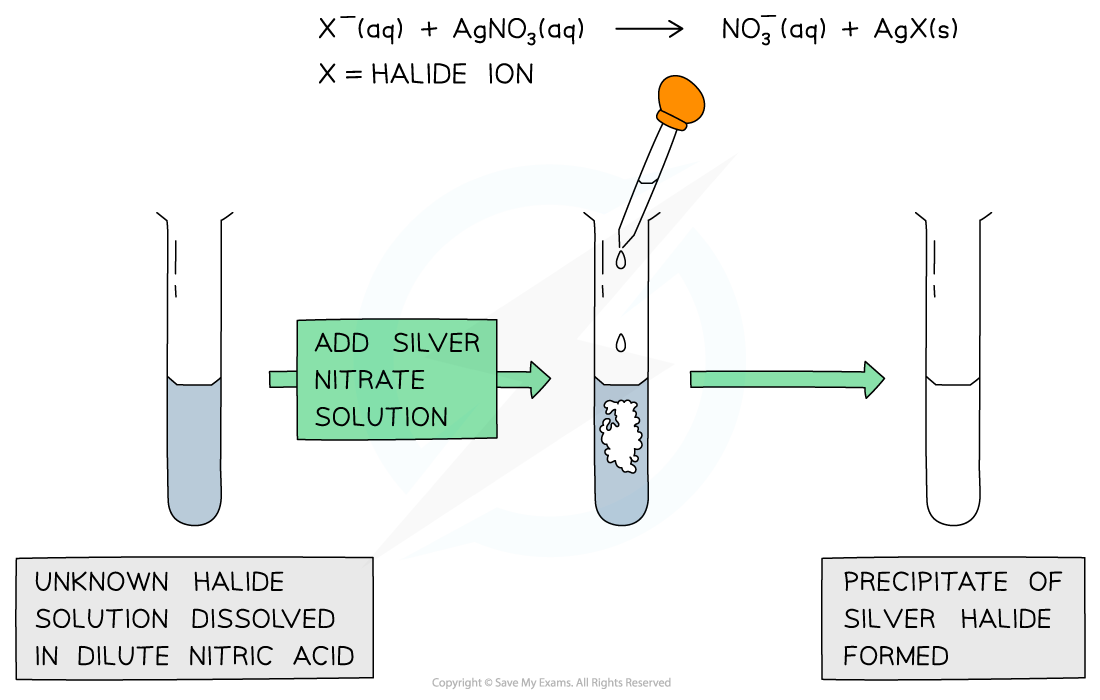
A silver halide precipitate is formed upon addition of silver nitrate solution to halide ion solution
- Dilute followed by concentrated ammonia is added to the silver halide solution to identify the halide ion
- If the precipitate dissolves in dilute ammonia the unknown halide is chloride
- If the precipitate does not dissolve in dilute but in concentrated ammonia the unknown halide is bromide
- If the precipitate does not dissolve in dilute nor concentrated ammonia the unknown halide is iodide
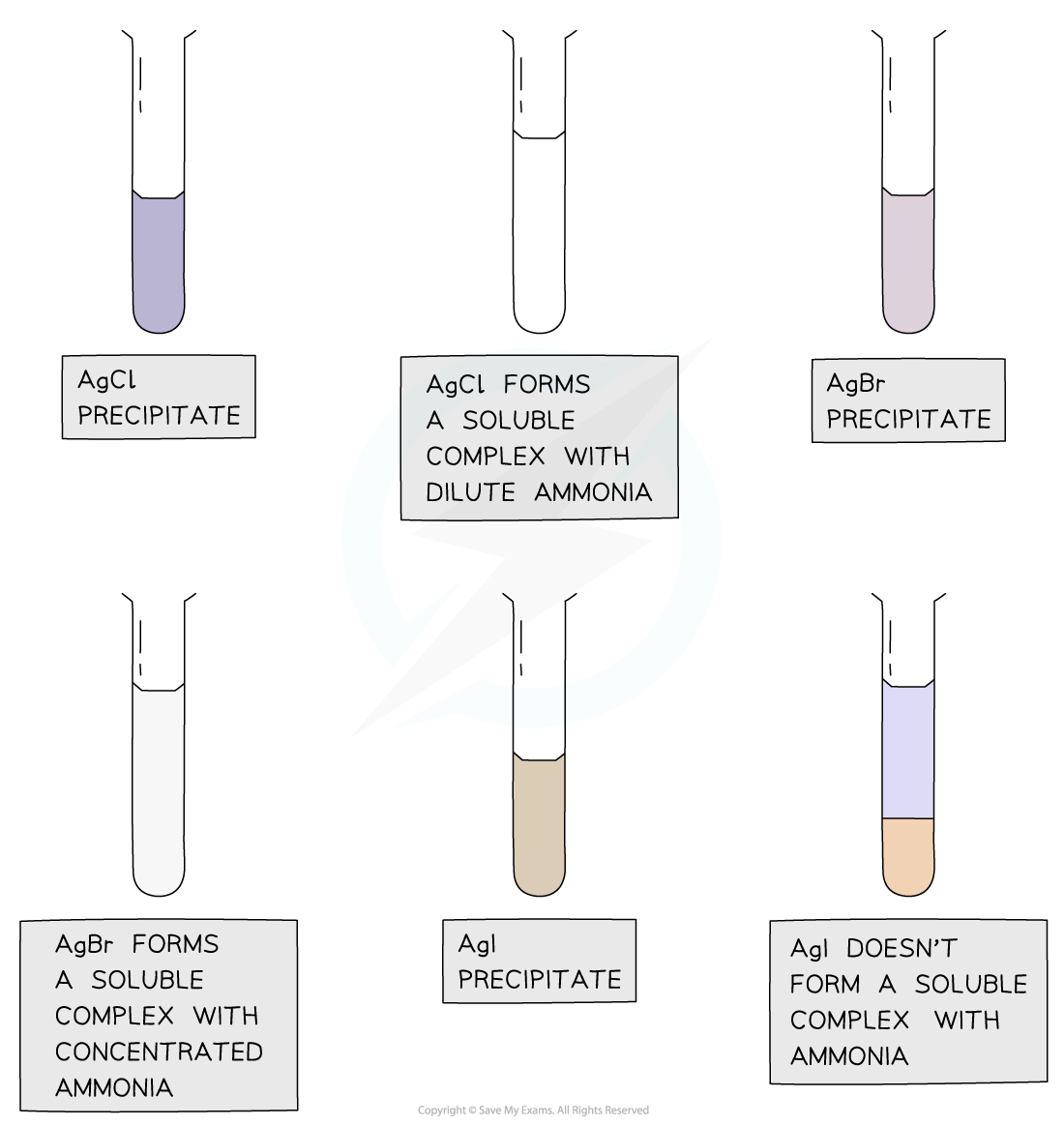
Silver chloride and silver bromide precipitates dissolve on addition of ammonia solution whereas silver iodide doesn’t
Reaction of Halide Ions with Silver Nitrate & Ammonia Solutions Table
| Halide ion | Colour of Silver Halide Solution | Effect of adding dil. NH3 | Effect of adding conc. NH3 |
|---|---|---|---|
| Cl- (aq) | White | Dissolves | Dissolves |
| Br- (aq) | Cream | Insoluble | Dissolves |
| I- (aq) | Pale yellow | Insoluble | Insoluble |
Reactions with hydrogen halides
-
When a halogen reacts with hydrogen a hydrogen halide is produced, for example:
- Cl2(g) + H2(g) → 2HCl (g)
-
These hydrogen halides react with ammonia gas to form ammonium halides
- NH3(g) + HCl (g) → NH4Cl (s)
-
Hydrogen halides will also react with water
-
For example, hydrogen chloride also dissolves in water to form hydrochloric acid
- HCl (g) → H+ (aq) + Cl-(aq)
Fluorine & Astatine
Spec point —
8.28
Fluorides and Astatides
-
If you are asked to predict reactions of fluorides and astatides that you are not familiar with you can use the information about Group 7 to help
-
There are, however, exceptions to some of the reactions
-
For example, silver fluoride is soluble, so we can not used acidified silver nitrate to test for the presence of fluoride ions
- Ag+ (aq) + F- (aq) → AgF (aq)
-
Worked Example Write an equation to show the formation of an acid when hydrogen astatide is added to water.
Answer:
Based on the reaction of hydrogen iodide with water:
HI (g) + H2O (g) → H3O+ (aq) + I– (aq)
So, hydrogen astatide must be:
- HAt (g) + H2O (g) → H3O+(aq) + At–(aq)
Was this revision note helpful?