Using Hess Cycles (Edexcel IAL Chemistry)
Hess Cycles - Construction
Spec point —
6.6
- In 1840, the Russian chemist Germain Hess formulated a law which went on to be known as Hess’s Law
- This went on to form the basis of one of the laws of thermodynamics. The first law of thermodynamics relates to the Law of Conservation of Energy
- It is sometimes expressed in the following form:
Energy cannot be created or destroyed, it can only change form
- This means that in a closed system, the total amount of energy present is always constant
- Hess’s law can be used to calculate the standard enthalpy change of a reaction from known standard enthalpy changes
- Hess’s Law states that:
"The total enthalpy change in a chemical reaction is independent of the route by which the chemical reaction takes place as long as the initial and final conditions are the same."
- This means that whether the reaction takes place in one or two steps, the total enthalpy change of the reaction will still be the same
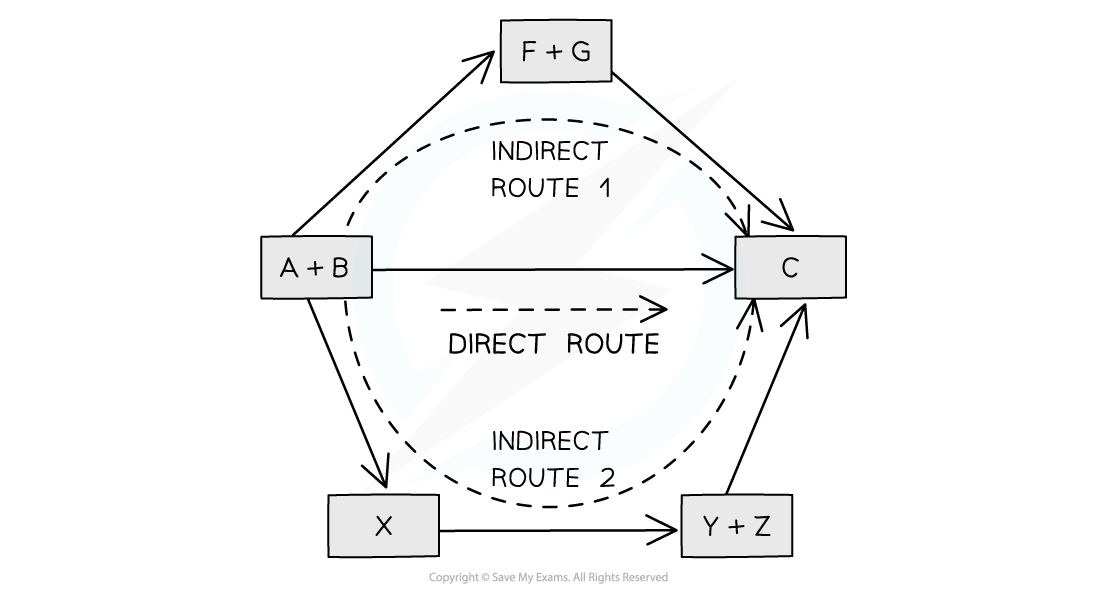
According to Hess’ Law, the enthalpy change of the direct route, going from reactants (A+B) to product (C), is equal to the enthalpy change of the indirect routes
- Hess’ Law is used to calculate enthalpy changes which can’t be found experimentally using calorimetry, e.g.:
3C (s) + 4H2 (g) → C3H8(g)
- ΔfH (propane) can’t be found experimentally as hydrogen and carbon don’t react under standard conditions
Calculating ΔHr from ΔHf using Hess’s Law energy cycles
- You can see the relationships on the following diagram:
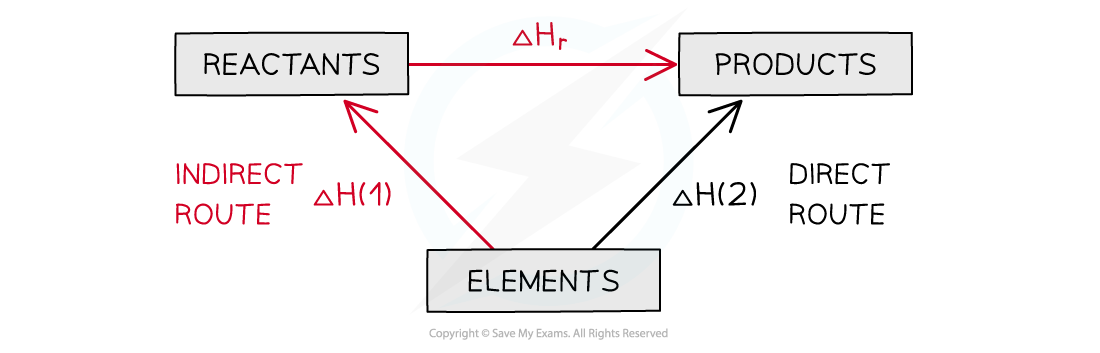
The enthalpy change from elements to products (direct route) is equal to the enthalpy change of elements forming reactants and then products (indirect route)
-
The products can be formed:
- Directly from the elements = ΔH2 OR Indirectly from the elements = ΔH1+ ΔHr
-
Equation
ΔH2= ΔH1+ ΔHr
- Therefore for energy to be conserved,
ΔHr = ΔH2– ΔH1
Exam Hint You do not need to learn Hess's Law word for word as it is not a syllabus requirement, but you do need to understand the principle as it provides the foundation for all the problem solving in Chemical Energetics
Hess Cycles - Calculations
Spec point —
6.6
Calculating ΔHr from ΔHf using Hess’s Law energy cycles
-
Knowing the enthalpy change of formation, ΔHf, allows us to determine the overall enthalpy change of a reaction, ΔHr
-
To do this, we follow these steps:
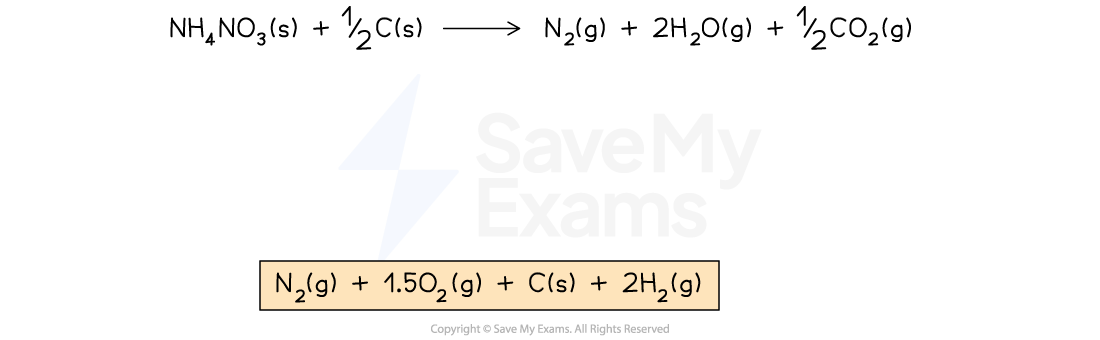
- Write the equation for the reaction
- Write the elements with the correct number of moles and state symbols underneath
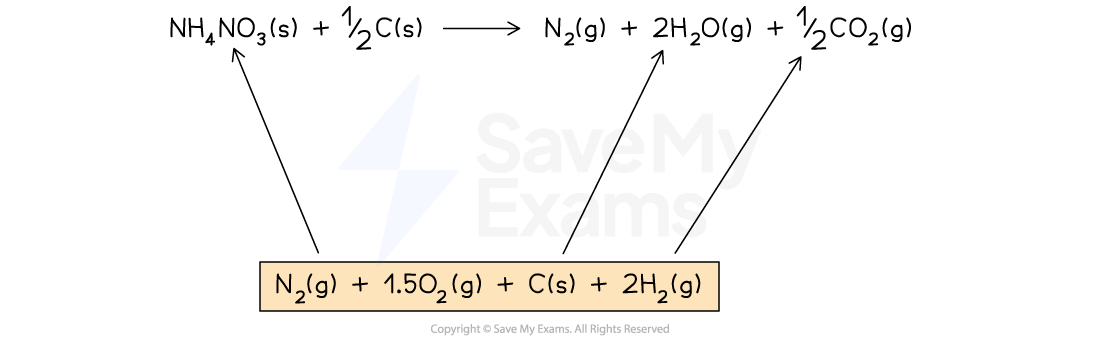
- Draw upwards pointing arrows to each compound
- Write the appropriate values on the arrows and multiply by the number of moles
- In a cycle, go from the reactants to the products, changing the sign of the value if the arrow points in the opposite direction
Worked Example Calculating the enthalpy change of reaction
Use the information in the table to calculate the enthalpy change for this reaction:
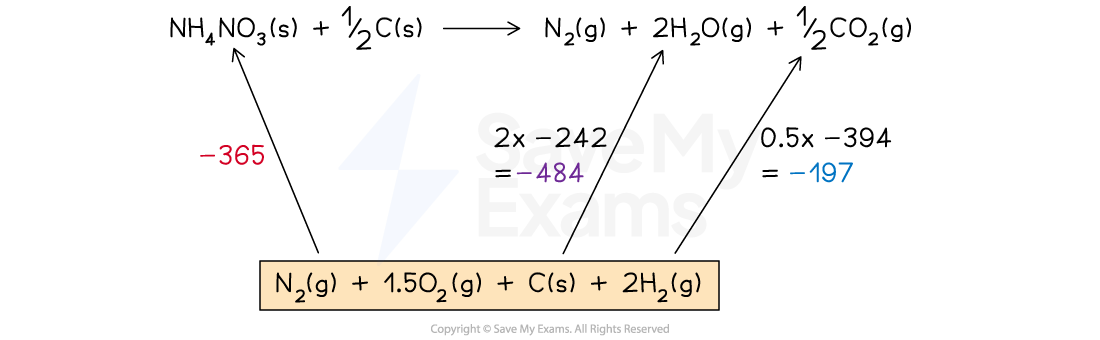
NH4NO3 (s) + ½C (s) → N2 (g) + 2H2O (g) + ½CO2 (g)
Substance C (s) N2 (g) H2O(g) CO2 (g) NH4NO3 (s) ∆Hfө / kJ mol –1 ** 0 0 –242 –394 –365 Final answer: Answer:
** Step 1: **Write the balanced equation
Step 2: Write the elements with the correct number of moles and state symbols underneath
** Step 3: Draw upwards pointing arrows to each compound
Step 4: Write the appropriate values on the arrows and multiply by the number of moles
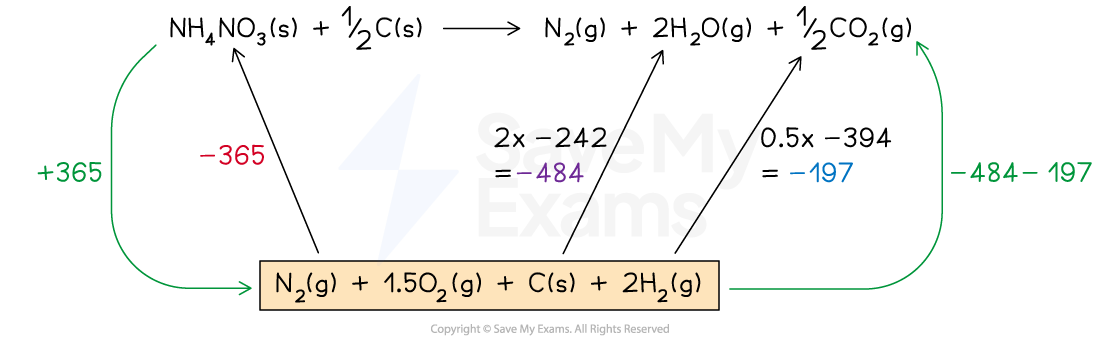
**Step 5: **In a cycle, go from the reactants to the products, changing the sign of the value if the arrow points in the opposite direction
ΔHrө = +365 - 484 - 197 = -316 kJ mol-1
- The sign on -365 needs reversing as the cycle goes in the opposite direction to the arrow pointing upwards
- There is no need to draw arrows from the elements to carbon and nitrogen as ΔHfө is 0 for elements

Exam Hint Keep your enthalpy values inside their own brackets so that you don't accidentally lose a minus sign
Calculating ΔHf from ΔHc using Hess’s Law energy cycles
-
It can be difficult to find the enthalpy change of formation of compounds experimentally
-
However, many enthalpy changes of combustion can be measured experimentally so these can be used to find the enthalpy of formation
-
To do this, we follow these steps:
- Write the equation for the formation of the compound
- Write the combustion products below the equation
- Draw downward pointing arrows from each substance to its combustion products
- Write values on the arrows and multiply by the number of moles
- In a cycle, go from the reactants to the products, changing the sign of the value if the arrow points in the opposite direction
Worked Example Calculating the enthalpy change of formation
Using the data provided, calculate the standard enthalpy change of formation, ΔHf, of propanone.
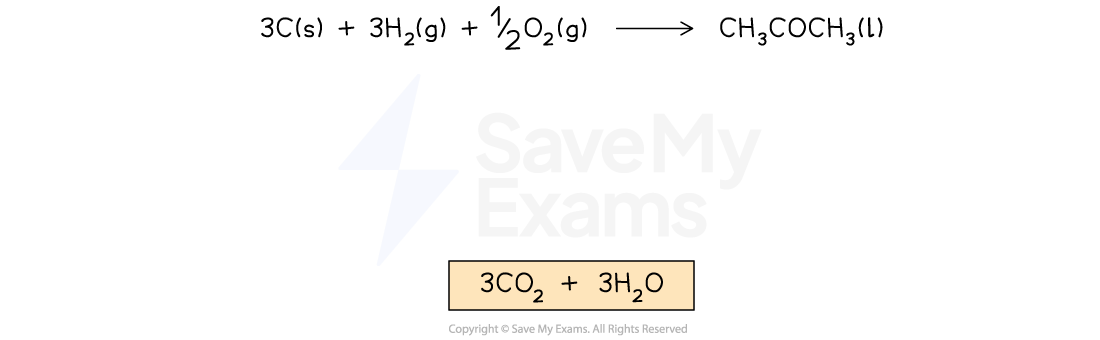
3C (s) + 3H2 (g) + ½ O2 (g) → CH3COCH3 (l)
Substance C (s) H2 (g) CH3COCH3 (l) ∆HCө / kJ mol –1 ** -394 -286 -1821 Final answer: Answer:
-** Step 1: **Write the balanced equation
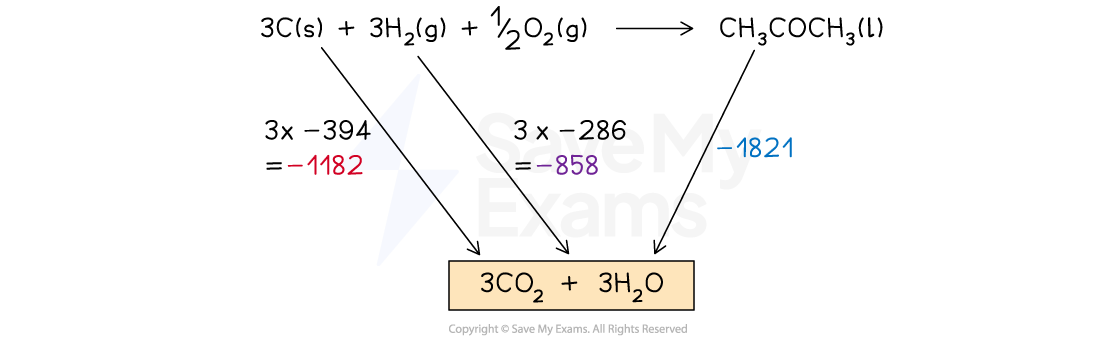
-** Step 2:Write the combustion products below the equation
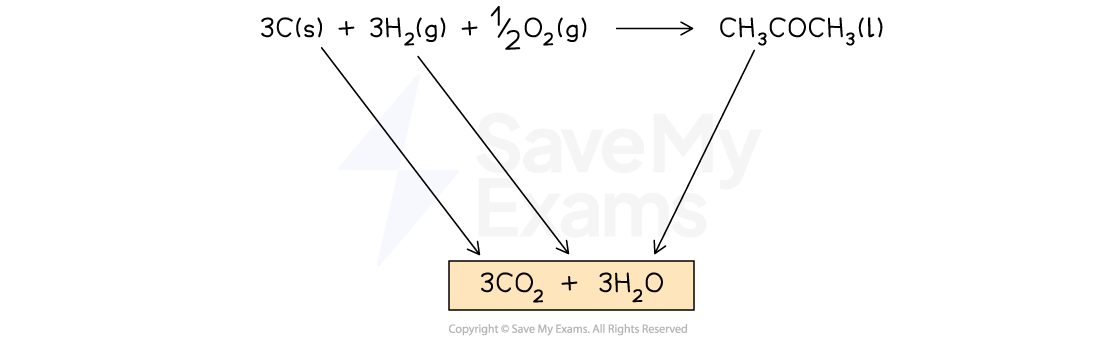
- Step 3: Draw downward pointing arrows from each substance to its combustion product
- **Step 4: **Write the appropriate values on the arrows and multiply by the number of moles
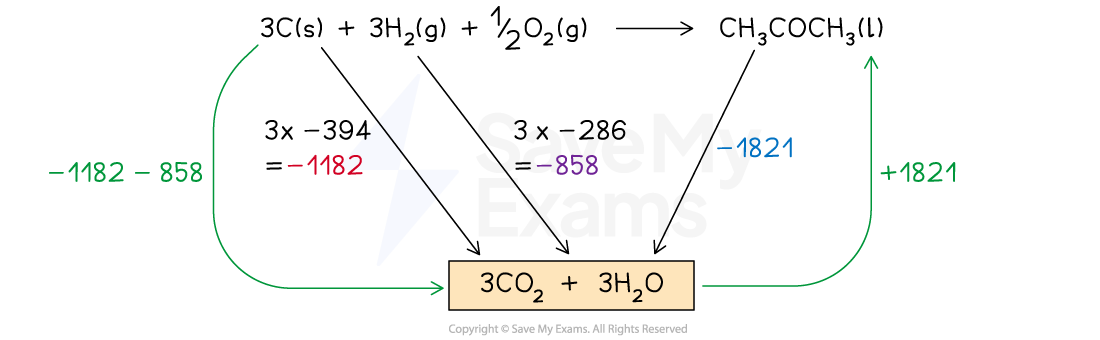
- Step 5: In a cycle, go from the reactants to the products, changing the sign of the value if the arrow points in the opposite direction
ΔHfө = -1182 - 858 + 1821 = -219 kJ mol-1
- The sign on -1821 needs reversing as the cycle goes in the opposite direction to the arrow pointing to the combustion products

Exam Hint Don't forget to make sure the number of atoms for each element is balanced when drawing your cycle.
Was this revision note helpful?
Build on this topic