Rate-Determining Steps from Equations (Edexcel IAL Chemistry)
Spec point —
11.7
Rate-Determining Steps from Equations
Rate-determining step & intermediates
-
A chemical reaction can only go as fast as the slowest part of the reaction
- So, the rate-determining step is the slowest step in the reaction
-
If a reactant appears in the rate-determining step, then the concentration of that reactant will also appear in the rate equation
-
For example, the rate equation for the reaction below is rate = k [CH3Br] [OH-]
CH3Br + OH-→ CH3OH + Br-
- This suggests that both CH3Br and OH- take part in the slow rate-determining step
Predicting the reaction mechanism
-
The overall reaction equation and rate equation can be used to predict a possible reaction mechanism of a reaction
- This shows the individual reaction steps which are taking place
-
For example, nitrogen dioxide (NO2) and carbon monoxide (CO) react to form nitrogen monoxide (NO) and carbon dioxide (CO2)
- The overall reaction equation is:
NO2(g) + CO (g) → NO (g) + CO2(g)
- The rate equation is:
Rate = k [NO2]2
- From the rate equation it can be concluded that the reaction is zero order with respect to CO (g) and second order with respect to NO2 (g)
- This means that there are two molecules of NO2 (g) involved in the rate-determining step and zero molecules of CO (g)
- A possible reaction mechanism could therefore be:
Step 1:
2NO2(g) → NO (g) + NO3(g) slow(rate-determining step)
Step 2:
NO3(g) + CO (g) → NO2(g) + CO2(g) fast
Overall:
2NO 2 (g) + NO3(g) + CO (g) → NO (g) + NO3(g) + NO2(g) + CO2 (g)
= NO2(g) + CO (g) → NO (g) + CO2(g)
Identifying the rate-determining step
- The rate-determining step can be identified from a rate equation given that the reaction mechanism is known
- For example, propane (CH3CH2CH3) undergoes bromination under alkaline solutions
- The overall reaction is:
CH3CH2CH3+ Br2+ OH-→ CH3CH2CH2Br + H2O + Br-
- The reaction mechanism is:
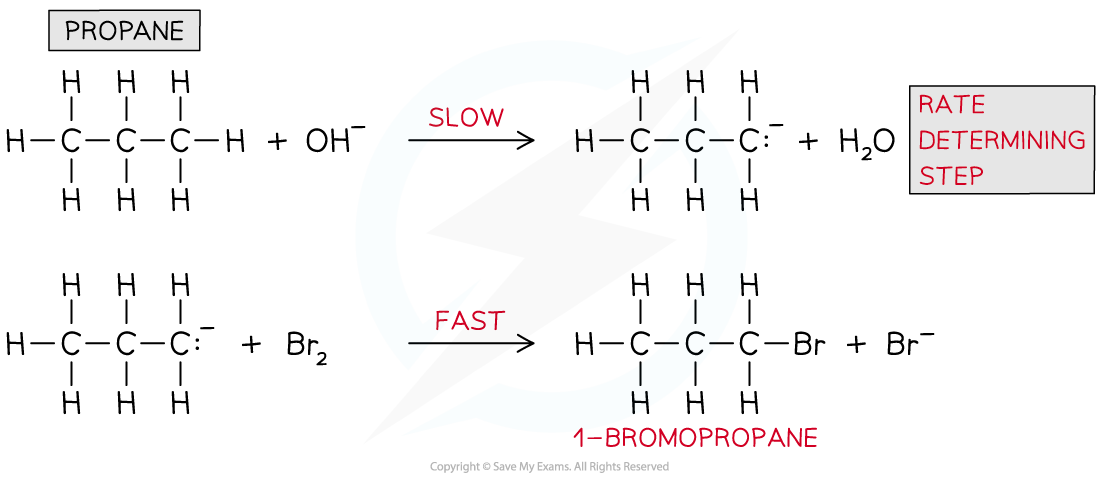
Reaction mechanism for the bromination of propane under alkaline conditions
- The rate equation is:
Rate = k [CH3CH2CH3] [OH-]
-
From the rate equation, it can be deduced that only CH3CH2CH3 and OH- are involved in the rate-determining step and not bromine (Br2)
-
CH3CH2CH3 and OH- are only involved in the first step of the reaction mechanism, therefore the rate-determining step is:
- CH3CH2CH3 + OH- → CH3CH2CH2- + H2O
Was this revision note helpful?
Build on this topic