The Nucleophilic Substitution Mechanism (Edexcel IAL Chemistry)
Exam board Pearson Edexcel · IALUpdated 2026-07-02
Nucleophilic Substitution - Mechanism
Spec point —
10.9
- A nucleophilic substitution reaction is one in which a nucleophile attacks a carbon atom which carries a partial positive charge
- An atom that has a partial negative charge is replaced by the nucleophile
- Halogenoalkanes will undergo nucleophilic substitution reactions due to the polar C-X bond (where X is a halogen)
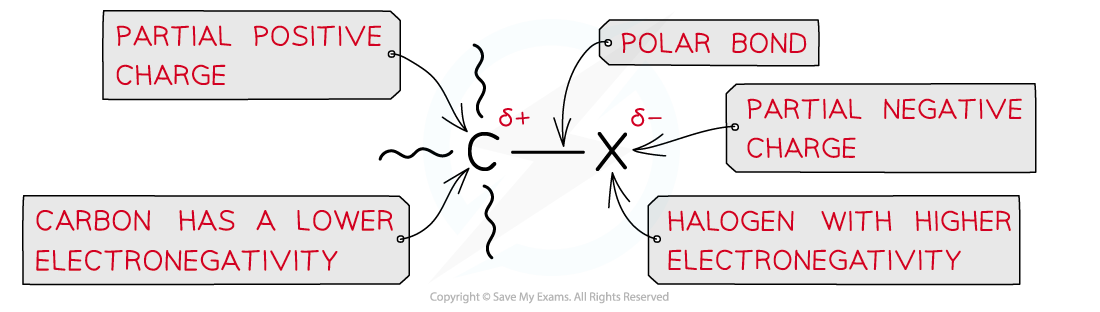
Due to large differences in electronegativity between the carbon and halogen atom, the C-X bond is polar
Mechanism with aqueous potassium hydroxide
- In the following reaction a halogenoalkane reacts with aqueous alkali to form an alcohol

The halogen is replaced by a nucleophile, OH–
- The mechanism for the reaction is as follows

Nucleophilic substitution reaction of bromoethane and aqueous alkali (e.g. NaOH)
Mechanism with ammonia
-
When ammonia reacts with a haloalkane a nucleophilic substitution reaction takes place forming a primary amine
- For example chloromethane reacts with ammonia in two steps to make methylamine and ammonium chloride
CH3Cl + NH3→ [CH3NH3]+Cl-
[CH3NH3]+Cl-+ NH3→ CH3NH2+ NH4+Cl-
- Excess ammonia is used to prevent further substitution and favour the formation of a primary amine
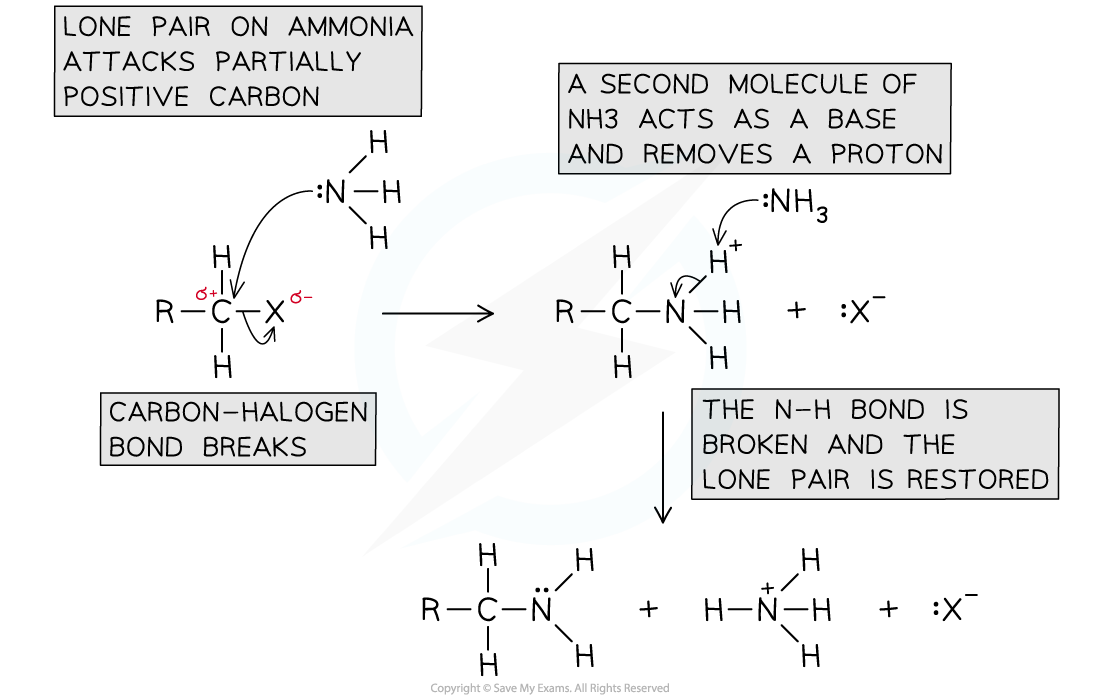
The mechanism of nucleophilic substitution between ammonia and a halogenoalkane
Was this revision note helpful?