Gene Locus (Edexcel IAL Biology)
Gene Loci
Spec point —
3.9
-
Every chromosome consists of a long DNA molecule that contains several hundred or even thousands of different genes coding for different proteins
- A length of DNA that codes for a single polypeptide or protein is called a gene
-
The position of a gene on a chromosome is known as its locus (plural: loci)
- Through experiments and genetic mapping techniques, scientists have been able to work out the specific physical locations of the genes on different chromosomes
- Each gene occupies a specific locus so that the gene for a particular characteristic is always found at the same position on a particular chromosome
-
Each gene can exist in two or more different forms called alleles
-
Different alleles of a gene have slightly different nucleotide sequences but they still occupy the same position (locus) on the chromosome
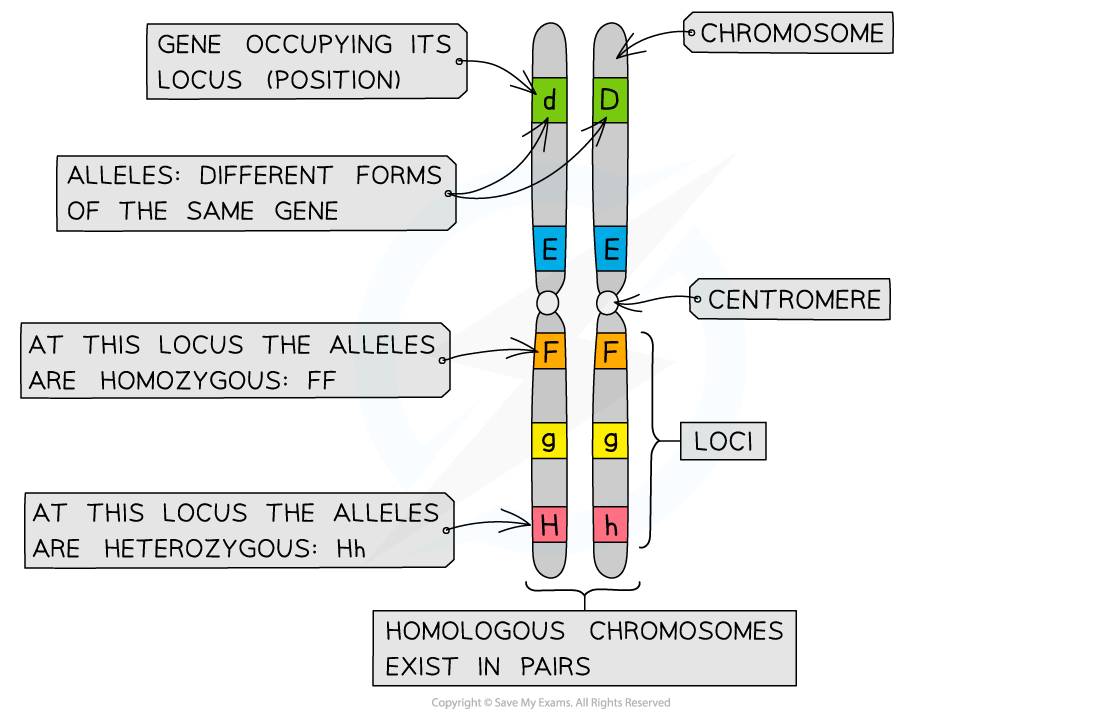
Five different genes found at five different loci
Gene Linkage
Spec point —
3.9
-
Gene loci are said to be linked if they are on the same chromosome
- Loci (singular: locus) refers to the specific linear positions on the chromosome that genes occupy
-
Linked genes located on human chromosomes 1 to 22 (i.e. any chromosome that is not a sex chromosome, known as autosomes) are said to be examples of autosomal linkage
-
If genes are located on the same sex chromosome, they are said to be sex-linked
Autosomal linkage
- As its name implies, autosomal linkage only occurs on the autosomes (any chromosome that isn’t a sex chromosome)
- Two or more genes on the same autosome do not assort independently during meiosis
- Instead, these genes are linked and they stay together in the original parental combination
- These linked genes are passed on to offspring all together (through the gametes)
Sex linkage
-
There are two sex chromosomes: X and Y
-
Females have two copies of the X chromosome (XX), whereas males have one X chromosome and one shorter Y chromosome (XY)
-
Some genes are only present on one sex chromosome and not the other
-
As the inheritance of these genes is dependent on the sex of the individual they are known as sex-linked genes
- Most often sex-linked genes are found on the longer X chromosome
-
If the gene is on the X chromosome, males (XY) will only have one copy of the gene, whereas females (XX) will have two
- Because males only have one X chromosome, they are much more likely to show sex-linked recessive conditions (such as red-green colour blindness and haemophilia)
- Females, having two copies of the X chromosome, are likely to inherit one dominant allele that masks the effect of the recessive allele
- A female with one recessive allele masked in this way is known as a carrier; she doesn’t have the disease, but she has a 50% chance of passing it on to her offspring
- If that offspring is a male, he will have the disease
-
The presence of sex linkage can be identified using pedigree diagrams and Punnett squares
- When a gene is sex-linked the phenotypes are not spread evenly across the sexes
- In the case of a gene that causes a sex-linked disease, one sex will be disproportionately affected
- The results of a cross between a normal male and a female who is a carrier for colour blindness are shown below. In this cross, there is a 25% chance of producing a male who is colour-blind, a 25% chance of producing a female carrier, a 25% chance of producing a normal female and a 25% chance of producing a normal male
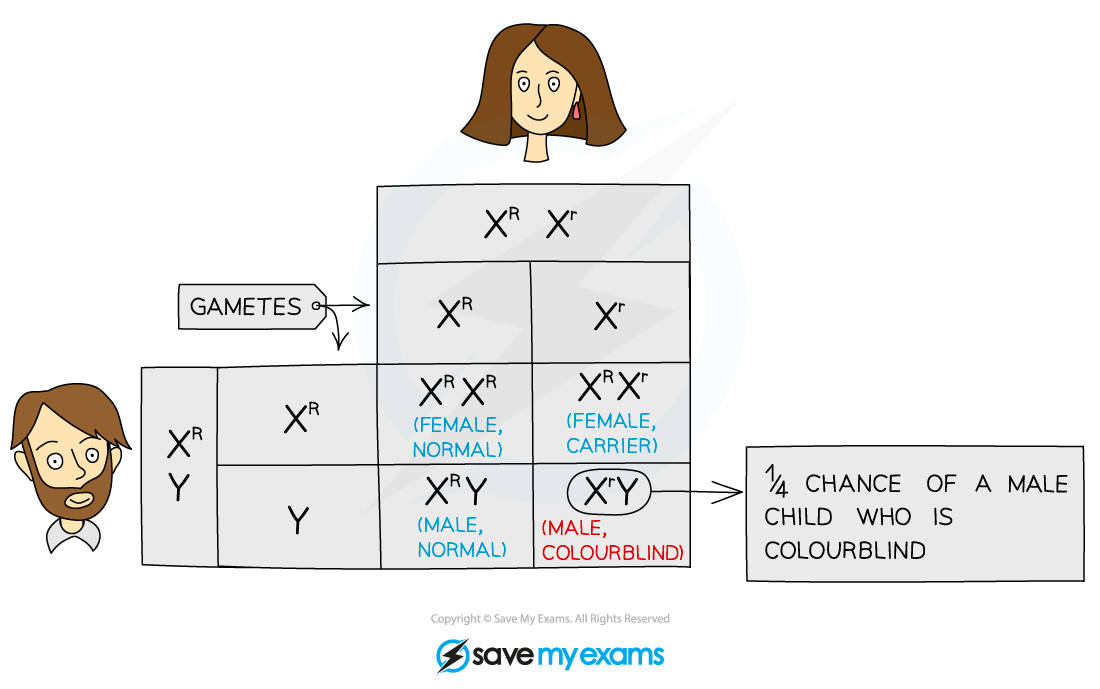
Punnett square showing the inheritance of colourblindness, an X-linked condition
-
Working in the USA in the early 20th century, a scientist called Thomas Hunt Morgan bred fruit flies (Drosophila melanogaster) over successive generations
-
In his cross-breeding experiments, he came across red-eyed wild types and white-eyed mutants
-
He realised there was a distinct sex bias in the phenotypic distribution of the offspring:
- All-female offspring of a red-eyed male were red-eyed while all male offspring of a white-eyed female were also white-eyed
-
Morgan hypothesised that this occurred because the gene for eye colour was located on a sex chromosome (i.e. it was X-linked)
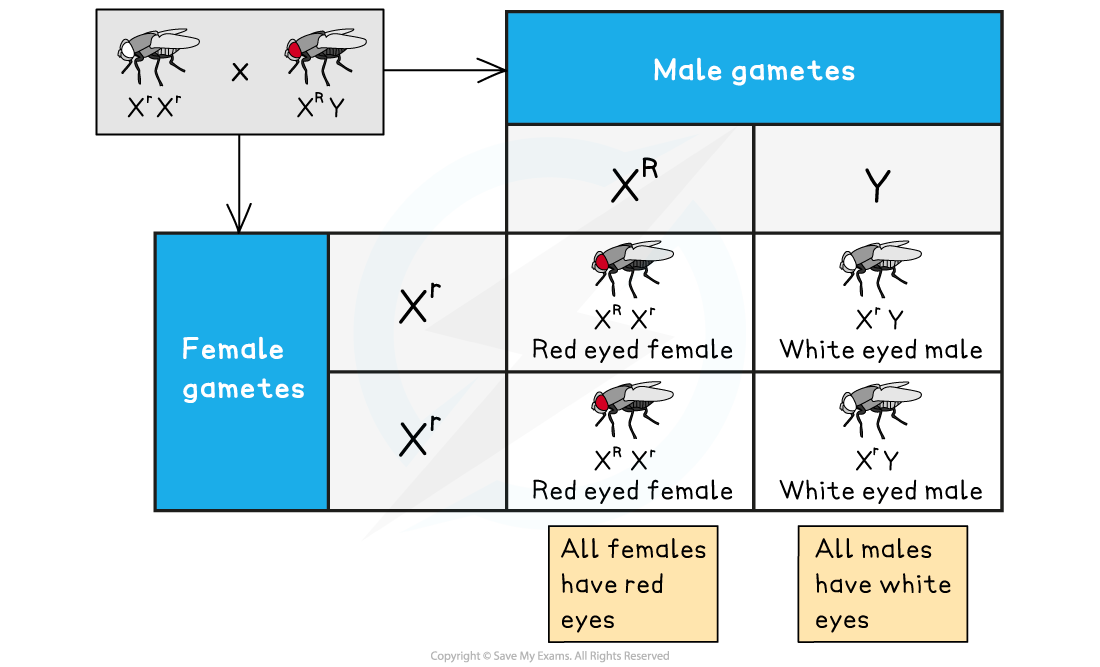
Sex linkage in Drosophila. A cross between a homozygous white-eyed female and a male with red eyes gives all white-eyed males and red-eyed female offspring
Was this revision note helpful?