The Reflex Arc (Edexcel IAL Biology)
Spec point —
8.3
The Reflex Arc
-
The central nervous system (CNS) consists of the brain and spinal cord
- The brain processes information about external and internal stimuli and co-ordinates the body's responses
- The spinal cord connects the brain to the rest of the nervous system as well as coordinating some reflex responses
-
Reflex responses are actions of the body that occur without conscious thought
- Reflexes are automatic and rapid, minimising damage to the body and therefore aiding survival
- Awareness of a reflex response occurs after it has been carried out; this is because the information takes longer to reach the conscious parts of the brain
-
Examples of reflexes include blinking, coughing, and the pupil and knee reflexes
- Blinking prevents the outer surface of the eye from drying out as well as protecting it from foreign objects
- Coughing prevents food from entering the airways and removes mucus from the airways during infection or an allergic reaction
- The pupil reflex prevents damage to the eye from bright light
- The knee reflex aids balance when standing upright
-
A reflex arc is a pathway along which impulses are transmitted from a receptor to an effector without involving conscious regions of the brain
- A reflex arc therefore brings about a reflex response
- Sensory neurones, relay neurones and motor neurones work together in a reflex arc
Spinal reflexes
-
The pathway of a spinal reflex involves relay neurones located in the spinal cord
-
The spinal cord is made up of types of tissue known as grey matter and white matter
- Grey matter contains the cell bodies of motor neurones along with relay neurones
- White matter contains long myelinated axons that carry information through the spinal cord
-
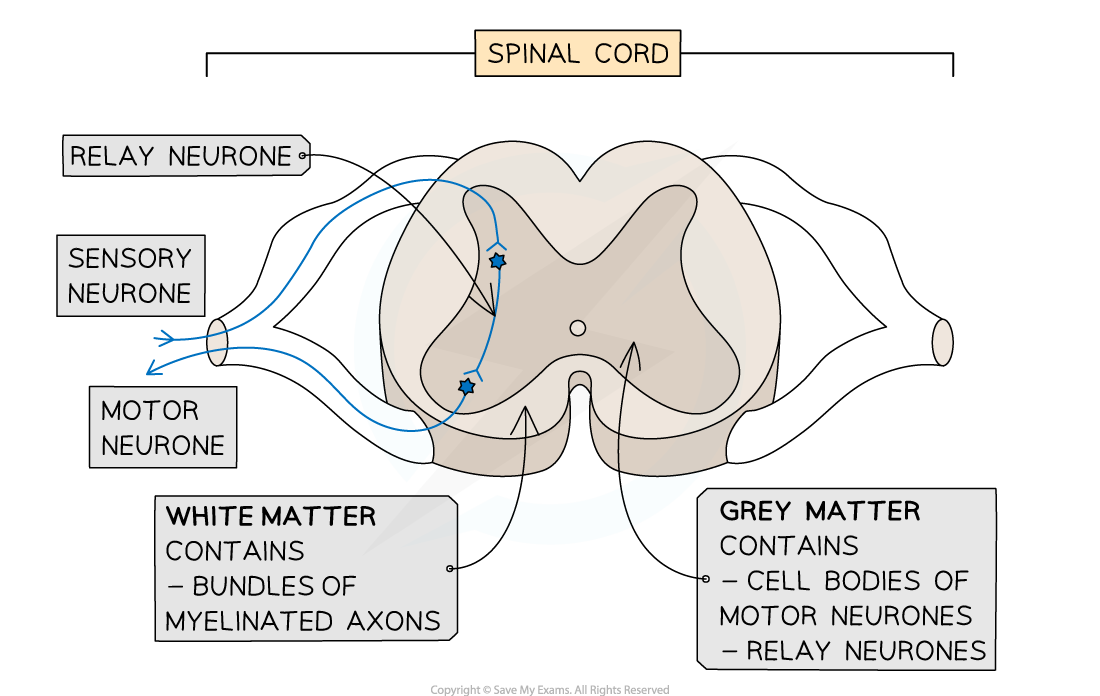
The spinal cord contains both grey matter and white matter
-
Pulling a foot away from a sharp object is an example of a spinal reflex
-
The stimulus of a sharp pin is detected by a receptor cell in the skin of the foot
- The skin has receptors for pressure, touch, and pain
-
A sensory neurone sends electrical impulses to the CNS
-
An electrical impulse is passed to a relay neurone in the spinal cord
-
A relay neurone synapses with a motor neurone
- A synapse is the junction between neurones; nerve impulses cross synapses by diffusion of a chemical called a neurotransmitter
-
A motor neurone carries an impulse to an effector muscle in the leg
-
When stimulated by the motor neurone the muscle will contract and pull the foot up and away from the sharp object; this is the reflex response
-
-
The reflex arc for a spinal reflex is as follows
stimulusreceptorsensory neuronerelay neurone in spinal cordmotor neuroneeffectorresponse
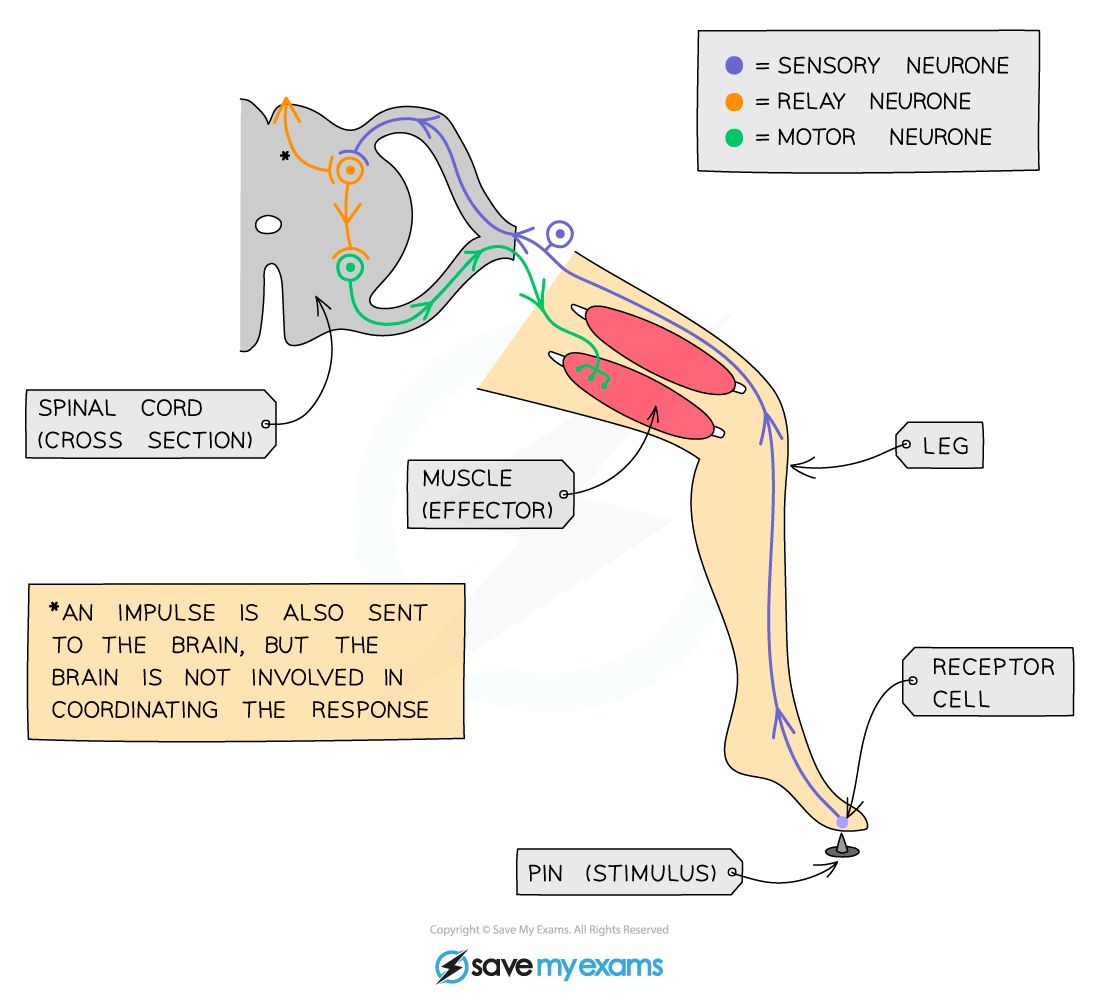
Spinal reflexes involve relay neurones in the spinal cord
Cranial reflexes
-
The pathway of a cranial reflex involves relay neurones located in the brain
-
The pupil reflex is an example of a cranial reflex
-
Changing pupil diameter enables the eye to control the amount of light hitting the retina
-
The diameter of the pupil in the eye is determined by two sets of muscles
- The circular muscles contract to constrict the pupil
- The radial muscles contract to dilate the pupil
-
The two sets of muscles work antagonistically, meaning that when one set of muscles contracts the other relaxes, and vice versa
-
-
When bright light falls on the eye, the following events occur
- The light level is detected by photoreceptors in the retina
- A sensory neurone sends electrical impulses to the CNS
- An electrical impulse is passed to a relay neurone in the brain
- A relay neurone synapses with a motor neurone
- A motor neurone carries an impulse to the effector muscle; in this case the circular muscle in the iris
- When stimulated by the motor neurone the muscle will contract and constrict the pupil; this is the reflex response
-
When in dim light the same process occurs, but the motor neurone stimulates the radial muscles in the iris, causing them to contract and dilate the pupil
-
The reflex arc for a cranial reflex is as follows
stimulusreceptorsensory neuronerelay neurone in brainmotor neuroneeffectorresponse
Was this revision note helpful?