The Musculoskeletal System (Edexcel IAL Biology)
Spec point —
7.9
The Musculoskeletal System
-
The effective movement of the human body requires both muscle and an incompressible skeleton
- This is because muscles will only produce effective movement if they pull on a structure that does not shorten or bend - bone
-
There are over 600 skeletal muscles in the human body
-
Muscles are effectors, stimulated by nerve impulses from motor neurones
-
The muscular system is complex, with multiple muscles crossing over each other in multiple directions
-
Lengths of strong connective tissue called tendons, connect muscles to bones
- They are flexible but do not stretch when a muscle is contracting and pulling on a bone
- There are a few muscles with very long tendons and also a few that are directly attached to the bone
-
Ligaments are also lengths of strong connective tissue but they connect bones to other bones, which keep the skeleton intact
Antagonistic muscle action
-
Muscles are only capable of contracting or pulling, they cannot push
-
As a result of this limitation muscles generally operate in pairs
-
A muscle pulls in one direction at a joint and the other muscle pulls in the opposite direction
- This is described as antagonistic muscle action
-
An example of this can be seen in the biceps and triceps of the arm
-
To raise the lower arm
- The bicep contracts and the tricep relaxes
- As the bone can't be stretched the arm flexes around the joint
- A muscle that bends a joint during contraction is known as a flexor (the bicep in this case)
- This brings the tricep into its full length so that it can contract again
-
To lower the lower arm
- The tricep contracts and bicep relaxes
- As the bone can't be stretched the arm flexes around the joint
- A muscle that straightens a joint during contraction is known as an extensor (the tricep in this case)
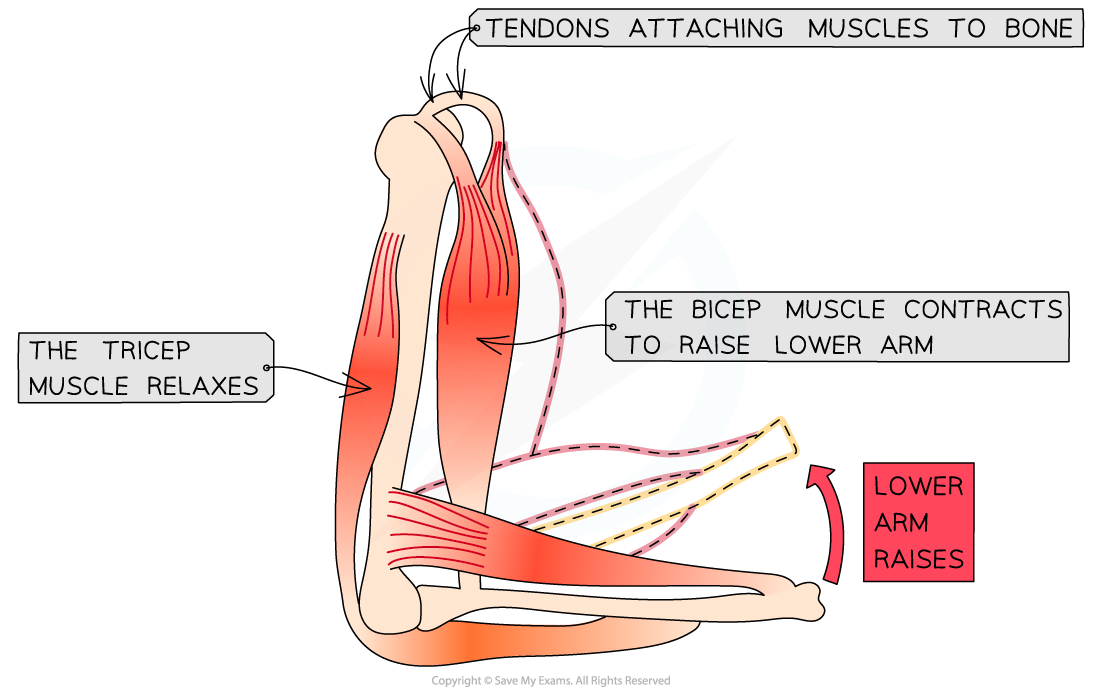
Antagonistic muscle action: the two muscles work together by pulling in opposite directions
Was this revision note helpful?