Chloroplasts (Edexcel IAL Biology)
Exam board Pearson Edexcel · IALUpdated 2026-07-02
Chloroplasts: Structure & Function
Spec point —
5.5
-
Chloroplasts are the organelles in plant cells where photosynthesis occurs
-
Each chloroplast is surrounded by a double-membrane known as the chloroplast envelope
- Each of the envelope membranes is a phospholipid bilayer
-
Chloroplasts are filled with a cytoplasm-like fluid known as the stroma
- The stroma contains enzymes and sugars, as well as ribosomes and chloroplast DNA
- If the chloroplast has been photosynthesising there may be starch grains or lipid droplets in the stroma
-
A separate system of membranes is found in the stroma
- This membrane system consists of a series of flattened fluid-filled sacs known as thylakoids, each surrounded by a thylakoid membrane
- Thylakoids stack up to form structures known as grana (singular granum)
- Grana are connected by membranous channels called **lamellae **(singular lamella), which ensure the stacks of sacs are connected but distanced from each other
-
Several components that are essential for photosynthesis are** embedded in the thylakoid membranes**, including:
- ATP synthase enzymes
- Proteins called photosystems that contain photosynthetic pigments such as chlorophyll a, chlorophyll b, and carotene
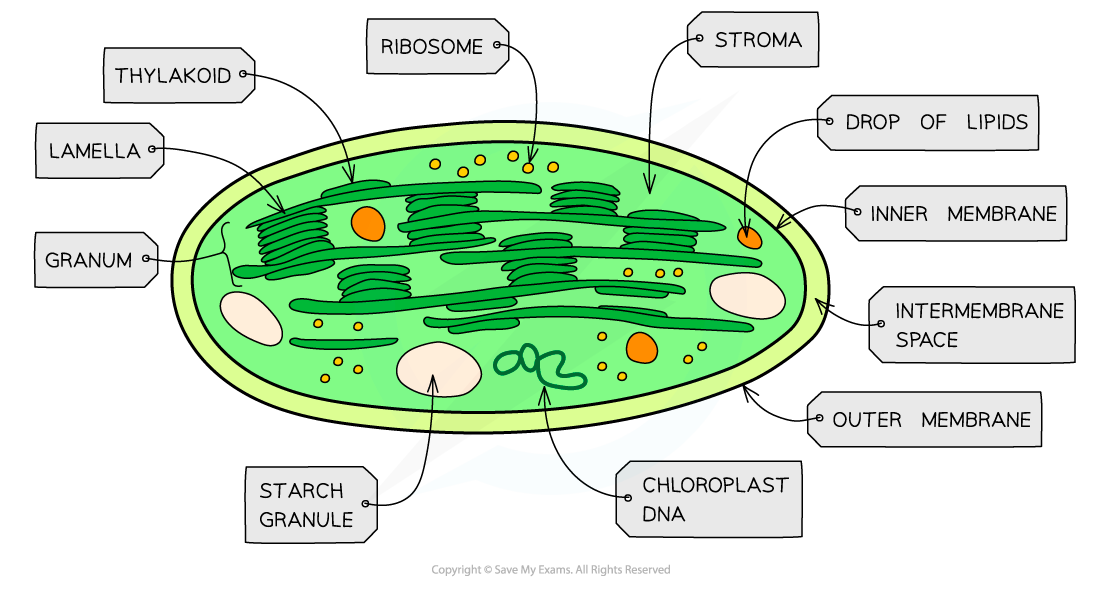
Chloroplasts are the site of photosynthesis
Chloroplast structure is related to function
-
Chloroplast envelope
- The double membrane encloses the chloroplast, keeping all of the components needed for photosynthesis close to each other
- The transport proteins present in the inner membrane control the flow of molecules between the stroma and cytoplasm
-
Stroma
- The gel-like fluid contains enzymes that catalyse the reactions of photosynthesis
-
DNA
- The chloroplast DNA contains genes that code for some of the proteins used in photosynthesis
-
Ribosomes
- Ribosomes enable the *translation of proteins coded by the chloroplast DNA
-
Thylakoid membrane
- There is a space between the two thylakoid membranes known as the thylakoid space, in which conditions can differ from the stroma e.g. a proton gradient can be established between the thylakoid space and the stroma
- The space has a very small volume so a proton gradient can develop very quickly
-
Grana
- The grana create a large surface area, maximising the number of photosystems and allowing maximum light absorption
- Grana also provide more membrane area for proteins such as electron carriers and ATP synthase enzymes, which together enable the production of ATP
-
Photosystems
- There are two types of photosystems; photosystem I and photosystem II, containing different combinations of photosynthetic pigments such as chlorophyll a, chlorophyll b, and carotene
- Each photosystem absorbs light of a different wavelength, maximising light absorption e.g. photosystem I absorbs light at a wavelength of 700 nm while photosystem II absorbs light at a wavelength of 680 nm
Was this revision note helpful?