Ecological Productivity (Edexcel IAL Biology)
Spec point —
5.9
Ecological Productivity
-
During photosynthesis organisms such as plants convert light energy into chemical energy stored in biological molecules
- Organisms that do this are known as **producers **
-
The** rate** at which producers convert light energy into chemical energy is known as primary productivity
-
Gross primary productivity, or GPP, can be defined as the rate at which chemical energy is converted into carbohydrates during photosynthesis
-
Net primary productivity, or NPP, is the GPP minus plant respiratory losses
- Of the total energy stored in glucose during photosynthesis, 90 % will be released from glucose to create ATP for the plant during respiration
- 90 % of the energy originally converted by the plant will therefore not be stored as new plant biomass and will not be available to be passed on* to herbivores, also known as primary consumers
-
The NPP can therefore be defined as the rate at which energy is stored in plant biomass
- NPP is important because it represents the energy that is available to organisms at higher trophic levels* in the ecosystem, such as primary consumers and decomposers
-
Net primary productivity can be calculated using the equation
NPP = GPP - R
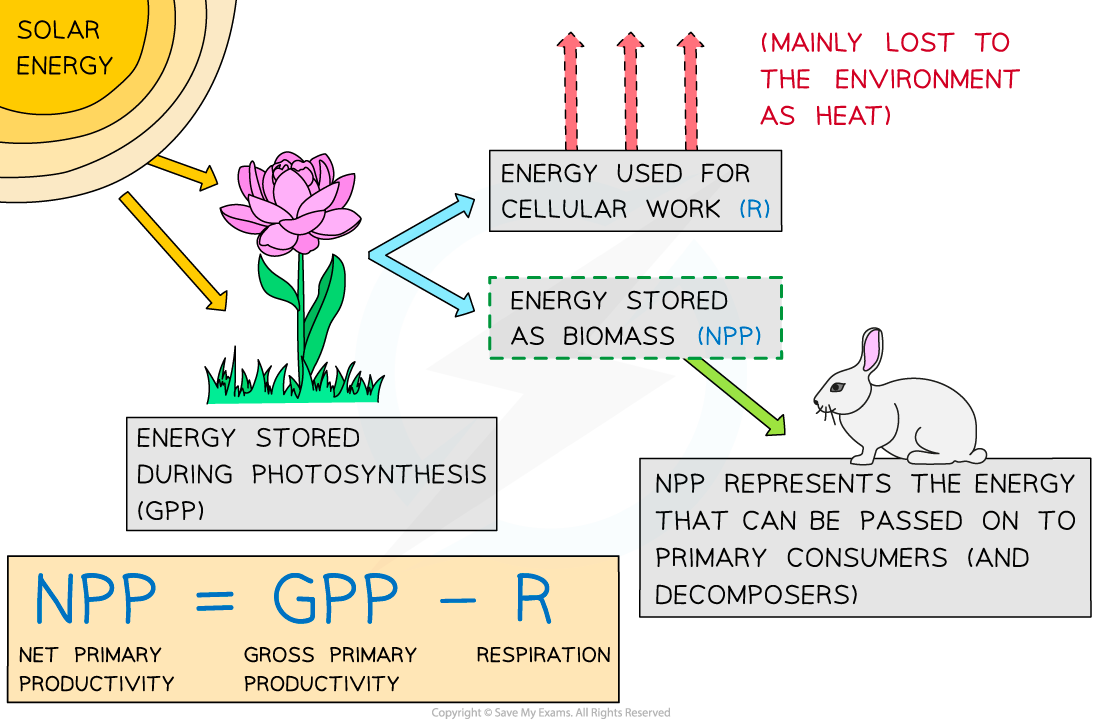
Net primary productivity, or NPP, is the rate at which energy is stored in plant biomass and made available to primary consumers.
Calculation of Ecological Productivity
Spec point —
5.9
- Net primary productivity can be calculated using the equation
NPP = GPP - R
-
Where
- NPP = net primary productivity; the rate at which light energy is stored in plant biomass
- GPP = gross primary productivity; the rate at which light energy is converted into carbohydrates during photosynthesis
- R = respiratory losses; the carbohydrates used up by the plant that are not stored in plant biomass
-
NPP is expressed in units of energy per unit area or volume per unit time e.g.
-
Using area: J m–2 yr-1 (joules per square metre per year)
-
Using volume: J m–3 yr-1 (joules per cubic metre per year)
- Volume would be used when calculating NPP in aquatic habitats
-
Worked Example The grass in a meadow habitat converts light energy into carbohydrates at a rate of 17 500 kJ m-2 yr-1. The grass releases 14 000 kJ m-2 yr-1 of that energy during respiration. Calculate the net primary productivity of the grass in the meadow habitat.
Answer:
Step 1: Work out which numbers correspond to which parts of the equation
The meadow grass converts 17 500 kJ m-2 yr-1 into carbohydrates; this is its GPP
The meadow grass releases 14 000 kJ m-2 yr-1 of that energy in respiration; this is R
Step 2: Substitute numbers into the equation
NPP = GPP - R
NPP = 17 500 - 14 000
Step 3: Complete calculation
17 500 - 14 000 = 3 500
NPP = 3 500 kJ m-2 yr-1
Exam Hint The worked example above uses the equation in its basic form, but you may also be expected to rearrange the equation e.g. to calculate GPP or R
- If a question provides you with the NPP and R and asks you to calculate GPP, you will need to use the equation
GPP = NPP + R
- If a question provides you with the NPP and the GPP and asks you to calculate R, you will need to use the equation
R = GPP - NPP
Was this revision note helpful?