Potential Difference in Circuits (Cambridge International IGCSE Science)
Potential difference in series circuits
Extended Tier Only
- In a series circuit, the sum of potential differences across the components is equal to the total e.m.f. (electromotive force) of the power supply
Potential difference in a series circuit
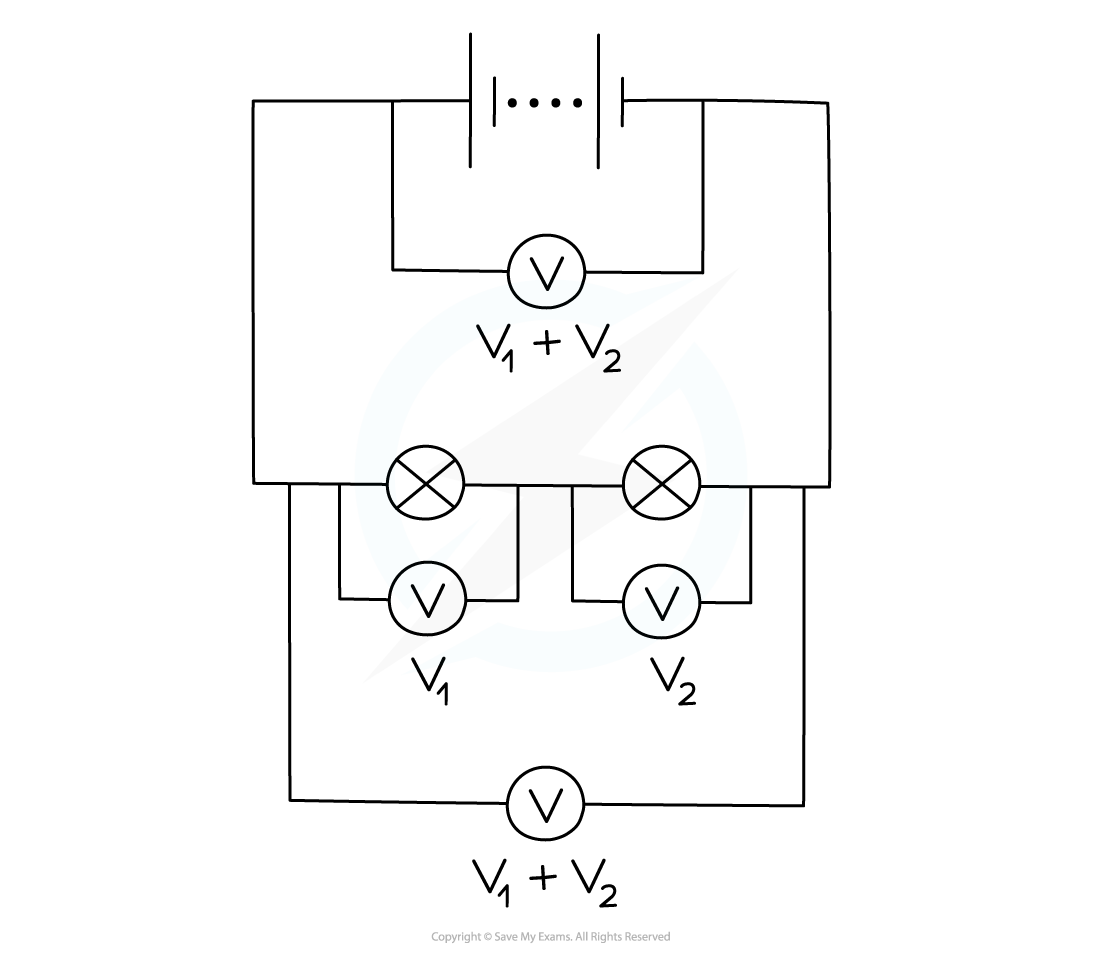
In a series circuit the components share the e.m.f. of the power supply
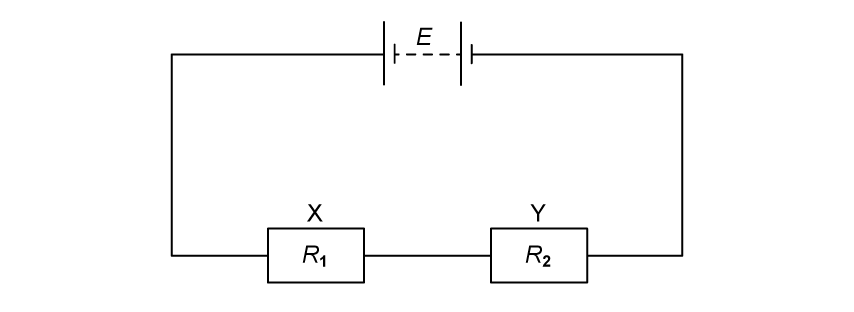
Worked Example In the circuit diagram below, the power source has an e.m.f., E, of 16 V. There is a potential difference of 10 V across component X. Calculate the potential difference across component Y.
Answer:
Step 1: Recall the rule for potential difference in series
- The sum of potential differences across components in series is equal to the e.m.f. across the power source
Step 2: Write an equation to determine the potential difference across Y
E = VX* *+ VY
Where:
- E is the e.m.f. of the power source = 16 V
- VX is the potential difference across X = 10 V
- VY is the potential difference across Y
Recall that:
- E = 16 V
- VX = 10 V
Step 3: Substitute in the known quantities and calculate VY
16 = 10 + VY
- Therefore, the potential difference across Y is 6 V
Potential difference in parallel circuits
Potential difference in a parallel circuit
Extended Tier Only
- The potential difference across each branch of a parallel circuit is the same as the e.m.f. of the power source
Potential difference in a parallel circuit
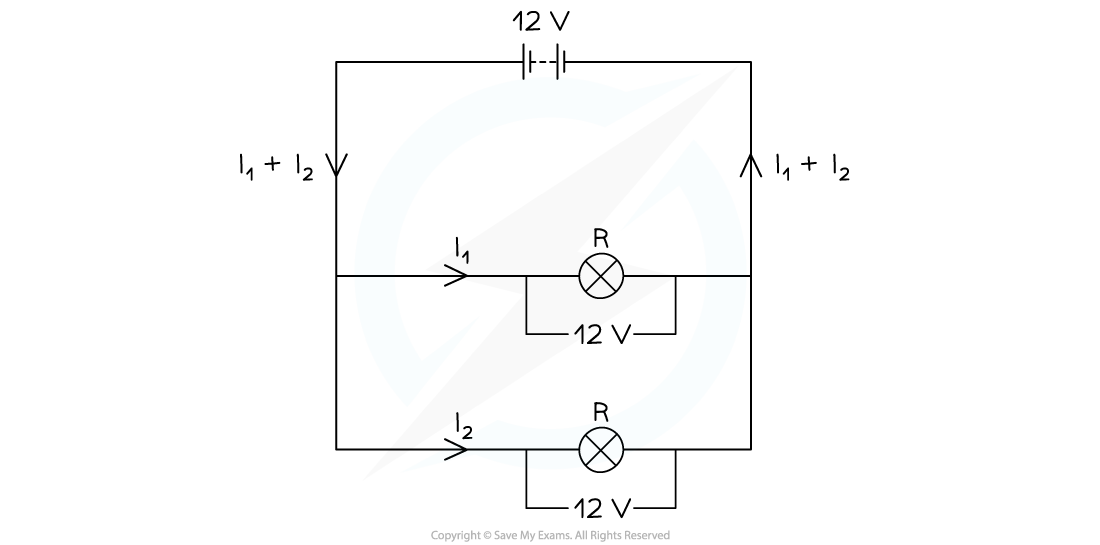
The power source has an e.m.f .of 12 V and there is a potential difference of 12 V across each branch
-
It is important to notice that the potential difference in a parallel circuit is equal across each branch
- In the example above, if one branch in the circuit contained multiple components, the 12 V would be split between the components on that branch
Was this revision note helpful?
Build on this topic