Newton's Second Law (Cambridge International IGCSE Science)
Newton's second law
Extended Tier Only
-
Newton's second law of motion states: The acceleration of an object is proportional to the resultant force acting on it and inversely proportional to the object's mass
-
Newton's second law of motion explains what happens when a non-zero resultant force acts on an object
-
A resultant force occurs when the forces acting on an object are not balanced
-
A resultant force acting on an object will cause a change in the object's motion
-
This change in motion is:
- Acceleration if the object speeds up
- Deceleration if the object slows down
-
If the resultant force on an object is not zero, the object will accelerate in the direction of the resultant force
-
The bigger this resultant force, the larger the acceleration
-
For a given force, the greater the object's mass, the smaller the acceleration experienced
Examples of Newton's second law
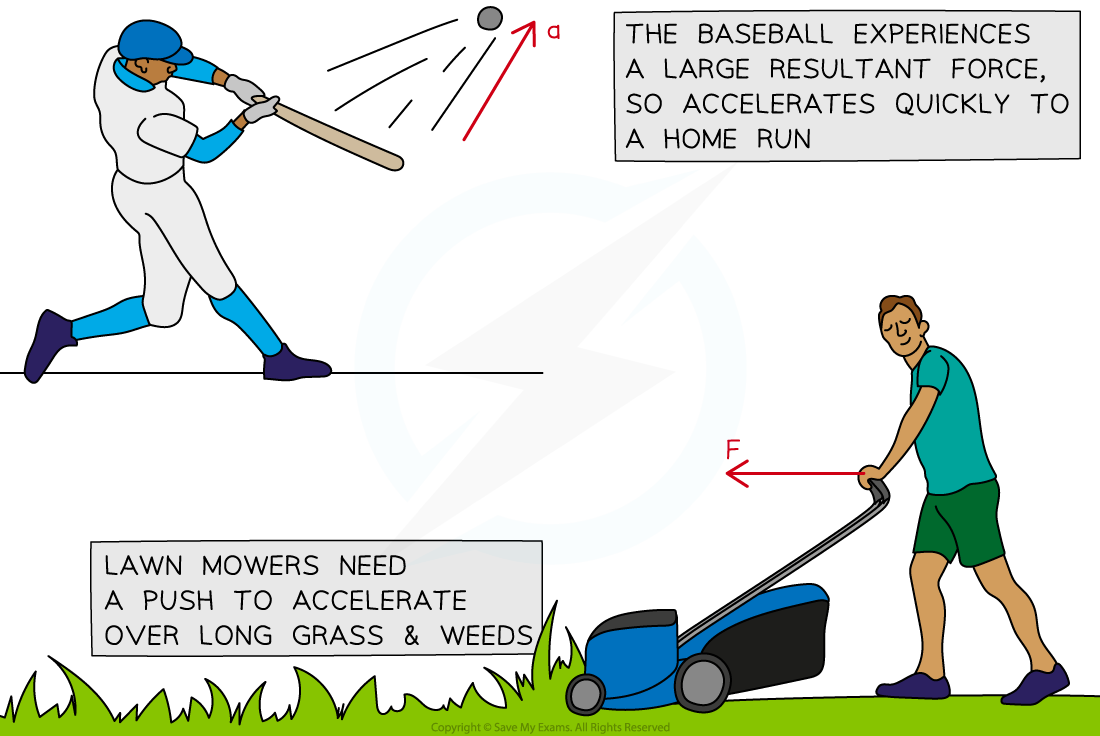
Objects like baseballs and lawnmowers accelerate when a resultant force is applied on them. The size of the acceleration is proportional to the size of the resultant force
Calculations using Newton's second law
- Newton's second law can be expressed as an equation:
-
Where:
- F = resultant force on the object, measured in newtons (N)
- m = mass of the object, measured in kilograms (kg)
- a = acceleration of the object, measured in metres per second squared (m/s2)
-
The acceleration occurs in the same direction as the resultant force
Formula triangle for acceleration, mass and resultant force
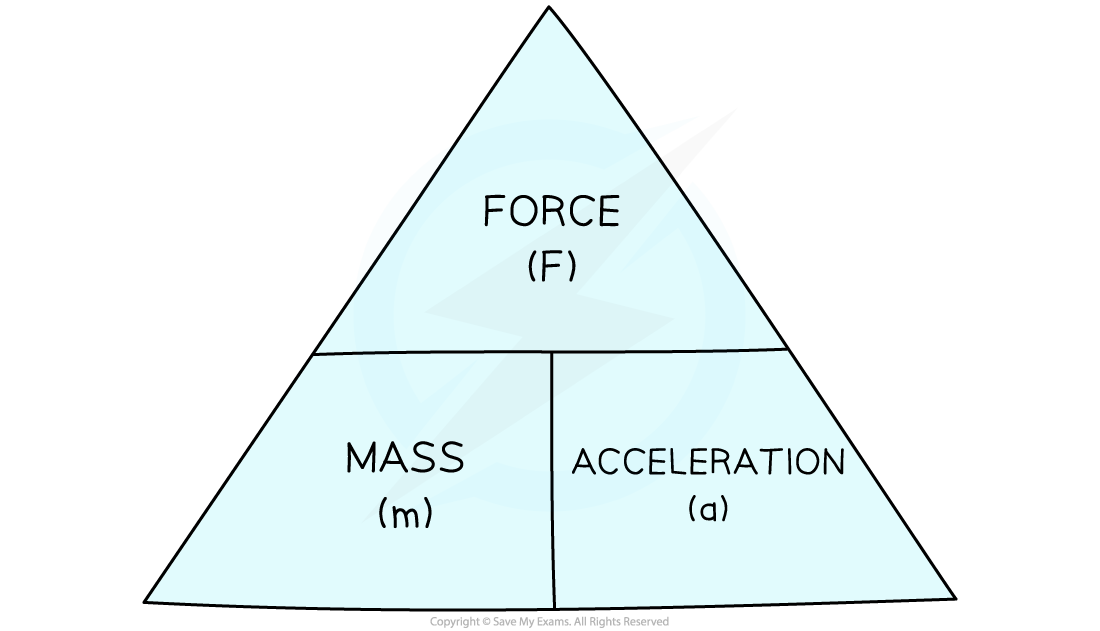
To use a formula triangle, simply cover up the quantity you wish calculate and the structure of the equation is revealed
- A more detailed explanation of how to use formula triangles is covered in the revision note Speed
Worked Example A car salesman says that their best car has a mass of 900 kg and can accelerate from 0 to 27 m/s in 3 seconds.
Calculate:
a) the acceleration of the car in the first 3 seconds.
b) the force required to produce this acceleration.
Answer:
Part (a)
Step 1: List the known quantities
- Initial speed,
- Final speed,
- Time,
Step 2: State the equation for acceleration, in terms of change in speed
Part (b)
Step 1: List the known quantities
- Mass of the car,
- Acceleration,
Step 2: Identify which law of motion to apply
- The question involves quantities of force, mass and acceleration, so Newton's second law is required:
Step 3: Calculate the force required to accelerate the car
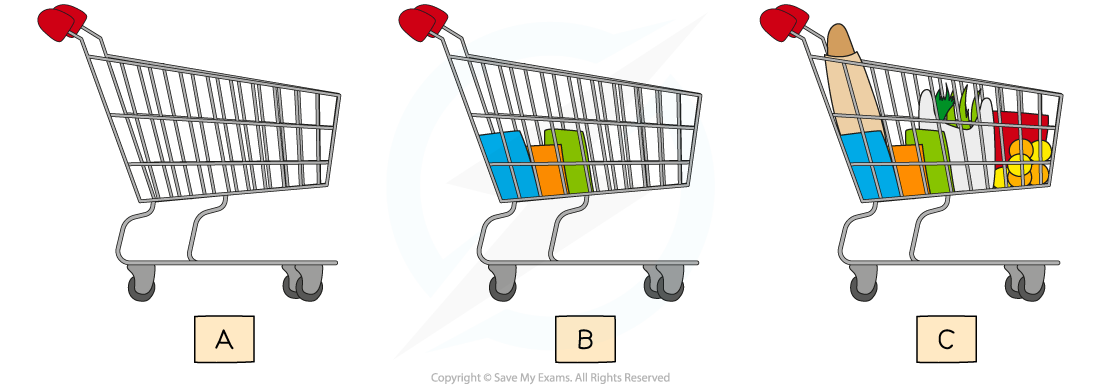
Worked Example Three shopping trolleys, A, B and C, are being pushed using the same force. This force causes each trolley to accelerate.
State which trolley would have the smallest acceleration. Explain your answer.
Answer: C
Step 1: Identify which law of motion to apply
- The question involves quantities of force and acceleration, and the image shows trolleys of different masses, so Newton's second law is required:
Step 2: Re-arrange the equation to make acceleration the subject
Step 3: Explain the inverse proportionality between acceleration and mass
- Acceleration is inversely proportional to mass
- This means that for the same amount of force, a large mass will experience a small acceleration
- Therefore, trolley C will have the smallest acceleration because it has the largest mass
Was this revision note helpful?
Build on this topic