11 markmedium
Two resistors are connected in series to a 12 V battery.
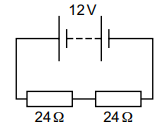
What is the current in one of the resistors?
Choose your answer
0.25 A
0.50 A
2.0 A
4.0 A
28 questions · 82 marks · ≈ 1 hour · spans 10 of 14 topics
Assembled from the topic question banks — not an official Cambridge International paperTwo resistors are connected in series to a 12 V battery.
What is the current in one of the resistors?
Choose your answer
0.25 A
0.50 A
2.0 A
4.0 A
(i) A spacecraft has a mass of 3.1 × 10³ kg.
Calculate the weight of the spacecraft on the surface of the Earth.
Include the unit in your answer.
(3 marks)
(ii) The spacecraft is launched into space. The spacecraft accelerates as it moves upwards through the Earth’s atmosphere.
State what is meant by accelerates.
(1 mark)
(iii) The spacecraft travels from the Earth to the Moon in 3.2 days.
Calculate the number of hours in 3.2 days.
(1 mark)
(iv) The distance from the Earth to the Moon is 384 000 km.
Use your answer to (a)(iii) to calculate the average speed of the spacecraft in km/h.
(2 marks)
(v) The spacecraft is controlled by radio waves sent from the Earth.
State whether the radio waves travel to the spacecraft faster, slower or at the same speed as visible light.
Give a reason for your answer.
speed: ..........................................................................................................
reason: .........................................................................................................
(1 mark)
The Earth orbits the Sun at an average distance of and takes for one orbit.
Calculate the orbital speed of the Earth around the Sun in .
State the name of the galaxy that contains the Sun.
The diagram shows a 12 V battery connected to an ammeter and two resistors.
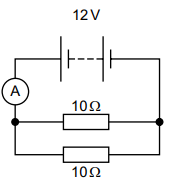
What is the reading on the ammeter?
Choose your answer
0.60 A
1.2 A
2.4 A
60 A
Table 9.1 gives some data about five substances.
Table 9.1
| aluminium | ethanol | poly(ethene | sulfur | water | |
|---|---|---|---|---|---|
| density in g / cm3 | 2.7 | 0.8 | 0.9 | 2.0 | 1.0 |
| state at 25 °C | solid | liquid | solid | solid | liquid |
| electrical property | conductor | insulator | insulator | insulator |
State the electrical property of poly(ethene)
Give a reason for your answer.
electrical property: ..................
reason: ..................
The student climbs a step into the school.
The student has a mass of 55 kg. The step is 0.15 m high.
Calculate the increase in the gravitational potential energy of the student climbing the step.
Include the unit in your answer.
(Take g = 9.8 N/kg)
A solid block has a density of 1.1 g/cm3.
The block is lowered into three liquids, X, Y and Z, with different densities.
The densities of the liquids are:
liquid X: 1.0 g/cm3
liquid Y: 1.2 g/cm3
liquid Z: 1.3 g/cm3
In which of the liquids does the block float?
Choose your answer
in liquid X only
in liquids Y and Z only
in liquids X, Y and Z
in none of the liquids
A rock has a mass of 20 kg. The rock is at rest at a height of 5.0 m above the ground.
It then falls to the ground.
What is the speed of the rock just before it hits the ground?
Choose your answer
7.0 m/s
9.9 m/s
44 m/s
98 m/s
A planet orbits the Sun with an orbital speed of 48 km/s. The radius of the orbit is 5.7 × 10⁷ km.
What is the orbital period of the planet?
Choose your answer
3.7 × 10⁶ s
7.5 × 10⁶ s
8.6 × 10⁹ s
1.7 × 10¹⁰ s
Billions of years in the future, the Sun will enter the next stage of its life cycle.
(i) State the next stage in the life cycle of the Sun.
(1 mark)
(ii) Explain why the Sun will not become a black hole at the end of its life cycle.
(1 mark)
A sample of a substance has a definite shape and a definite volume.
The substance changes state. The sample now has no definite shape but still has a definite volume.
What is the name of the change of state?
Choose your answer
condensation
evaporation
freezing
melting
(i) Thermal energy transfer from the Sun to the Earth is mainly due to radiation in one region of the electromagnetic spectrum.
State the name of this region.
(1 mark)
(ii) Electromagnetic radiation from the Sun heats the Earth.
Circle the correct words or phrases to complete the paragraph.
The temperature of the Earth is increasing. This is because the amount of radiation absorbed / emitted by the Earth from the Sun is greater than / less than the amount of radiation absorbed / emitted by the Earth into space.
(1 mark)
Earthquakes produce seismic P-waves (primary) and seismic S-waves (secondary). P-waves are longitudinal and S-waves are transverse.
(i) State one other type of longitudinal wave.
(1 mark)
(ii) Describe the difference between transverse waves and longitudinal waves.
(2 marks)
The diagram shows a battery that is connected to three LEDs, P, Q and R.
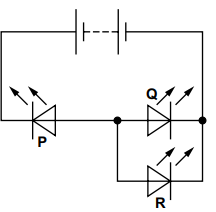
Which of the LEDs are lit?
Choose your answer
P only
P and Q only
Q and R only
none of them
A quantity is defined as 'the electrical work done by a source in moving a unit charge around a complete circuit'.
What is the quantity?
Choose your answer
electric current
electromotive force (e.m.f.)
potential difference (p.d.)
resistance
The diagram shows a force of 200 N pulling an object up a slope. The object moves 5.0 m along the slope.
The object moves 3.0 m vertically upwards and 4.0 m horizontally.
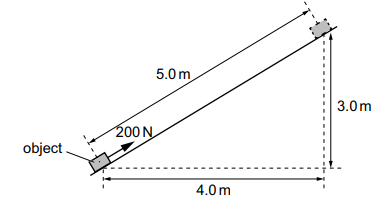
How much work is done by the 200 N force?
Choose your answer
600 J
800 J
1000 J
1400 J
A student determines the density of the material used to make a metre rule.
Fig. 4.1 shows the metre rule (not drawn to scale).
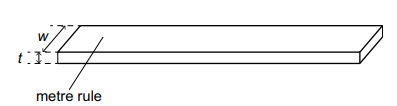
Fig. 4.1 (not to scale)
(i) On Fig. 4.1, draw a double-headed arrow (↔) to show the length L of the metre rule.
(1 mark)
(ii) Fig. 4.2 shows the actual size of the end of the metre rule.
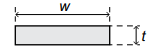
Fig. 4.2 (actual size)
Use a ruler to measure width w and thickness t of the metre rule in Fig. 4.2.
Record each measurement to the nearest 0.1 cm.
(2 marks)
(iii) The measurements in (a)(ii) are recorded to the nearest 0.1 cm.
State why it is not appropriate to record the measurements to the nearest 0.01 cm.
(1 mark)
(iv) The length L of the metre rule is 100.0 cm.
Calculate the volume V of the metre rule.
Use your answers to (a)(ii) and the equation shown.
(1 mark)
The student determines the mass M of the metre rule using a balancing method.
Procedure
The student:
step 1 places a pivot directly under the 60.0 cm mark on the metre rule.
Fig. 4.3 shows the distance d = 60.0 cm.
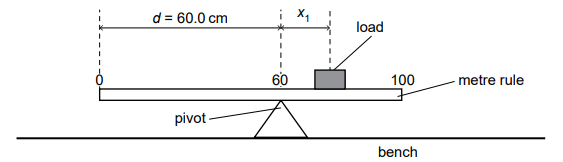
Fig. 4.3 (not to scale)
step 2 places a load on the metre rule and adjusts the position of the load so that the rule balances
step 3 records that the centre of the load is directly above the 67.1 cm mark on the metre rule.
(i) Calculate the distance from the centre of the load to the pivot.
(1 mark)
step 4 moves the pivot so that distance d = 70.0 cm
step 5 adjusts the position of the load so that the metre rule balances
step 6 records that the centre of the load is directly above the 84.2 cm mark on the metre rule
(ii) Calculate the distance from the centre of the load to the pivot.
(1 mark)
(iii) Use the results for (b)(i) and (b)(ii) to calculate the mass M of the metre rule.
Use the equation shown.
M = 5 \left(\right. x_{1} + x_{2} \left.\right)
(1 mark)
Fig. 4.4 shows apparatus used for measuring mass.
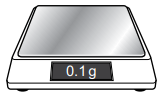
Fig. 4.4
(i) State the name of the apparatus shown in Fig. 4.4.
(1 mark)
(ii) The apparatus in Fig. 4.4 is showing an error.
State the type of error shown in Fig. 4.4.
(1 mark)
Use your answers to (a)(iv) and (b)(iii) to calculate the density ρ of the material used to make the metre rule.
Use the equation shown.
Give your answer to two significant figures.
Give the unit for your answer.
The diagrams show four distance–time graphs.
Which graph represents the motion of an object that is at rest?
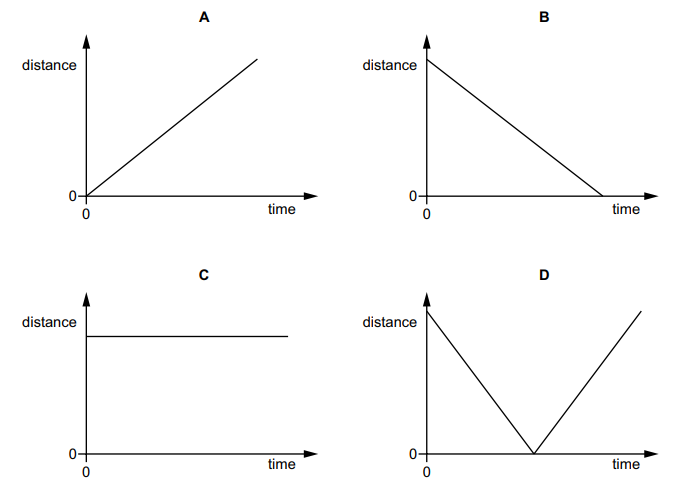
Choose your answer
The Earth orbits the Sun as part of the Solar System.
State the name of the planet that orbits closest to the Sun.
Which sequence is part of the life cycle of a small star (about the same size as the Sun)?
Choose your answer
red giant → planetary nebula + white dwarf
red giant → supernova → black hole
red supergiant → planetary nebula + black hole
red supergiant → supernova → white dwarf
Which statement about thermal radiation is correct?
Choose your answer
It can travel through a vacuum.
It is absorbed more quickly by shiny surfaces than by dull surfaces.
It is emitted more quickly by shiny surfaces than by dull surfaces.
It is mainly ultraviolet radiation.
A seismic P-wave (primary) passes through the ground.
What is the nature of this wave and what is the direction of vibration of the ground as the P-wave passes through it?
| nature of P-wave | direction of vibration | |
|---|---|---|
| A | longitudinal | at right angles to direction of propagation |
| B | longitudinal | parallel to direction of propagation |
| C | transverse | at right angles to direction of propagation |
| D | transverse | parallel to direction of propagation |
Choose your answer
Fig. 7.1 shows an electric heater connected in a circuit.
Fig. 7.1
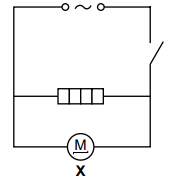
(i) State the name of component X.
(1 mark)
(ii) The current in component X is 0.5 A.
The current in the heater is 8.3 A.
Circle the value of the current from the source.
0.5 A7.8 A8.3 A8.8 A
(1 mark)
(iii) The electric heater uses 2.0 kW of electrical power.
Electrical energy costs $0.15 per kWh.
Calculate the cost of using the heater for 5.5 hours.
(2 marks)
An electric heater and an electric motor are connected to a mains power supply.
The power of the heater is 3.0 kW and the power of the motor is 1.0 kW.
The cost of electricity is $0.20 per kWh.
What is the total cost of using the heater and the motor for 5.0 hours?
Choose your answer
$0.12
$0.16
$3.00
$4.00
Fig. 9.1 shows a circuit used in a toy car.
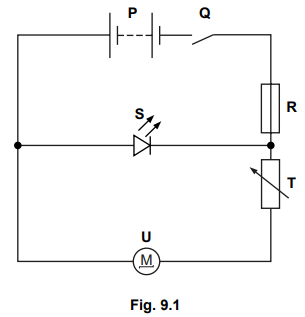
Fig. 9.1
(i) The resistance of component T is . The resistance of component U is .
Calculate the combined resistance of components T and U.
(1 mark)
(ii) The current in component R is 2.7 A. The current in component T is 2.5 A.
Determine the current in component S and component U.
(2 marks)
(iii) State the name of component S.
(1 mark)
Component U is an electric motor. When the motor is switched on, the toy car moves.
(i) Complete Fig. 9.2 to show one energy transfer that occurs.
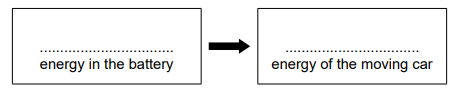
Fig. 9.2
(2 marks)
(ii) The toy car moves for 10 s.
The power input to the motor is 3.6 W.
The useful energy output by the motor is 32 J.
Show that the efficiency of the motor is 89 \%.
(3 marks)
You are going to determine the density of the material used to make a metre rule.
Fig. 4.1 shows the length L, width w and thickness t of a metre rule.
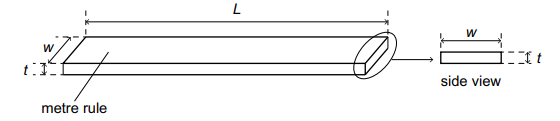
Fig. 4.1 (not to scale)
(i) Use the ruler to measure the width w and thickness t of your metre rule.
Record each measurement to the nearest .
(2 marks)
(ii) The measurements in (a)(i) are recorded to the nearest .
State why it is not appropriate to record the measurements to the nearest .
(1 mark)
(iii) The length L of the metre rule is .
Calculate the volume V of the metre rule.
Use your answers to (a)(i) and the equation shown.
(1 mark)
You are going to determine the mass M of the metre rule using a balancing method.
(i) Procedure
step 1 Place the pivot directly under the 60 cm mark on the metre rule.
Fig. 4.2 shows distance d = 60.0 cm.
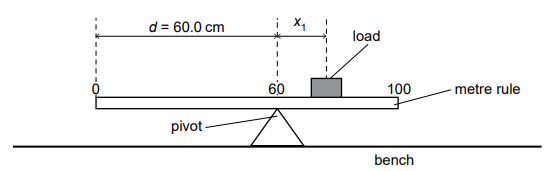
Fig. 4.2
step 2 Place the load on the metre rule.
step 3 Adjust the position of the load until the metre rule is as close to balance as possible.
Measure distance x1 from the centre of the load to the pivot.
(1 mark)
(ii) Procedure
step 4 Remove the load.
step 5 Move the pivot to directly underneath the 70 cm mark so that distance d = 70.0 cm.
step 6 Repeat step 2 and step 3 in (b)(i).
Measure distance X2 from the centre of the load to the pivot.
(2 marks)
(iii) Use your results for (b)(i) and (b)(ii) to calculate the mass M of the metre rule.
Use the equation shown.
M = 5 (x1 + x2)
(2 marks)
(iv) State one practical difficulty involved in using this method to determine M.
(1 mark)
Use your answers to (a)(iii) and (b)(iii) to calculate the density ρ of the material used to make the metre rule.
Use the equation shown.
Give your answer to two significant figures.
Give the unit for your answer.
Fig. 7.1 shows a speed–time graph for a student walking to school.
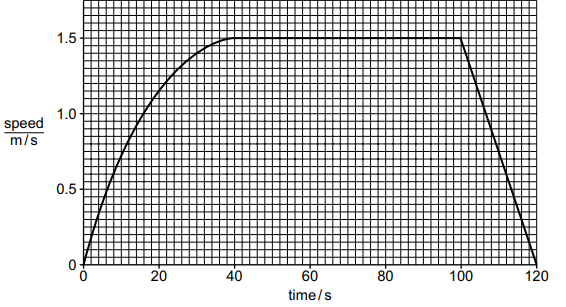
Fig. 7.1
(i) Determine the time taken by the student to reach maximum speed.
(1 mark)
(ii) On Fig. 7.1, write an X at a point on the graph when the student is decelerating.
(1 mark)
(iii) Determine the distance the student walks at constant speed.
(3 marks)