Celebration of Shabbat (Cambridge International IGCSE Religious Studies)
Synagogue services for Shabbat
What is Shabbat?
-
Shabbat is a **day of rest **for Jews
-
It originates from the creation story, as told in Genesis, which says that** G-d** rested on the seventh day after creating the world
- This idea is also repeated in the book of Exodus:
blockquote “It is a sign forever that in a six day period, G-d made heaven and Earth, and on the seventh day, he rested” (Exodus 31:17)
-
The day also connects Jews to their ancestors, who were enslaved
- Not working on Shabbat is a sign of freedom for Jews
-
During Shabbat, Jews are expected to rest and spend time with their family
-
They are forbidden by Jewish law from taking part in several categories of work:
- These include creating or extinguishing fire, writing and repairing things
-
Many Jews will also avoid all other kinds of work
-
What synagogue services are there for Shabbat?
-
During Shabbat, three main services take place in the synagogue, which most Jews attend
-
On Friday evening, Shabbat is welcomed with special prayers, **hymns **and psalms
-
On Saturday morning,**** there are readings from the Torah and the Nevi’im
- This is considered to be the main service of the week
- This service is called Shacharit Shabbat
- These services vary between synagogues but share a similar overall structure
-
On Saturday evening, there are more prayers and readings from the Torah
- The Havdalah ceremony marks the end of Shabbat
-
Friday evening meal preparation
What happens during the Friday evening meal preparation?
-
On Friday evening, the focus of Shabbat is a meal that brings the **family **together
-
All of the food for the** Friday night meal**(and usually Saturday meals) is prepared in advance, as cooking is not allowed during Shabbat
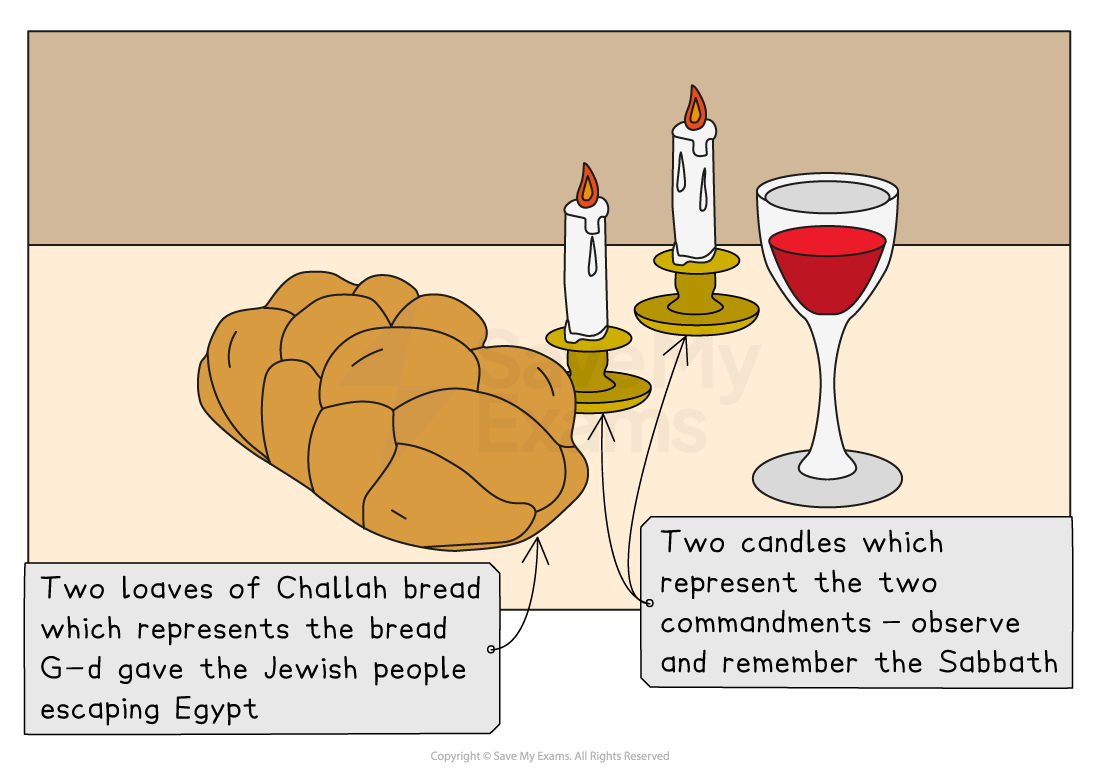
- A festive table is set with a white tablecloth, candles, wine or grape juice and challah covered with a decorative cloth
- The day of rest is welcomed with the lighting of the two candles
- Traditionally, the mother of the family places her hands over her eyes and recites a blessing
- Before the food, more blessings are said for the children, and kiddush is said over the wine to make the evening holy
- Drinking wine shows that it is a joyful, celebratory time
- The challah is blessed, and everyone takes a piece
Shabbat in the home
The Havdalah ceremony
What happens during the Havdalah ceremony?
-
Havdalah(meaning separation) marks the end of Shabbat and the start of the new week
-
It’s a brief, symbolic ritual held after nightfall on Saturday
-
The Havdalah cup of wine is filled to overflowing as an expression of hope, and blessings are said:
- Over wine — blessing for the fruit of the vine
- Over spices — smelled to comfort the soul
- Over the candle — thanking G-d for the **light **of fire
-
The** Havdalah blessing** is also said, praising G-d for distinguishing between **holy **and everyday
-
A braided candle with a double wick is used for the ceremony,**** and a spice box is taken into each room of the house
- The hope is that the week to come will be as **sweet **as the smell from the spice box
-
The meal usually lasts for a** few hours**, with everyone enjoying family time, often singing songs and telling religious stories
-
There are certain rituals that mark the end of the ceremony:
- The candle is extinguished in the wine
- Some Jews dip their fingers in the wine for symbolic blessing
- Traditional songs, like Eliyahu HaNavi, are sung
Worked Example Give two artefacts used during Shabbat, and outline how they are used
[4 marks]
Final answer: Answer:
The Havdalah cup of wine is filled to overflowing as an expression of hope, and blessings are said [2]
During the Havdalah ceremony, a spice box is taken into each room of the house. The hope is that the week to come will be as sweet as the smell from the spice box [2]
Exam Hint Here is a summary of the main elements of Shabbat:
Meaning of Shabbat
- A day of rest, commanded in the Ten Commandments
- Celebrates G-d’s creation and liberation from slavery in Egypt
Shabbat Preparation
- Begins Friday before sunset
- Involves cleaning, cooking, setting the table and lighting candles
Shabbat Observance
- Candle lighting: welcoming Shabbat
- Kiddush: blessing over the wine
- Challah: special braided bread with a blessing
- Synagogue services: Friday night and Saturday morning
- No work (Melachot): 39 categories of prohibited activities
Havdalah
- The ceremony marking the end of Shabbat
Learn about all of these elements and also the symbolic meaning of certain practices
Was this revision note helpful?