Extract:
Question stem:
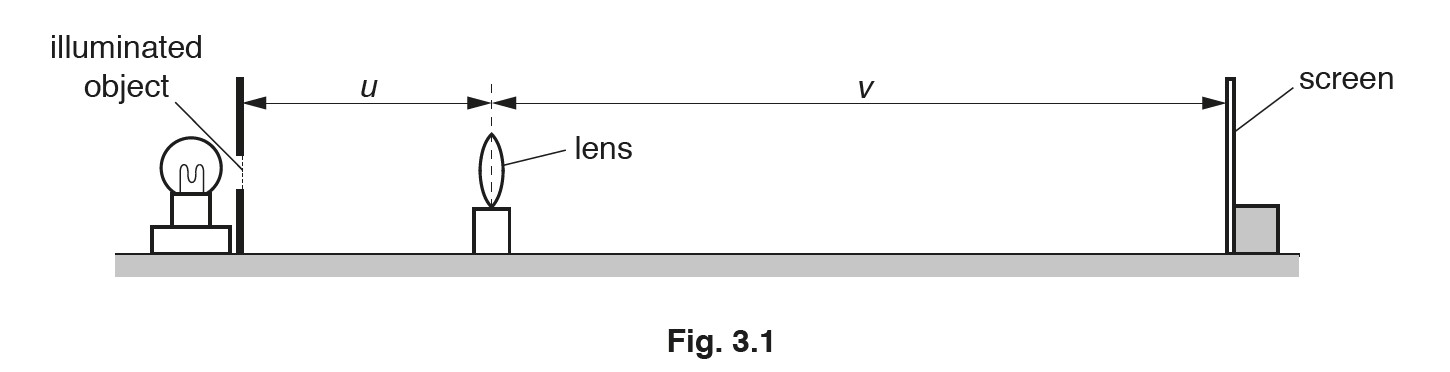
- On the diagram, u = 5.0 cm and v = 7.5 cm
- The diagram is drawn to 1/5 scale, so U = 5.0 × 5 = 25 cm and V = 7.5 × 5 = 37.5 cm
When marking this answer:
- In part (i), the mark needs both U and V correct
- In part (ii), accept f1 correctly calculated from the candidate's own U and V (ecf), for example 15.1 cm from V = 38 cm
- In part (ii), f1 must be given to two or three significant figures and with the unit cm; a bare 15 with no unit does not earn the mark
- In part (iii), "move the screen slowly" or "move the screen backwards and forwards" each earns the mark on its own
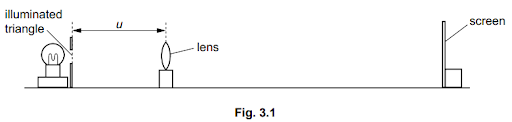
Some students determine the focal length of a converging lens by two different methods. They use the apparatus shown in Fig. 2.1.
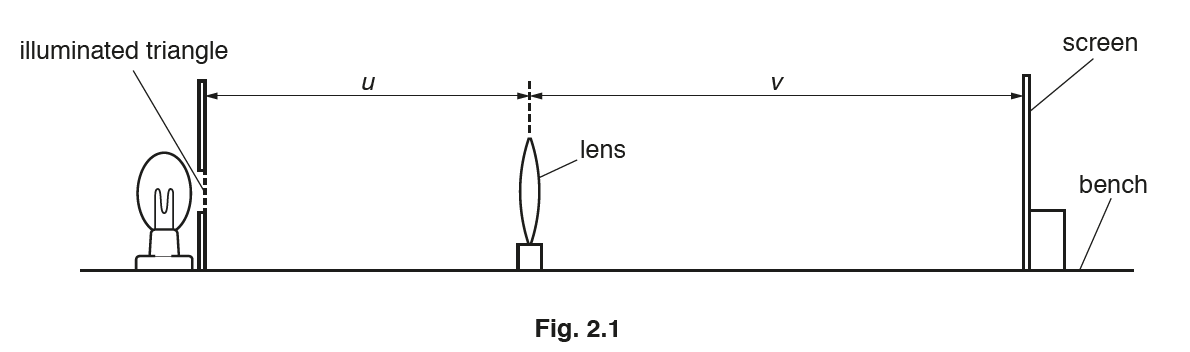
A student sets the distance U between the illuminated triangle and the lens.
She moves the screen until a sharp image of the triangle is seen on the screen.
Method 1
On Fig. 2.1, the distance u between the illuminated triangle and the lens is .
On Fig. 2.1, the distance v between the lens and the screen is .
Fig. 2.1 is drawn to 1/5 scale.
(i) Calculate the actual distance U between the illuminated triangle and the lens, and the actual distance V between the lens and the screen, in the experiment.
U = ...............................................................
V = ...............................................................
(1 mark)
(ii) Calculate a value for the focal length of the lens, using the equation:
f_{1} = \frac{UV}{\left(U + V\right)}
= .........................................................
(1 mark)
(iii) Briefly describe a technique to obtain an image on the screen that is as sharp as possible in this experiment.
(1 mark)
Extract:
Question stem:
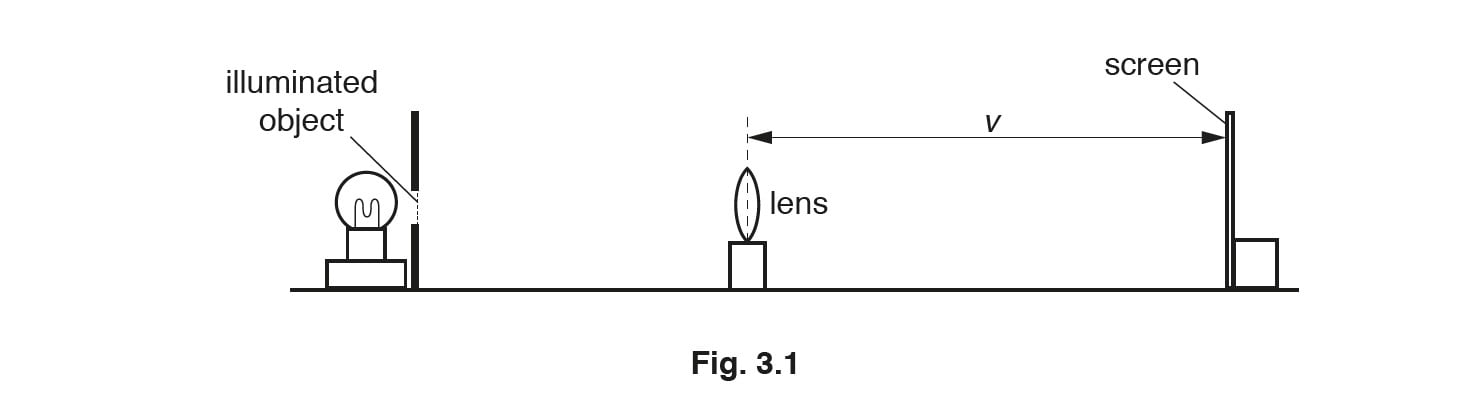
- From part (a): on the diagram v = 7.5 cm and the diagram is drawn to 1/5 scale, so V = 7.5 × 5 = 37.5 cm
- hO = 1.5 cm and hI = 2.4 cm
When marking this answer:
- In part (i), M = 1.6 must be given without a unit; an answer with a unit does not earn the mark
- In part (ii), accept 14 cm or 14.4 cm for f2 (from V = 37.5 cm) as well as 15 cm or 14.6 cm (from V = 38 cm)
- In part (ii), accept f2 correctly calculated from the candidate's own V and M (ecf)
- In part (ii), the unit is not required for the mark
Method 2
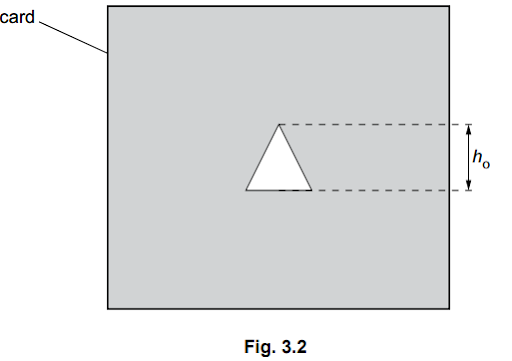
On Fig. 2.2, the height of the illuminated triangle is measured to be .
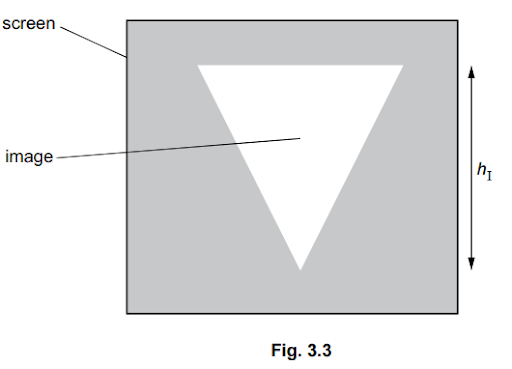
On Fig. 2.3, the height of the image on the screen is measured to be .
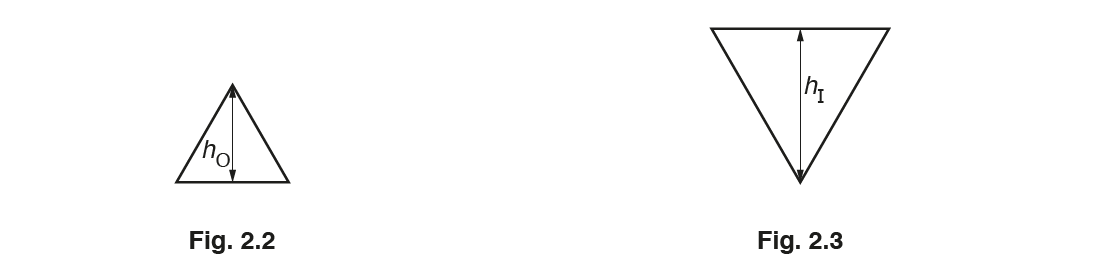
(i) Calculate a value for the magnification M, using the equation:
M = .........................................................
(1 mark)
(ii) Calculate a second value for the focal length of the lens, using the value of V from (a)(i) and the equation:
f_{2} = \frac{V}{\left(M + 1\right)}
= .........................................................
(1 mark)
Extract:
Question stem:
Some students determine the focal length of a converging lens by two methods, using an illuminated triangle, a converging lens and a screen on a bench. Method 1 uses the distances U (triangle to lens) and V (lens to screen); Method 2 uses the heights of the triangle and of its image on the screen.
When marking this answer:
- Award the mark for any one precaution from the mark scheme list
- Vague answers such as "be careful" or "measure accurately" do not earn the mark
State one precaution that could be taken to ensure that the measurements in the experiment are taken as reliably as possible.