Cubic Graphs (Cambridge International IGCSE Maths)
Cubic Graphs
What is a cubic?
-
A cubic is a function of the form
-
and are constants
-
It is a polynomial of degree (order) 3
- So and/or could be zero
- but cannot be equal to zero
-
-
To sketch the graph of a cubic, the polynomial needs to be in factorised form
- E.g. is the factorised form of
-
You do not need to factorise a cubic unless it is a more simple one
- E.g.
- You should be able to expand three brackets to find the expanded form of a cubic
What does the graph of a cubic look like?
-
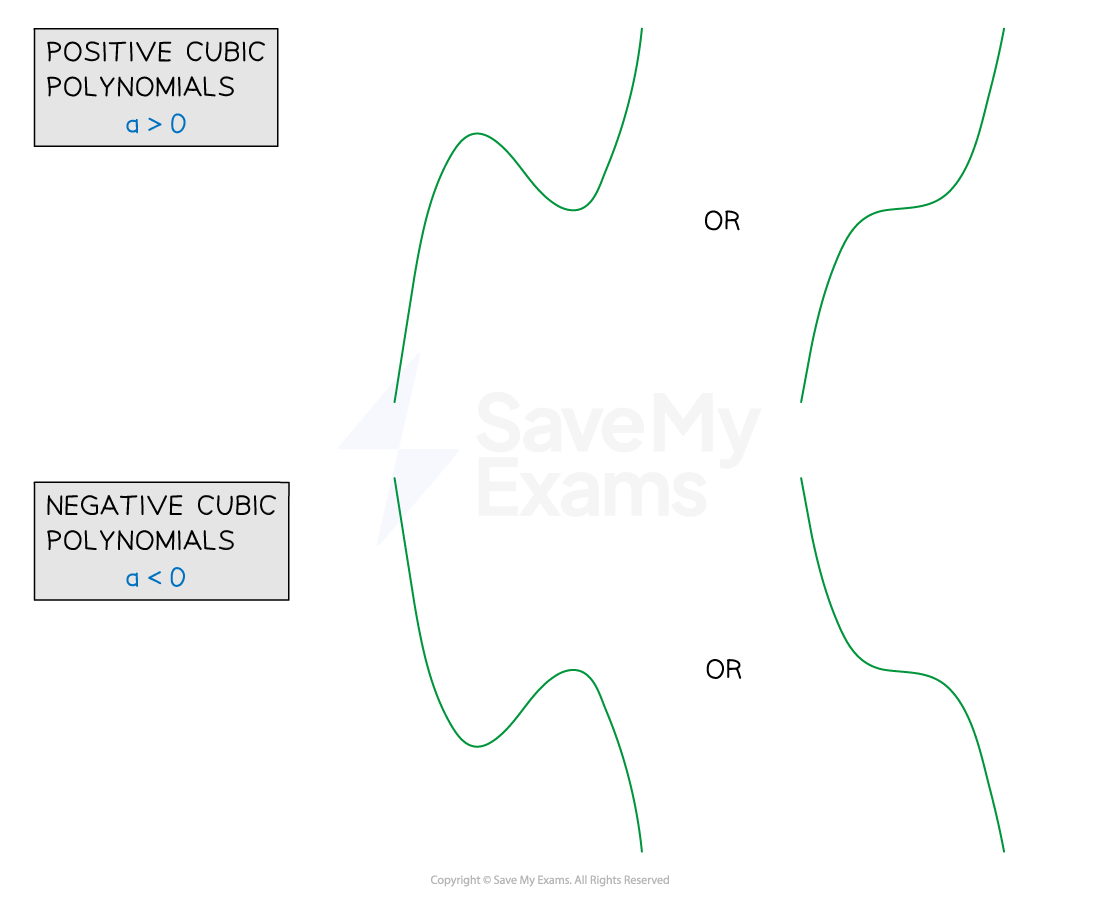
In general the graph of a cubic will take one of the four forms
- All are smooth curves
-
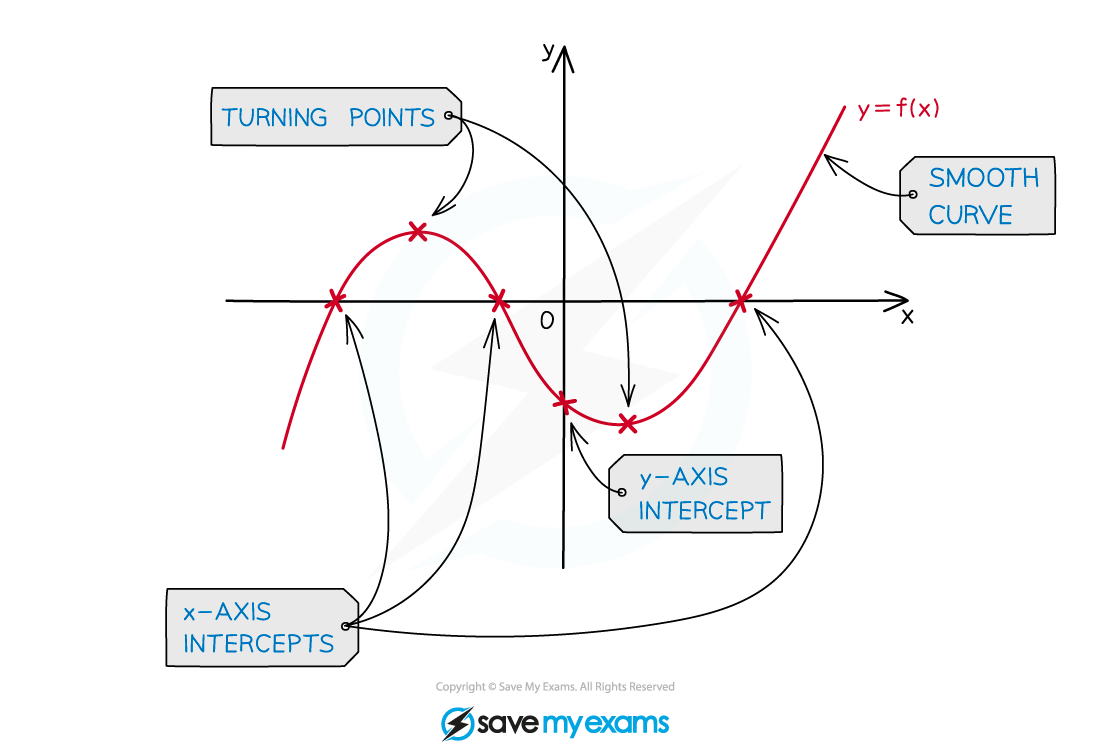
The exact form of a particular cubic will depend on:
-
The number (and value) of roots (-axis intercepts)
-
The -axis intercept
-
The sign of the coefficient of the term ()
- If the graph is a positive cubic ('starts' in the bottom left, 'ends' in the top right)
- If the graph is a negative cubic ('starts' in the top left, 'ends' in the bottom right)
-
The turning points
-
-
Cubics can have two turning points
- a maximum point and a minimum point
-
However, note that the graphs of and :
- Do not have a maximum or minimum (turning points)
- Only cross the -axis once, at
How do I sketch the graph of a cubic?
-
STEP 1 Find the -axis intercept by setting
-
STEP 2 Find the -axis intercepts (roots) by setting
-
In factorised form, this can be done by inspection
- A cubic of the form has roots at and
- E.g. has roots at 2, 3, and -5
-
Any repeated roots will mean the graph touches the -axis
- The graph does not cross the -axis
- E.g. * touches *the -axis at , and intersects *the -axis at
-
-
STEP 3 Consider the shape of the graph
- Is it a positive cubic or a negative cubic?
- Where does the graph 'start' and 'end'?
-
STEP 4 Consider where any turning points should go
-
STEP 5 Sketch the graph with a smooth curve Label points where the graph intercepts the and axes
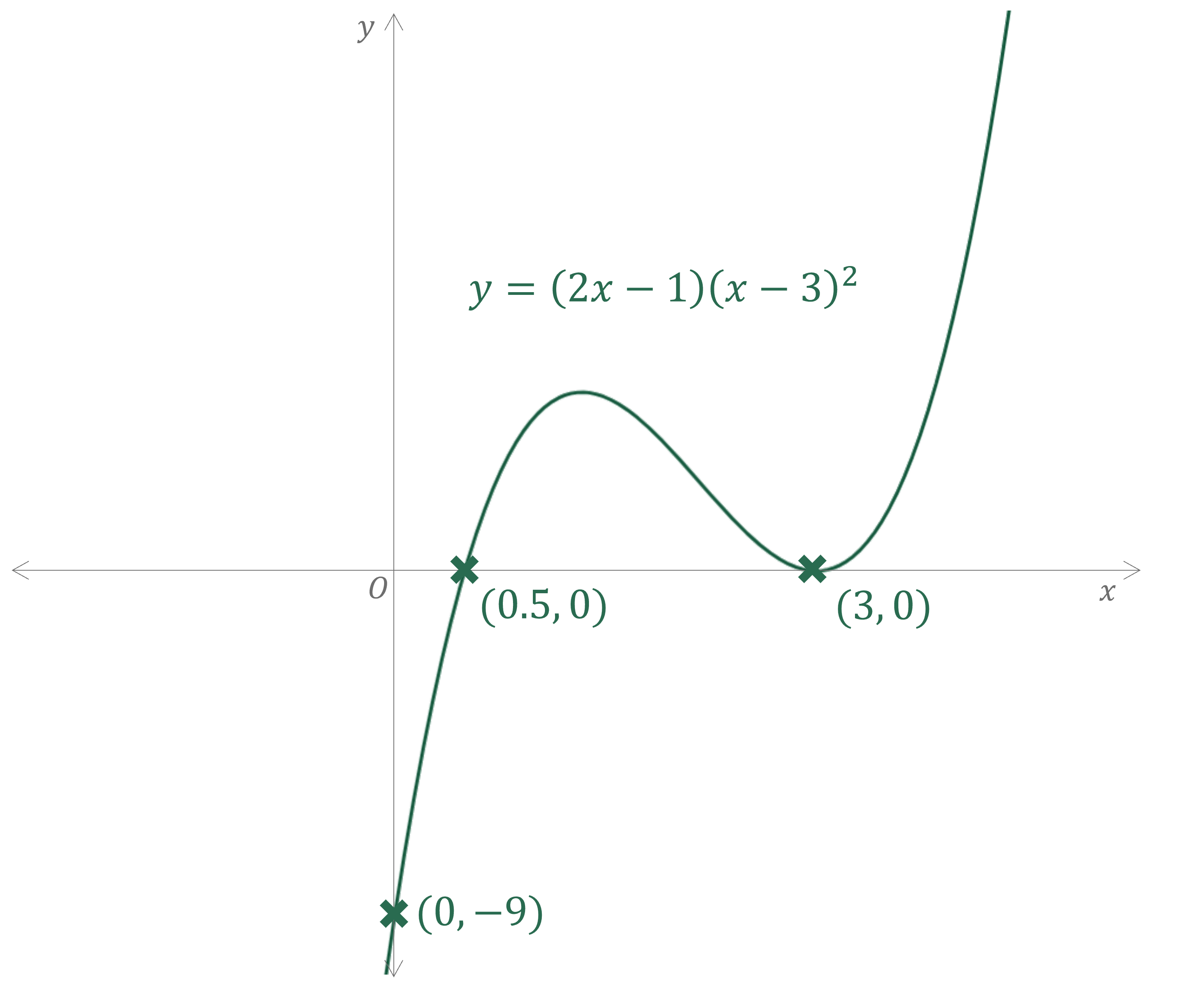
Worked Example Sketch the graph of .
STEP 1 Find the -axis intercept by substituting in
STEP 2 Find the -axis intercepts by solving Either bracket can be equal to zero
(repeated solution, as there are two brackets
STEP 3 Consider the shape, and the 'start' and 'end' points:
so it is a positive cubic * is a repeated root so the graph will touch the -axis at this point*
STEP 4 Consider the turning points
One turning point (minimum) will need to be where the curve touches the -axis The other (maximum) will need to be between the two roots and
STEP 5 Sketch a smooth curve with labelled intercepts
Was this revision note helpful?
Build on this topic